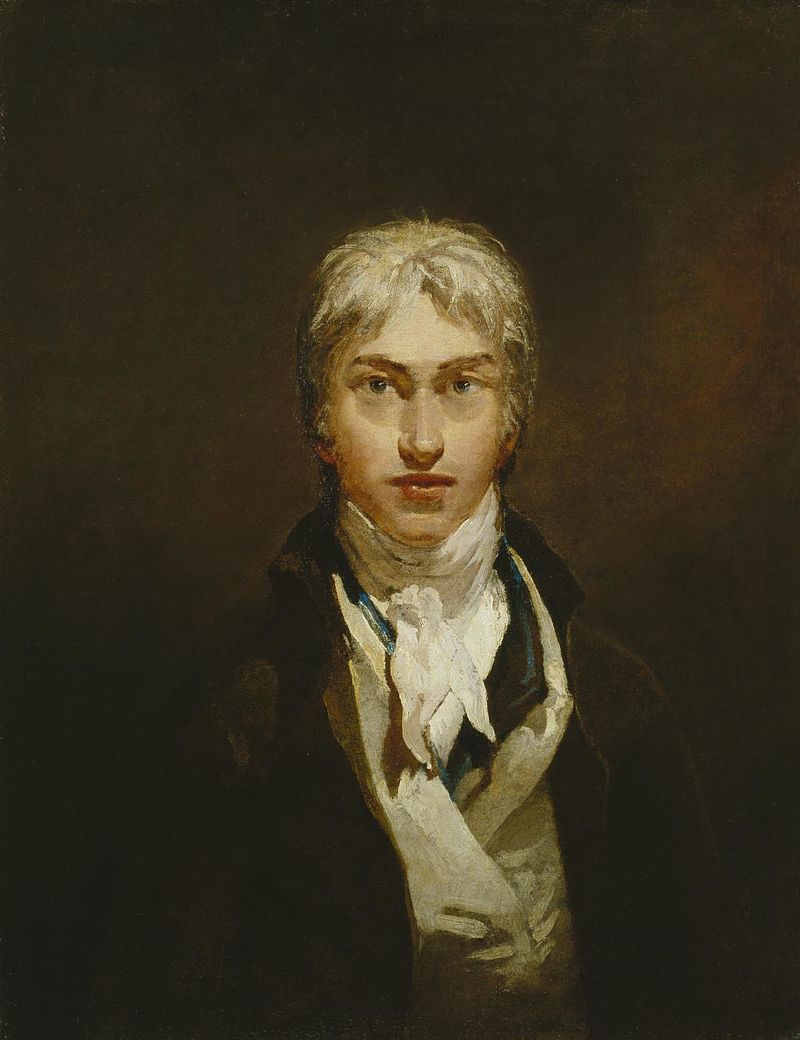
File:Joseph_Mallord_William_Turner_auto-retrato.jpg · Wikimedia Commons · See Wikimedia Commons
J. M. W. Turner
Sign in to saveAlso known as Joseph Mallord William Turner, William Turner, James Mallord William Turner, Joseph Mallord W. Turner, JMW Turner, Joseph Mallard William Turner, Tzozeph Mallornt Ouilliam Tarner
English painter and draftsman (c.1775–1851)
OverviewAI-generated
Joseph Mallord William Turner was a male painter, landscape painter, draftsperson, and printmaker associated with the Romanticism movement. He was a member of the Royal Academy of Arts, where he was also educated. His training included study under Joshua Reynolds and Thomas Malton, and his work was influenced by Claude Lorrain and Thomas Girtin. Turner’s artistic output spans marine art, history painting, and landscape painting.
He is known for notable works including *The Fighting Temeraire*, *Fishermen at Sea*, *The Battle of Trafalgar*, and *Rain, Steam and Speed – The Great Western Railway*. His works are held in the collections of the Minneapolis Institute of Art, the Art Institute of Chicago, The Nelson-Atkins Museum of Art, and Auckland Art Gallery Toi o Tāmaki. Turner died of cholera in 1851 and is buried at St Paul's Cathedral.
Synthesized by Vinony from 22 facts across 2 sources: Wikidata, Europeana Sparql. Generated from structured data (not the Wikipedia text) and checked against those facts — may still contain errors.
Wikidata facts
- Instance of
- human
- Given name
- William
- Family name
- Turner
- Gender
- male
- Citizenship
- United Kingdom
- Place of birth
- London
- Place of death
- Royal Borough of Kensington and Chelsea
- Occupation
- artist
- Educated at
- Royal Academy of Arts
- Languages spoken
- English language
- Native language
- English language
- Notable work
- Chichester Canal
- Student of
- Thomas Malton
- Genre
- landscape painting
- Image
- Joseph Mallord William Turner auto-retrato.jpg
- Work location
- Twickenham
Show 16 more facts
- date of birth
- 1775-04-23
- date of death
- 1851-12-19
- Commons category
- Joseph Mallord William Turner
- topic's main category
- Category:J. M. W. Turner
- Commons Creator page
- Joseph Mallord William Turner
- date of baptism
- 1775-05-14
- Commons gallery
- J. M. W. Turner
- member of
- Royal Academy of Arts
- influenced by
- Thomas Girtin
- name in native language
- Joseph Mallord William Turner
- place of burial
- St Paul's Cathedral
- different from
- William Turner
- has works in the collection
- Tochigi Prefectural Museum of Fine Arts
- cause of death
- cholera
- P12749
- Shavkat Mirziyoyev
- manner of death
- natural causes
Sources (9)
via Wikidata · CC0
Works in European collections
24 objects attributed to J. M. W. Turner, held across European museums, libraries & archives · via Europeana
Ansicht der St. Peterskirche, von der Villa Barberini aus gesehen
Das Wrack. Fischerboote versuchen, die Mannschaft zu retten
Intérieur aus Petworth House
Die Promenade in Nantes
Intérieur aus Petworth House
Stadt am See
Saint Mawes, Falmouth Harbour, Cornwall
Die "Téméraire" wird abgeschleppt
Intérieur aus Petworth House
Ansicht von Paris: Hotel de Ville und Pont d'Arcole
Ansicht von Venedig
Die Seeschlacht von Trafalgar, vom Deck der 'Victory' aus gesehen
Die Stadt Luzern
Sonnenaufgang im Nebel
Valley of Aosta, Snowstorm, Avalanche and Thunderstorm
Newcastle-on-Tyne
Römische Ansicht: Garten der Villa Farnese und Konstantinsbasilika
Holländische Fischerboote
Stonehenge
Flussufer mit Barken und Gondeln
Die Ruinen von Malmesbury Abbey
Ansicht von Paris: Blumenmarkt und Pont du Change
Die Promenade in Nantes
Ansicht von Venedig
~32 min read
Encyclopedic overview
Joseph Mallord William Turner (23 April 1775 – 19 December 1851), known in his time as William Turner, was an English Romantic painter, printmaker and watercolourist. He is known for his expressive colouring, imaginative landscapes and turbulent, often violent marine paintings. His artistic style developed over his lifetime, moving away from Romanticism—bypassing the following rising style of Realism—and, instead, with his later works being a significant precursor of and presaging the later Impressionist and Abstract Art movements that arose in the decades after his death. He left behind more than 550 oil paintings, 2,000 watercolours, and 30,000 works on paper. He was championed by the leading English art critic John Ruskin from 1840, and is today regarded as having elevated landscape painting to an eminence rivalling history painting. In 1969 art historian Kenneth Clark wrote of Turner: "He was a genius of the first order—far the greatest painter that England has ever produced..."
Turner was born in Maiden Lane, Covent Garden, London, to a modest lower-middle-class family and retained his lower-class accent, while assiduously avoiding the trappings of success and fame. A child prodigy, Turner studied at the Royal Academy of Arts from 1789, enrolling when he was 14, and exhibited his first work there at 15. During this period, he also served as an architectural draftsman. He earned a steady income from commissions and sales, which he often only begrudgingly accepted owing to his troubled and contrary nature. He opened his own gallery in 1804 and became professor of perspective at the academy in 1807, where he lectured until 1828. He travelled around Europe from 1802, typically returning with voluminous sketchbooks.
Excerpted from Wikipedia’s “J. M. W. Turner” article, available under the CC BY-SA 4.0 licence.
Gallery (12)
Available in 77 languages
- Español
- Français
- Deutsch
- 中文
- 日本語
- Русский
- Português
- Italiano
- العربية
- हिन्दी
- Afrikaans
- Armenian
- Asturian
- Azerbaijani
- Bahasa Indonesia
- Bashkir
- Basque
- be_x_old
Show 58 more
- Breton
- Bulgarian
- Burmese
- Catalan
- Chuvash
- Croatian
- Czech
- Danish
- Egyptian Arabic
- Esperanto
- Estonian
- Fiji Hindi
- Finnish
- fiu_vro
- Galician
- Georgian
- Greek
- Hebrew
- Hungarian
- Icelandic
- Irish
- Kannada
- Latin
- Latvian
- Lithuanian
- Luxembourgish
- Maithili
- Malagasy
- Malayalam
- Nederlands
- Newari
- Norwegian
- Norwegian Nynorsk
- Ossetic
- Piedmontese
- Polski
- Punjabi
- Romanian
- Sardinian
- Saterland Frisian
- Scottish Gaelic
- Serbian
- Serbian (Latin)
- simple
- Slovenian
- Svenska
- Tiếng Việt
- Türkçe
- Ukrainian
- Waray
- Welsh
- Western Frisian
- Western Panjabi
- Wu Chinese
- zh_yue
- فارسی
- ไทย
- 한국어
via Wikidata sitelinks · CC0