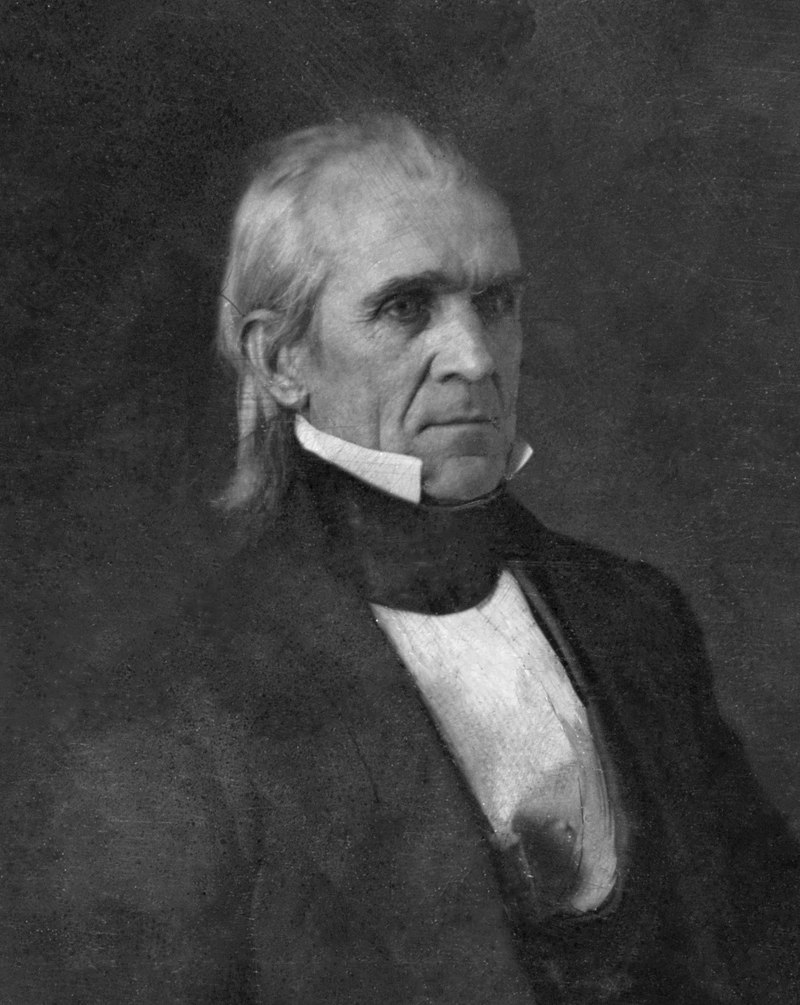
File:Polk_crop.jpg · Wikimedia Commons · See Wikimedia Commons
James K. Polk
Sign in to saveAlso known as James Knox Polk, James Polk, J. K. Polk, J. Polk, President Polk
President of the United States from 1845 to 1849 (1795–1849)
James K. Polk was the 11th President of the United States, serving from 1845 to 1849 during a significant period of American expansion. His presidency matters because it occurred during major territorial growth and international developments that shaped the modern United States.
AI-generated from the Wikipedia summary — may contain errors.
Wikidata facts
- Instance of
- human
- Gender
- male
- Citizenship
- United States
- Place of birth
- Pineville
- Place of death
- Nashville
- Spouse
- Sarah Childress Polk
- Occupation
- planter class
- Educated at
- University of North Carolina at Chapel Hill
- Political party
- Democratic Party (United States)
- Languages spoken
- Greek
- Native language
- English language
- Religion
- Methodism
- Image
- Polkpolk.jpg
- Height
- 173
- Number of children
- 0
- Work location
- Washington, D.C.
Show 17 more facts
- cause of death
- cholera
- Commons category
- James Knox Polk
- manner of death
- natural causes
- topic's main category
- Category:James K. Polk
- date of birth
- 1795-11-02
- date of death
- 1849-06-15
- Commons gallery
- James Knox Polk
- place of burial
- Tennessee State Capitol
- name in native language
- James K. Polk
- birth name
- James Knox Polk
- writing language
- English language
- candidacy in election
- 1844 United States presidential election
- pseudonym
- Young Hickory
- Commons Creator page
- James K. Polk
- National Governors Association biography URL
- www.nga.org/governor/james-knox-polk
- P8168
- Gauss's lemma
- archives at
- New York Public Library Main Branch
Sources (8)
via Wikidata · CC0
~40 min read
Encyclopedic overview
James Knox Polk (/poʊk/; November 2, 1795 – June 15, 1849) was the 11th president of the United States, serving from 1845 to 1849. A protégé of Andrew Jackson and a member of the Democratic Party, he was an advocate of American expansionism and Jacksonian democracy. Polk saw Texas join the Union in his first year in office, one of the precipitating causes that soon led the U.S. into the Mexican–American War. The settlement of that war expanded American territory to the Pacific Ocean. During his term, the dispute over the Oregon Territory with the United Kingdom was resolved as well, creating the present U.S.-Canadian boundary.
After building a successful law practice in Tennessee, Polk was elected to its state legislature in 1823 and then to the United States House of Representatives in 1825, becoming a strong supporter of Jackson. Following his tenure as chairman of the Ways and Means Committee, he became Speaker of the House in 1835, the only person to serve both as Speaker and U.S. president. Polk left Congress to run for governor of Tennessee, winning in 1839 but losing in 1841 and 1843. He was a dark-horse candidate in the 1844 presidential election as the Democratic Party nominee. Polk entered his party's convention as a potential nominee for vice president but emerged as a compromise to head the ticket when no presidential candidate could gain the necessary two-thirds majority. In the general election, he narrowly defeated Henry Clay of the Whig Party and pledged to serve only one term.
Excerpted from Wikipedia’s “James K. Polk” article, available under the CC BY-SA 4.0 licence.
Gallery (12)
Available in 132 languages
- Español
- Français
- Deutsch
- 中文
- 日本語
- Русский
- Português
- Italiano
- العربية
- हिन्दी
- Afrikaans
- Albanian
- Amharic
- Aragonese
- Armenian
- Asturian
- azb
- Azerbaijani
Show 113 more
- Bahasa Indonesia
- Balinese
- Bangla
- Basque
- be_x_old
- Belarusian
- Bikol
- Bislama
- Bosnian
- Breton
- Bulgarian
- Burmese
- Catalan
- cdo
- Cebuano
- Central Kurdish
- Chuvash
- Cornish
- Corsican
- Croatian
- Czech
- Danish
- Divehi
- Egyptian Arabic
- Esperanto
- Estonian
- Faroese
- Fiji Hindi
- Filipino
- Finnish
- Galician
- Georgian
- Greek
- guw
- Hakka Chinese
- Hausa
- Hebrew
- Hungarian
- Icelandic
- Ido
- Iloko
- Interlingua
- Irish
- Javanese
- Kazakh
- Kinyarwanda
- Kurdish
- Latin
- Latvian
- Ligurian
- Limburgish
- Lingua Franca Nova
- Lithuanian
- Lombard
- Low German
- Luxembourgish
- Malagasy
- Malay
- Malayalam
- Manx
- Marathi
- Mazanderani
- Mingrelian
- Mongolian
- Moroccan Arabic
- Nederlands
- Nepali
- Norwegian
- Norwegian Nynorsk
- Occitan
- Old English
- Pampanga
- Pashto
- Piedmontese
- Polski
- Punjabi
- Quechua
- Romanian
- Scots
- Scottish Gaelic
- Serbian
- Serbian (Latin)
- Sicilian
- simple
- skr
- Slovak
- Slovenian
- Sundanese
- Svenska
- Swahili
- Tajik
- Tamil
- Tatar
- Telugu
- Tiếng Việt
- Türkçe
- Turkmen
- Ukrainian
- Urdu
- Uyghur
- Uzbek
- Waray
- Welsh
- Western Panjabi
- Wu Chinese
- Yiddish
- Yoruba
- Zaza
- zh_min_nan
- zh_yue
- فارسی
- ไทย
- 한국어
via Wikidata sitelinks · CC0