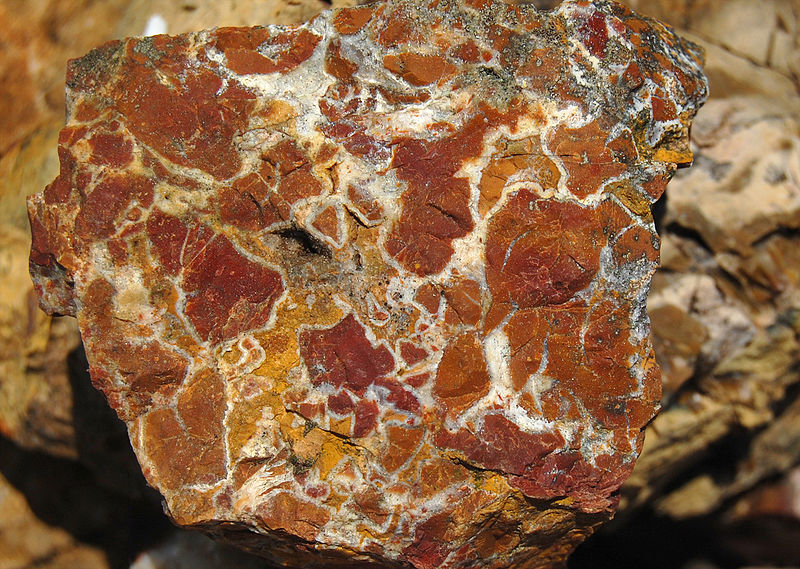
File:Jasper_outcrop_in_the_Bucegi_Mountains.jpg · Wikimedia Commons · See Wikimedia Commons
Jasper is a colorful, opaque stone made primarily of quartz that breaks smoothly and can be polished to a shine, making it useful for decorative objects and jewelry. Its practical value lies in its durability and attractive appearance—qualities that have made it a material of choice for ornamental items like vases and gemstones throughout history.
AI-generated from the Wikipedia summary — may contain errors.
Key facts
- Mineral.name
- Jasper
- Mineral.boxbgcolor
- 732b1c
- Mineral.boxtextcolor
- FFFFFF
- Mineral.image
- Jasper outcrop in the Bucegi Mountains.jpg
- Mineral.imagesize
- 280px
- Mineral.caption
- Jasper outcrop, Bucegi Mountains, Romania
- Mineral.category
- Aggregate rock (impure chalcedony variety)
- Mineral.formula
- SiO2 (with varying impurities)
- Mineral.system
- Hexagonal
- Mineral.colour
- Most commonly red, but may be yellow, brown, green or (rarely) blue
- Mineral.habit
- Massive
- Mineral.cleavage
- Indiscernible
- Mineral.fracture
- Conchoidal
- Mineral.mohs
- 6.5–7
- Mineral.luster
- Vitreous
- Mineral.diaphaneity
- Opaque
- Mineral.gravity
- 2.5–2.9
- Mineral.refractive
- 1.54–2.65
via Wikipedia infobox
Wikidata facts
- Instance of
- mineral variety
- Subclass of
- chalcedony
- Part of
- Priestly breastplate
- Image
- Unpolished jasper.jpg
Show 3 more facts
- Commons category
- Jasper
- Mohs' hardness
- 7
- color
- black
Sources (2)
via Wikidata · CC0
Article · Deutsch
Jaspis ist eine mikrokristalline, feinkörnige Varietät des Minerals Quarz (SiO2) und eng verwandt mit dem stets faserig aufgebauten Chalcedon. Die Verwandtschaft ist so eng, dass sogar Stücke vorkommen, bei denen körnig und faserig aufgebaute Quarzmaterialien miteinander verwachsen sind. Aufgrund seiner polykristallinen Struktur ist Jaspis im Allgemeinen undurchsichtig weiß und kann durch Beimengungen wie unter anderem verschiedene Eisenoxide alle Farbtönungen von Gelb über Rot und Braun bis Schwarz, aber auch rosa und grünliche Farbtöne annehmen. Jaspis wird ausschließlich zu Schmucksteinen verarbeitet, die aufgrund der Mohshärte von 6,5 bis 7 sehr widerstandsfähig gegenüber mechanischer Beanspruchung sind. Geschliffen und poliert weisen die Steinoberflächen anschließend einen glas- bis fettähnlichen Glanz auf.
Abstract from DBpedia / Wikipedia · CC BY-SA
Gallery (26)
Available in 59 languages
- Español
- Français
- Deutsch
- 中文
- 日本語
- Русский
- Português
- Italiano
- العربية
- Aragonese
- Armenian
- Azerbaijani
- Bahasa Indonesia
- Basque
- be_x_old
- Belarusian
- Bulgarian
- Catalan
Show 40 more
- Crimean Tatar
- Czech
- Esperanto
- Estonian
- Finnish
- Galician
- Georgian
- Hebrew
- Icelandic
- Ido
- Kannada
- Kashubian
- Kazakh
- Kyrgyz
- Latin
- Latvian
- Lithuanian
- Macedonian
- Malagasy
- nah
- Nederlands
- Norwegian
- Norwegian Nynorsk
- Polski
- Romanian
- Serbian
- simple
- Slovak
- Slovenian
- Svenska
- Tiếng Việt
- Türkçe
- Ukrainian
- Uyghur
- Uzbek
- Western Panjabi
- zh_yue
- فارسی
- ไทย
- 한국어
via Wikidata sitelinks · CC0