File:JvmSpec7.png · Wikimedia Commons · See Wikimedia Commons
Java virtual machine
Sign in to saveAlso known as JVM, Java VM, JavaVM
runtime environment that can execute Java bytecode as a result of compiling computer programs written in the Java programming language
Key facts
- Designer
- Sun Microsystems
- Bits
- 32-bit , 64-bit
- Introduced
- 1994 ; 32 years ago ( 1994 )
- Version
- Java SE 26
- Type
- Stack and register–register
- Encoding
- Variable
- Branching
- Compare and branch
- Endianness
- Big
- Open
- Yes
- General purpose
- Per-method operand stack (up to 65535 operands) plus per-method local variables (up to 65535)
via Wikipedia infobox
Wikidata facts
Show 2 more facts
- Stack Exchange tag
- stackoverflow.com/tags/jvm
- Commons category
- Java Virtual Machine
Sources (3)
via Wikidata · CC0
~22 min read
Article
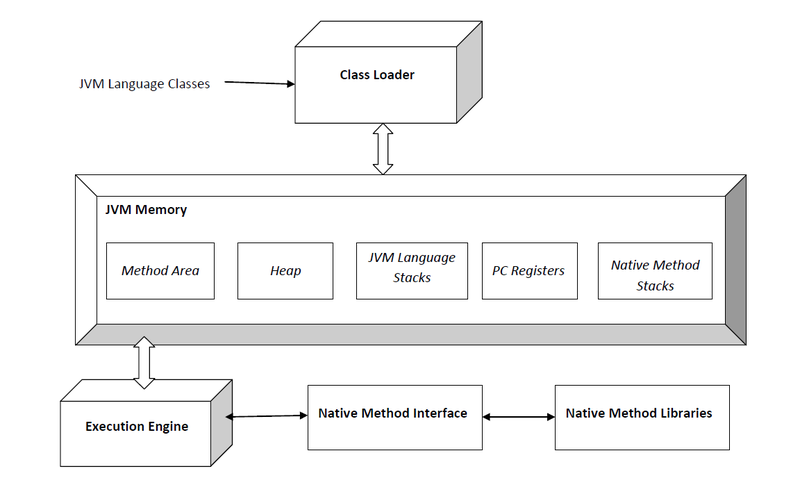
Overview of a Java virtual machine (JVM) architecture based on The Java Virtual Machine Specification Java SE 7 Edition A Java virtual machine (JVM) is a virtual machine that enables a computer to run Java programs as well as programs written in other languages, other languages referred to as JVM languages that are also compiled to Java bytecode. The JVM is detailed by a specification that formally describes what is required in a JVM implementation. Having a specification ensures interoperability of Java programs across different implementations so that program authors using the Java Development Kit (JDK) need not worry about idiosyncrasies of the underlying hardware platform.
The JVM reference implementation is developed by the OpenJDK project as open source code and includes a JIT compiler called HotSpot. The commercially supported Java releases available from Oracle are based on the OpenJDK runtime. Eclipse OpenJ9 is another open source JVM for OpenJDK.