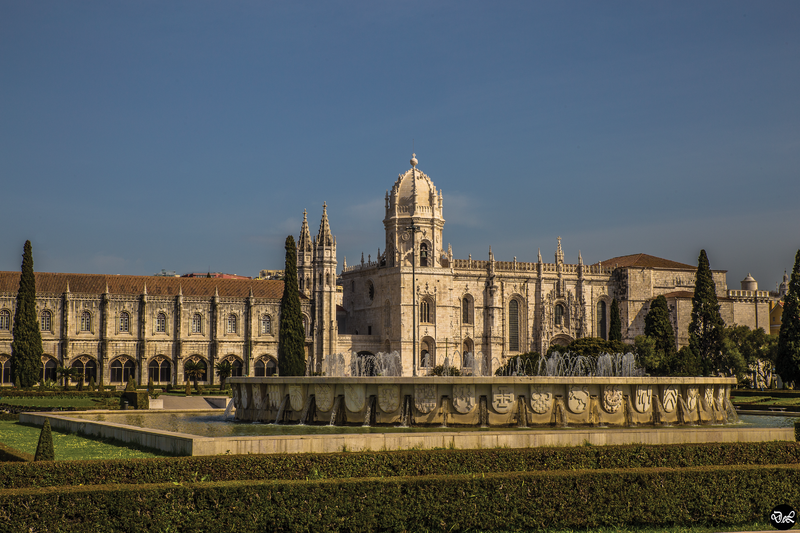
File:The_Jerónimos_Monastery_or_Hieronymites_Monastery.png · Wikimedia Commons · See Wikimedia Commons
Jerónimos Monastery
Sign in to saveAlso known as Jeronimos Monastery
building in Santa Maria de Belém, Lisbon District, Portugal
Key facts
- Type
- Monastery
- Architectural style
- Portuguese Gothic , Manueline architecture
- Location
- Santa Maria de Belém, Lisbon , Portugal
- Owner
- Portuguese Republic
- Material
- Lioz stone
- Architect
- Diogo de Boitaca
- Official name
- Monastery of the Hieronymites and Tower of Belém
- Criteria
- iii, vi
- Inscription
- 1983 (7th Session )
- Designated
- 10 January 1907
- Reference no
- IPA.00006543
via Wikipedia infobox
Research organization · ROR
- Type
- Other
- Location
- Lisbon, Portugal
- Status
- Active
ISNI 0000 0004 0607 6786
Wikidata facts
- Instance of
- cultural heritage
- Religion
- Catholicism
- Country
- Portugal
- Located in
- Belém
- Area
- 51.5
- Time zone
- Western European Time
- Official website
- www.mosteirojeronimos.pt
- Image
- 1502 legte König Manuel I. den Grundstein für das Hieronymus Kloster in Lissabon. 06.jpg
- Religious order
- Order of Saint Jerome
Show 13 more facts
- architect
- Nicolau Chanterene
- Commons category
- Mosteiro dos Jerónimos
- Commons gallery
- Mosteiro dos Jerónimos
- heritage designation
- World Heritage Site
- category for people buried here
- Category:Tombs in Mosteiro dos Jerónimos
- architectural style
- Manueline
- date of official opening
- 1601-00-00
- diocese
- Patriarchate of Lisbon
- inception
- 1502-00-00
- native label
- Mosteiro dos Jerónimos
- Christian liturgical rite
- Roman Rite
- visitors per year
- 1096283
- P13311
- Walow
via Wikidata · CC0
~25 min read
Encyclopedic overview
The Jerónimos Monastery or Hieronymites Monastery (Portuguese: Mosteiro dos Jerónimos, pronounced [muʃˈtɐjɾu ðu(ʒ) ʒɨˈɾɔnimuʃ]) is a former monastery of the Order of Saint Jerome near the Tagus river in the parish of Belém, in the Lisbon Municipality, Portugal. It became the necropolis of the Portuguese royal dynasty of Aviz in the 16th century but was secularized on 28 December 1833 by state decree and its ownership transferred to the charitable institution, Real Casa Pia de Lisboa.
The Jerónimos Monastery is one of the most prominent examples of the late Portuguese Gothic Manueline style of architecture in Lisbon. It was erected in the early 1500s near the launch point of Vasco da Gama's first journey, and its construction funded by a tax on the profits of the yearly Portuguese India Armadas. In 1880, da Gama's remains and those of the poet Luís de Camões (who celebrated da Gama's first voyage in his 1572 epic poem The Lusiad), were moved to new carved tombs in the nave of the monastery's church, only a few meters away from the tombs of the kings Manuel I and John III, whom da Gama had served. In 1983, the Jerónimos Monastery was classified as a UNESCO World Heritage Site, along with the nearby Tower of Belém.
Excerpted from Wikipedia’s “Jerónimos Monastery” article, available under the CC BY-SA 4.0 licence.