
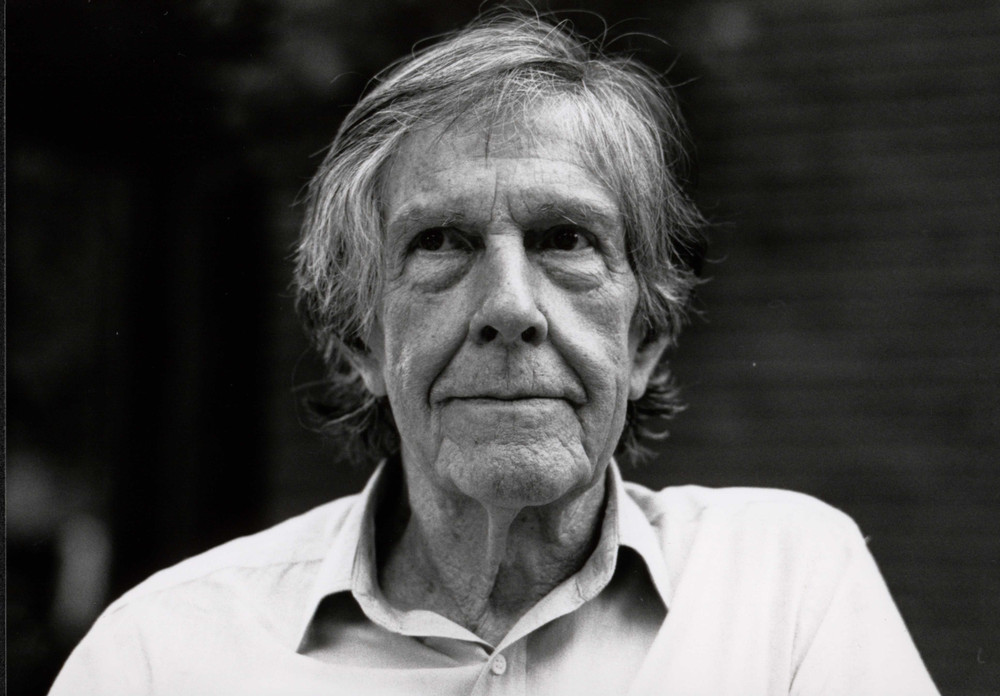
File:John_Cage_(1988).jpg · Wikimedia Commons · See Wikimedia Commons
John Cage
Sign in to saveAlso known as John Milton Cage Jr., John Milton Cage, Jr., John Milton, Jr. Cage, J. C.
American avant-garde composer (1912-1992)
OverviewAI-generated
John Milton Cage was an American composer, writer, poet, and university teacher. He was born in Los Angeles, California, in 1912 and died in New York City in 1992 from a stroke. Cage studied at the University of California, Los Angeles, and Los Angeles High School. His teachers included Fannie Charles Dillon, Arnold Schoenberg, Henry Cowell, and Adolph Weiss. He was employed by Wesleyan University and Black Mountain College.
His notable works include 4′33″, Sonatas and Interludes, and ORGAN²/ASLSP. He is associated with genres such as aleatoric music, opera, classical music, and electronic music. His movements include Fluxus and 20th-century classical music. He received the Guggenheim Fellowship, the Kyoto Prize in Arts and Philosophy, and was a Fellow of the American Academy of Arts and Sciences. He was also a member of the American Academy of Arts and Letters and the International Society for Contemporary Music.
Cage’s lifestyle involved mysticism. He was the unmarried partner of Merce Cunningham and was married to Xenia Cage. His works are described by sources such as UbuWeb. He is recognized in the American Academy Arts Sciences collection.
Synthesized by Vinony from 39 facts across 7 sources: Wikidata, Open Library, MusicBrainz, Last.fm, TMDb, Europeana Sparql, Vinony collections. Generated from structured data (not the Wikipedia text) and checked against those facts — may still contain errors.
Person · Open Library
- Born
- 1912
- Died
- 1993
- Works
- 160
Top works
- A year from Monday
- Silence
- Empty Words
- X
- John Cage
via Open Library + Wikidata
Film & TV
Los Angeles, California, USA
John Milton Cage Jr. was an American composer, music theorist, artist, and philosopher. A pioneer of indeterminacy in music, electroacoustic music, and non-standard use of musical instruments, Cage was one of the leading figures of the post-war avant-garde.
Known for
- Nova '78 — Self (archive footage)2025
- Nam June Paik: Moon Is the Oldest TV — Self (archive footage)2023
- Take the Cage Train – Boletus Edulis2023
- Twinkle Dammit!2020
- Symphony Of The Invisible — Self (voice)2020
- Making Waves: The Art of Cinematic Sound — Self (archive footage)2019
- Everybody's Cage — John Cage2015
- John Cage: Journeys in Sound — Himself2012
- How to Get Out of the Cage (A year with John Cage) — himself2012
- Cursive II2006
via TMDB
Music · MusicBrainz
- Type
- Person
- Gender
- Male
- Origin
- United States
- Active from
- 1912
- Active to
- 1992
Discography
- Sonatas & Interludes for Prepared Piano1951
- The 25-Year Retrospective Concert of the Music of John Cage1959
- Fontana Mix - Feed (Six Realizations of John Cage)1966
- Electronic Music1967
- New Electronic Music From Leaders of the Avant-Garde1967
- Cage: Concerto for Prepared Piano & Orchestra / Foss: Baroque Variations1968
- Cage & Hiller: HPSCHD / Johnston: String Quartet no. 21969
- John Cage: Atlas Eclipticalis • Winter Music • Cartridge Music / Dieter Schnebel: Glossolalie1969
- Music for Marcel Duchamp1970
- John Cage: Three Dances / Steve Reich: Four Organs1973
via MusicBrainz · CC0
Listeners · Last.fm
- Listeners
- 322,830
- Total plays
- 3,492,270
Tags
John Milton Cage Jr. (September 5, 1912 – August 12, 1992) was an American composer, philosopher, poet, music theorist, artist, printmaker, and amateur mycologist and mushroom collector. A pioneer of chance music, electronic music and non-standard use of musical instruments, Cage was one of the leading figures of the post-war avant-garde. Critics have lauded him as one of the most influential American composers of the 20th century. He was also instrumental in the development of modern dance <a h
Wikidata facts
- Instance of
- human
- Given name
- Milton
- Gender
- male
- Citizenship
- United States
- Place of birth
- Los Angeles
- Place of death
- New York City
- Spouse
- Xenia Cage
- Occupation
- musician
- Educated at
- Los Angeles High School
- Employer
- Black Mountain College
- Languages spoken
- English language
- Religion
- Zen
- Notable work
- ORGAN²/ASLSP
- Participant in
- documenta 8
- Student of
- Richard Buhlig
- Field of work
- mycology
- Movement
- 20th-century classical music
- Instrument
- piano
- Record label
- ECM Records
- Official website
- johncage.org
- Image
- Opdracht GPD componist John Cage , kop, Bestanddeelnr 934-2728.jpg
- Work location
- New York City
- Political ideology
- anarchism
Show 22 more facts
- Commons category
- John Cage
- date of birth
- 1912-10-05
- date of death
- 1992-08-02
- unmarried partner
- Merce Cunningham
- lifestyle
- mysticism
- name in native language
- John Cage
- topic's main category
- Category:John Cage
- cause of death
- stroke
- student
- Geeta Sarabhai
- has works in the collection
- J. Paul Getty Museum
- sexual orientation
- non-heterosexuality
- archives at
- University of California, Santa Cruz
- different from
- Johnny Cage
- start of work period
- 1938-00-00
- related category
- Category:Compositions by John Cage
- manner of death
- natural causes
- medical condition
- arthritis
- P8168
- Gilette
- end of work period
- 1992-01-01
- pseudonym
- Cage, Jr., John Milton
- P12674
- Giungano
Sources (15)
via Wikidata · CC0
Works in European collections
18 objects attributed to John Cage, held across European museums, libraries & archives · via Europeana
El tramposo don Fausto [Manuscrito] :]comedia en dos actos y en verso. Emp.: Me opongo, como tutor (p. 5)... Fin.: que te pagará mi alma (p. 99)
¡Viva! ¡Viva! [Manuscript]:] comic toy in two acts. Emp.: Make the horses drink (h. 3)... End.: Long live! (h. 75v)
Grandes cuestiones que se han de ventilar con preferencia en las próximas Cortes
Nuevo catecismo político arreglado a la constitución de la monarquía española para ilustración del pueblo, instrucción de la juventud y uso de las escuelas de primeras letras
Kammerballett

Untitled

Untitled

Untitled

Untitled

Untitled

Untitled

Untitled

Untitled

Untitled

Untitled

Untitled
Untitled
Untitled
~40 min read
Encyclopedic overview
John Milton Cage Jr. (September 5, 1912 – August 12, 1992) was an American composer, artist, and music theorist. A pioneer of indeterminacy in music, electroacoustic music, and non-standard use of musical instruments, Cage was one of the leading figures of the post-war avant-garde. Critics have lauded him as one of the most influential composers of the 20th century. He was also instrumental in the development of modern dance, mostly through his association with choreographer Merce Cunningham, who was also Cage's romantic partner for most of their lives.
Cage's teachers included Henry Cowell (1933) and Arnold Schoenberg (1933–35), both known for their radical innovations in music, but Cage's major influences lay in various East and South Asian cultures. Through his studies of Indian philosophy and Zen Buddhism in the late 1940s, Cage came to the idea of aleatoric or chance-controlled music, which he started composing in 1951. The I Ching, an ancient Chinese classic text and decision-making tool, became Cage's standard composition tool for the rest of his life. In a 1957 lecture, "Experimental Music", he described music as "a purposeless play" which is "an affirmation of life – not an attempt to bring order out of chaos nor to suggest improvements in creation, but simply a way of waking up to the very life we're living".
Excerpted from Wikipedia’s “John Cage” article, available under the CC BY-SA 4.0 licence.
Gallery (14)
Available in 67 languages
- Español
- Français
- Deutsch
- 中文
- 日本語
- Русский
- Português
- Italiano
- العربية
- Armenian
- Azerbaijani
- Bahasa Indonesia
- Bangla
- Basque
- Belarusian
- Bulgarian
- Catalan
- Cebuano
Show 48 more
- Croatian
- Czech
- Danish
- Egyptian Arabic
- Esperanto
- Estonian
- Filipino
- Finnish
- Friulian
- Galician
- Georgian
- Greek
- Hebrew
- Hungarian
- Ido
- Interlingua
- Irish
- Latin
- Latvian
- Limburgish
- Lithuanian
- Macedonian
- Malay
- Nederlands
- Norwegian
- Norwegian Nynorsk
- Occitan
- Pampanga
- Pashto
- Polski
- Romanian
- Scottish Gaelic
- Serbian
- Serbian (Latin)
- Sicilian
- simple
- Slovak
- Slovenian
- Svenska
- Tiếng Việt
- Türkçe
- Ukrainian
- Welsh
- Western Frisian
- Wu Chinese
- فارسی
- ไทย
- 한국어
via Wikidata sitelinks · CC0