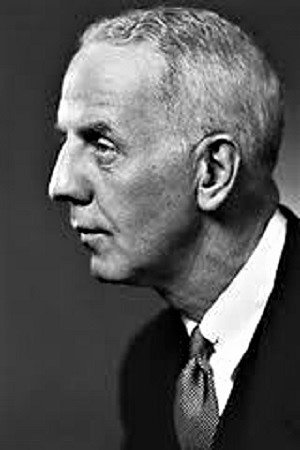
Profile via TMDB · Courtesy of TMDB
Person · Open Library
- Born
- 3 Jul 1900
- Died
- 16 Mar 1969
- Works
- 37
Top works
- The Ordeal of a Playwright
- Insides Out
- The Ladies' home journal treasury
- As They Appear
- Accustomed as I am;
via Open Library + Wikidata
Film & TV
Louisville, Kentucky, USA
Known for
- Small World — Self1958
- Main Street to Broadway — Critic (uncredited)1953
- Critic at Large — Himself - Host1948
- Americana1947
- Americana — Host1947
via TMDB
Described at

John Mason Brown: Cheers for a Forgotten Critic – (Travalanche)
July 3 was the birthday of theatre critic, columnist and author John Mason Brown (1900-1969). Most of the major theatre critics of Brown's day enjoyed lingering pop culture fame by expanding into other forms and other media (e.g. George S. Kaufman, Dorothy Parker, Alexander Woollcott, P.G. Wodehouse, Robert Benchley, et al). One peer who stuck…
travsd.wordpress.com →July 3 was the birthday of theatre critic, columnist and author John Mason Brown (1900-1969). Both of these books aided me immeasurably in my understanding of American theatre from the earliest years to the first third of the 20th century. Furthermore, they served to me as examples of how to write. A lot of people gush about George Jean Nathan, but Nathan has never spoken to me. Neither his style nor his sensibilities have ever impressed me. (You’ll note that while I’ve done posts on all these others, I’ve not yet bothered with Nathan, whom everyone seems to love). Whereas, I find the forgotten Brown to be entertaining, engaging, a much more satisfying guy to read, both because of his literary style and his grounding in history. He’s funny, he’s passionate, he grabs you by the lapels. Brown was a Kentuckian with American roots going back to the earliest days of colonial Virginia. His namesake and grandfather, Colonel John Mason Brown (1837-1890), led the 45th Kentucky Mounted Infantry Regiment in the Union Army during the Civil War and was brother to U.S. Senator Benjamin Gratz Brown (1826-1885). His great-grandfather was U.S. Senator John Brown (1757-1837), a relation of both the Breckinridge and Preston families, important political families in both Virginia and Kentucky. Brown attended Harvard (which holds his papers), graduating in 1923. (He is thus sadly not the inspiration for Rida Johnson Young’s 1906 Brown of Harvard ). His professional affiliations included Theatre Arts Magazine (1925-29), The New York Evening Post (1929-41), The World Telegram (1941), and The Saturday Review (1944-69), for which he wrote a column called “Seeing Things”. That gap (1941-44) is of course accounted for by World War Two service. He served as a Naval Lieutenant on the USS Ancon during the Invasion of Sicily, penning a book about the experience entitled To All Hands. Brown was a big supporter of Robert Sherwood , and wrote a couple of books about him. His old professor George Pearce Baker was another favorite theatrical subject. Brown’s writings about all of the contemporary theatrical figures of his time are invaluable. But he was curious and eclectic in his interests, so he also wrote books about such farther afield topics as Kentucky history, the life of Daniel Boone, his own illustrious family, and much else. We have at least one thing to dislike Brown for. He was one of those who led the anti-comic book crusade of the post-war years, making him one of the arch-enemies of Max and William Gaines. It makes perfect sense that such would be his perspective. Given his background, upbringing, and education, it would be surprising if he didn’t bring a certain set of biases to the table. But when it came to theatre he was always open-minded and forward-looking, from his early, breathlessly enthusiastic early book The Modern Theatre in Revolt (1929), to his 1963 resignation from the Pulitzer Prize for Drama jury for its refusal to give the award to Edward Albee for Who’s Afraid of Virginia Woolf? One can’t help but wonder however what he would have made of Oh! Calcutta!
Excerpt from a page describing this subject · 10,124 chars · not written by Vinony
Wikidata facts
- Instance of
- human
- Given name
- John
- Family name
- Brown
- Gender
- male
- Citizenship
- United States
- Place of birth
- Louisville
- Place of death
- New York City
- Occupation
- journalist
- Languages spoken
- English language
- Image
- Portret van John Mason Brown 1930 barcode 910000105015.jpg
Show 5 more facts
- member of
- New York Drama Critics' Circle
- date of death
- 1969-03-16
- date of birth
- 1900-07-03
- Commons category
- John Mason Brown
Sources (1)
via Wikidata · CC0