
Image by LizzieMou on Pixabay · Pixabay License
José Enrique Rodó
Sign in to saveAlso known as Jose Enrique Rodo, Xose Rodo
Uruguayan writer (1871–1917)
OverviewAI-generated
José Enrique Rodó was a Uruguayan writer, poet, philosopher, and university teacher born in Montevideo in 1871. He wrote in Spanish and was a member of the Colorado Party. His literary output included essays, with notable works such as *Motivos de Proteo*, *Ariel; liberalismo y jacobinismo*, *Ariel (Colleccion Austral)*, and *Obras completas*. He also used the pseudonyms Ariel, Calibán, and Vincy.
Rodó died in Palermo on May 1, 1917. He is buried in the Central Cemetery.
Synthesized by Vinony from 20 facts across 3 sources: Wikidata, Open Library, Europeana Sparql. Generated from structured data (not the Wikipedia text) and checked against those facts — may still contain errors.
Person · Open Library
- Born
- 1871
- Died
- 1917
- Works
- 10
via Open Library + Wikidata
Key facts
- Born
- José Enrique Camilo Rodó Piñeyro , ( 1871-07-15 ) July 15, 1871, Montevideo , Uruguay
- Died
- May 1, 1917 (1917-05-01) (aged 45), Palermo , Italy
- Occupation
- essayist
via Wikipedia infobox
Wikidata facts
- Instance of
- human
- Gender
- male
- Citizenship
- Uruguay
- Place of birth
- Montevideo
- Place of death
- Palermo
- Occupation
- philosopher
- Political party
- Colorado Party
- Languages spoken
- Spanish
- Genre
- essay
- Image
- José Enrique Rodó.jpg
Show 8 more facts
- Commons category
- José Enrique Rodó
- date of birth
- 1871-07-15
- date of death
- 1917-05-01
- place of burial
- Central Cemetery
- different from
- José Enrique Rodó
- Commons Creator page
- José Enrique Rodó
- name in native language
- José Enrique Rodó
- pseudonym
- Vincy
via Wikidata · CC0
Works in European collections
23 objects attributed to José Enrique Rodó, held across European museums, libraries & archives · via Europeana

Cinco ensayos : Montalvo - Ariel - Bolívar - Rubén Darío - Liberalismo y Jacobinismo

Ariel/José Enrique Rodó; the Hispanic lingvo translkis Manuel Fernández Menéndez; antaAriparolo, biography noto pri la aAritoto kaj aldono de la translkinto
Ariel : liberalismo y jacobinismo

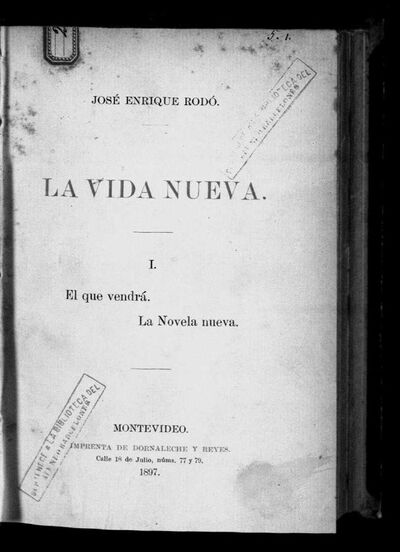
La novela nueva

Hombres de América : (Montalvo-Bolívar-Rubén Darío). Discursos parlamentarios

Los escritos de "La Revista Nacional de Literatura y Ciencias Sociales" : Poesías dispersas
![Ariel [Traducción]](https://api.europeana.eu/thumbnail/v2/url.json?uri=http%3A%2F%2Fmedia.cervantesvirtual.com%2Fs3%2FBVMC_OBRAS%2F3dc%2F3b5%2Fd05%2F890%2F446%2F195%2Fac5%2F1d1%2F964%2F6a6%2F77%2Fportada%2FCover.jpg&type=IMAGE)
Ariel [Traducción]

Grounds of Promotion

Rubén Darío : su personalidad literaria, su última obra

Rubén Darío : su personalidad literaria, su última obra

Grounds of Promotion

El mirador de Próspero

Ariel

El mirador de Próspero
![El que vendrá [Antología]](https://api.europeana.eu/thumbnail/v2/url.json?uri=http%3A%2F%2Fmedia.cervantesvirtual.com%2Fs3%2FBVMC_OBRAS%2Ffef%2Fccf%2Fe28%2F2b1%2F11d%2Ffac%2Fc70%2F021%2F85c%2Fe60%2F64%2Fportada%2FCover.jpg&type=IMAGE)
El que vendrá [Antología]

El que vendrá ; La novela nueva ; Rubén Darío ; Ariel ; Liberalismo y jacobinismo
![Ariel [Traducción]](https://api.europeana.eu/thumbnail/v2/url.json?uri=http%3A%2F%2Fmedia.cervantesvirtual.com%2Fs3%2FBVMC_OBRAS%2Fb98%2F486%2F8e5%2F5b0%2F471%2Fa94%2F7bd%2Fca8%2Fbe9%2F2cd%2F0a%2Fportada%2FCover.jpg&type=IMAGE)
Ariel [Traducción]

Ariel

El camino de Paros : (meditaciones y andanzas)
Untitled
Untitled

Untitled

Untitled
~10 min read
Encyclopedic overview
José Enrique Camilo Rodó Piñeyro (15 July 1871 – 1 May 1917) was a Uruguayan essayist. He cultivated an epistolary relationship with important Hispanic thinkers of that time, Leopoldo Alas (Clarín) in Spain, José de la Riva-Agüero in Peru, and, most importantly, with Rubén Darío, the most influential Latin American poet to date, the founder of modernismo. As a result of his refined prose style and the modernista ideology he pushed, Rodó is today considered the preeminent theorist of the modernista school of literature.
Rodó is best known for his essay Ariel (1900), drawn from The Tempest, in which Ariel represents the positive, and Caliban represents the negative tendencies in human nature, and they debate the future course of history, in what Rodó intended to be a secular sermon to Latin American youth, championing the cause of the classical western tradition. What Rodó was afraid of was the debilitating effect of working individuals' limited existence doing the same work, over and over again, never having time to develop the spirit. Parque Rodó, one of the main parks in Montevideo, was named after him.
Excerpted from Wikipedia’s “José Enrique Rodó” article, available under the CC BY-SA 4.0 licence.