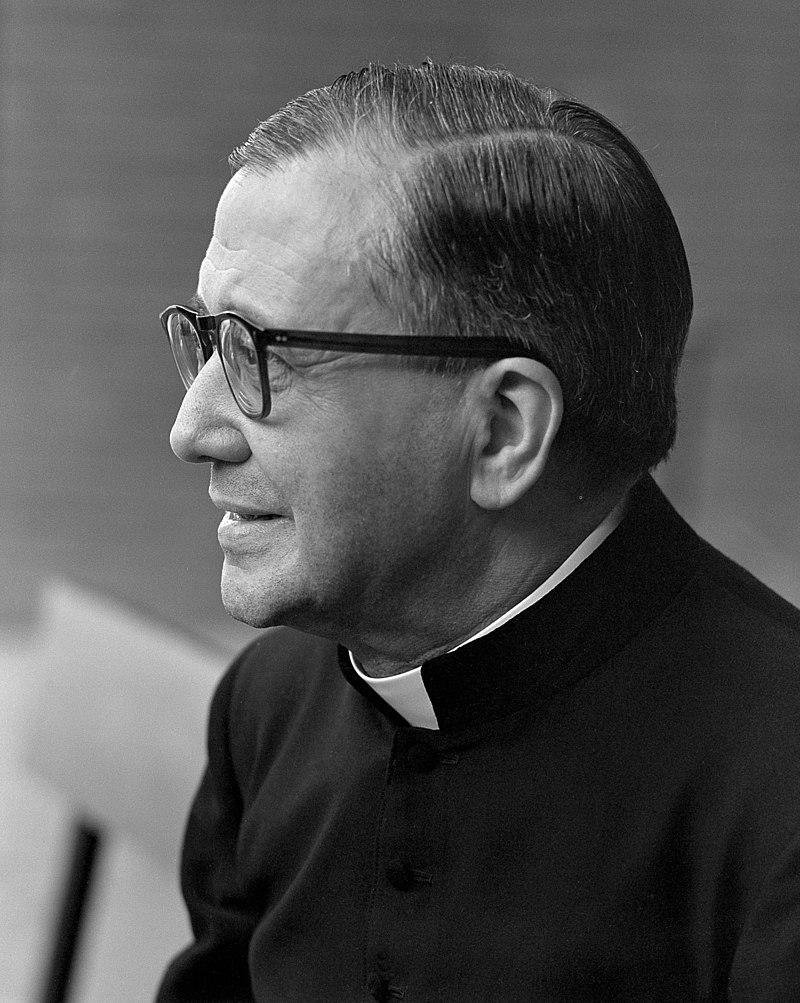
File:Josemaria_Escriva.jpg · Wikimedia Commons · See Wikimedia Commons
Josemaría Escrivá
Sign in to saveAlso known as Josemaria Escriva, Josemaría Escrivá de Balaguer
Spanish priest, writer and Catholic saint
Josemaría Escrivá was a Spanish priest and Catholic writer who founded the Opus Dei organization and was later canonized as a saint. He matters because his teachings on integrating faith into everyday work and secular life influenced millions of Catholics and shaped modern Catholic thought.
AI-generated from the Wikipedia summary — may contain errors.
Wikidata facts
- Instance of
- human
- Given name
- Mariano
- Gender
- male
- Citizenship
- Spain
- Place of death
- Rome
- Occupation
- lawyer
- Educated at
- Universidad Central
- Languages spoken
- Italian
- Religion
- Catholic Church
- Notable work
- Prelature of the Holy Cross and Opus Dei
- Academic degree
- doctorate
- Image
- Roma - San Pietro in Vaticano 8421.jpg
Show 12 more facts
- manner of death
- natural causes
- Commons category
- Josemaria Escrivá de Balaguer
- date of birth
- 1902-01-09
- date of death
- 1975-06-26
- feast day
- June 26
- member of
- Priestly Society of the Holy Cross
- birth name
- José María Julián Mariano Escrivá Albás
- name in native language
- Josemaría Escrivá de Balaguer
- cause of death
- disease
- place of burial
- prelatic church of Our Lady of Peace
- date of baptism
- 1902-01-13
- described by source
- Wikitólica
via Wikidata · CC0
~40 min read
Encyclopedic overview
Josemaría Escrivá de Balaguer y Albás (9 January 1902 – 26 June 1975) was a Spanish Catholic priest who founded Opus Dei, an organization of laypeople and priests dedicated to the principle of everyday holiness. He was canonized by Pope John Paul II in 2002.
Escrivá studied for the priesthood in Logroño and Zaragoza and in 1925 was ordained in the latter. He then moved to Madrid, where he pursued doctoral studies in civil law at the Central University. After the start of the Spanish Civil War in 1936, Escrivá fled from Madrid, via Andorra and France, to the city of Burgos, which at the time served as the headquarters of the rebel Nationalist forces under General Francisco Franco. After the military triumph of the Nationalists, Escrivá returned to Madrid and completed his doctorate in 1939. His principal work was the initiation, government and expansion of Opus Dei. His best-known publication is The Way, which has been translated into 43 languages and has sold several million copies. Escrivá settled in Rome in 1946. In 1955, he received a doctorate in theology from the Lateran University.
Excerpted from Wikipedia’s “Josemaría Escrivá” article, available under the CC BY-SA 4.0 licence.