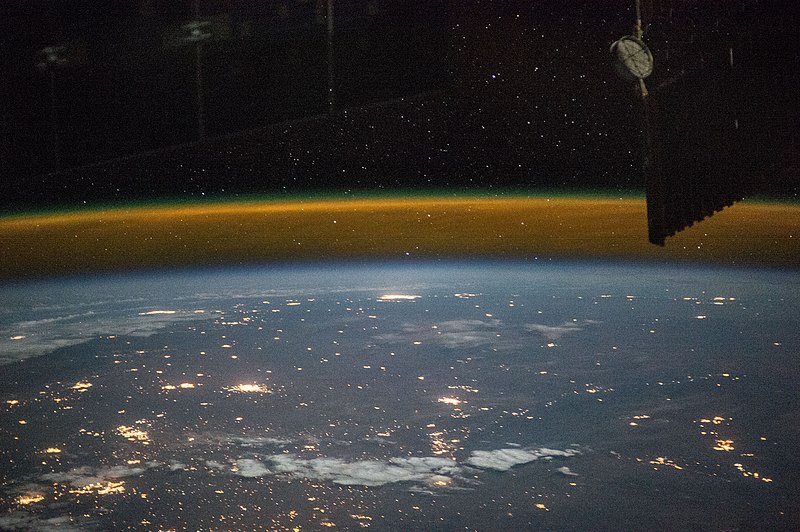
File:ISS043-E-143486_-_View_of_Earth.jpg · Wikimedia Commons · See Wikimedia Commons
The Kármán line is a popularly recognized boundary marking where Earth's atmosphere ends and outer space begins, located at an altitude of about 100 kilometers (62 miles) above sea level. It matters because it serves as a useful reference point for defining what counts as space travel and helps distinguish between atmospheric flight and spaceflight.
AI-generated from the Wikipedia summary — may contain errors.
Wikidata facts
- Instance of
- rule
- Named after
- Theodore von Kármán
- Elevation
- 100
- Location
- thermosphere
- Image
- Top of Atmosphere.jpg
Sources (2)
via Wikidata · CC0
~12 min read
Encyclopedic overview
Earth's atmosphere photographed from the International Space Station. The orange and green line of airglow is at roughly the altitude of the Kármán line.
The Kármán line (or von Kármán line /vɒn ˈkɑːrmɑːn/) is a conventional definition of the edge of space; it is widely but not universally accepted. The international record-keeping body FAI (Fédération aéronautique internationale) defines the Kármán line at an altitude of 100 kilometres (54 nautical miles; 62 miles; 328,084 feet) above mean sea level.
Excerpted from Wikipedia’s “Kármán line” article, available under the CC BY-SA 4.0 licence.