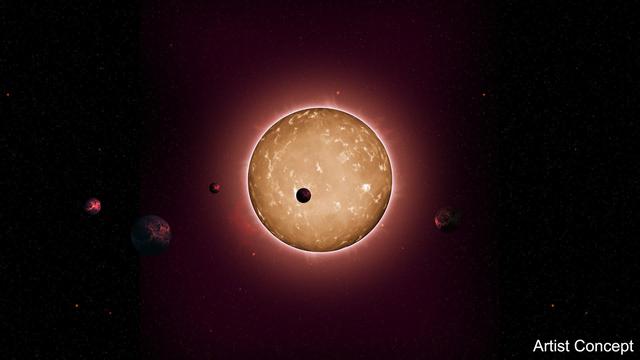
Kepler-444 Planetary System Artist Concept · NASA · NASA — public domain
Kepler-444
Sign in to saveKepler-444 (or KOI-3158, KIC 6278762, 2MASS J19190052+4138043, BD+41°3306) is a triple star system, estimated to be 11.2 billion years old (more than 80% of the age of the universe), approximately away from Earth in the constellation Lyra. On 27 January 2015, the Kepler spacecraft is reported to have confirmed the detection of five sub-Earth-sized rocky exoplanets orbiting the main star. The star is a K-type main sequence star. All of the planets are far too close to their star to harbour life forms.
Astronomical data · SIMBAD
- Object type
- PM*
- Spectral type
- K0V
- Distance
- 119 light-years
- Redshift
- z = -0.00040626525504838806
- Coordinates
- RA 289.7523° · Dec 41.6346°
via SIMBAD · CDS Strasbourg
Wikidata facts
- Instance of
- multiple star
- Constellation
- Lyra
- Variable-star type
- rotating variable star
Show 15 more facts
- epoch
- J2000.0
- right ascension
- 289.752287916
- declination
- 41.634602277
- effective temperature
- 5053
- apparent magnitude
- 6.703
- radial velocity
- -125.0
- parallax
- 28.28
- spectral class
- K0V
- catalog code
- WEB 16574
- metallicity
- 7.02
- stellar rotational velocity
- 1.7
- surface gravity
- 35000
- luminosity
- 1.13
- right ascension component of proper motion
- 102
- declination component of proper motion
- -629
Sources (1)
via Wikidata · CC0
~5 min read
Encyclopedic overview
9 sectionsContents
- Discovery
- History
- Characteristics
- Stellar system
- Planetary system
- See also
- Notes
- References
- External links
Kepler-444 (or KOI-3158, KIC 6278762, 2MASS J19190052+4138043, BD+41°3306) is a triple star system, estimated to be 11.2 billion years old (more than 80% of the age of the universe), approximately away from Earth in the constellation Lyra. On 27 January 2015, the Kepler spacecraft is reported to have confirmed the detection of five sub-Earth-sized rocky exoplanets orbiting the main star. The star is a K-type main sequence star. All of the planets are far too close to their star to harbour life forms.
==Discovery== Preliminary results of the planetary system around Kepler-444 were first announced at the second Kepler Science Conference in 2013. At that conference, the star was known as KOI-3158.
Excerpted from Wikipedia’s “Kepler-444” article, available under the CC BY-SA 4.0 licence.