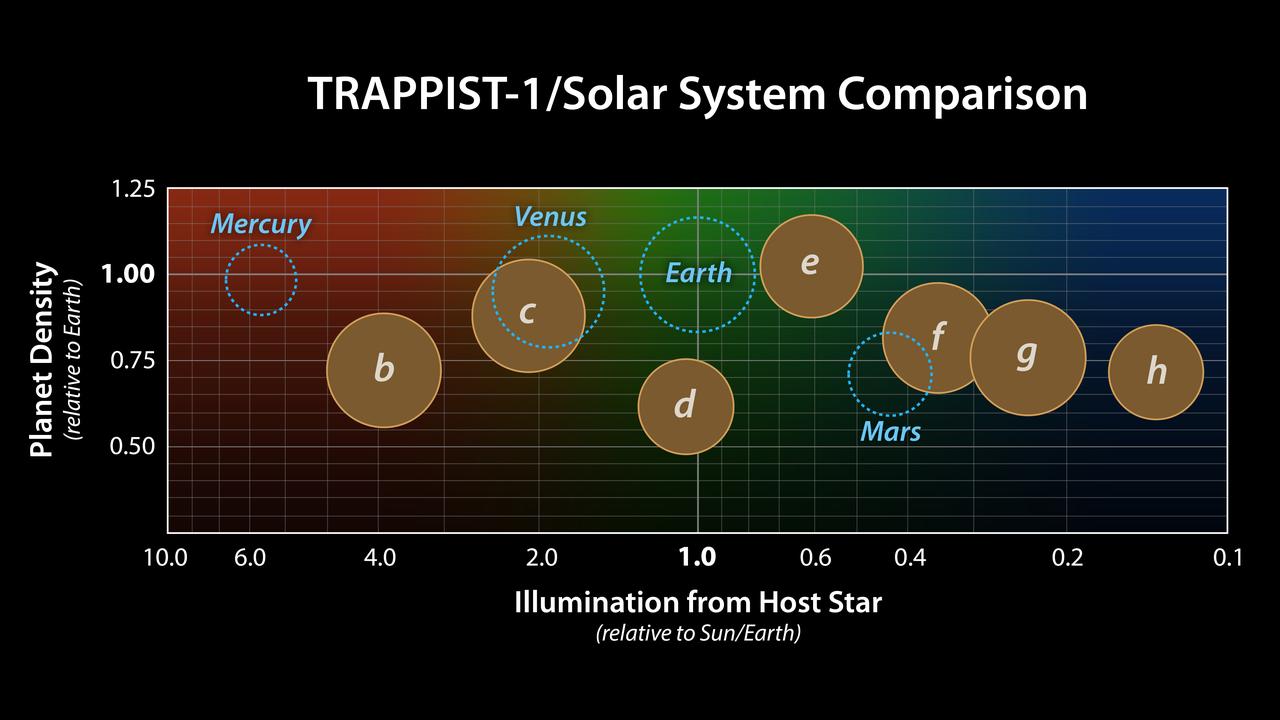
Comparing TRAPPIST-1 to the Solar System · NASA · NASA — public domain
Astronomical data · SIMBAD
- Object type
- Pl
- Distance
- 2,061 light-years
- Coordinates
- RA 285.5740° · Dec 38.4009°
via SIMBAD · CDS Strasbourg
Key facts
- Planet.name
- Kepler-9b
- Planet.image
- Exoplanet Comparison Kepler-9 b.png
- Planet.caption
- Size comparison of Kepler-9b (left) with Jupiter (right)
- Planet.discoverer
- Kepler Mission team
- Planet.discovery_site
- Kepler space telescope
- Planet.discovered
- 26 August 2010
- Planet.discovery_method
- Transit
- Planet.apsis
- astron
- Planet.eccentricity
- 0
- Planet.period
- 19.24 d
- Planet.inclination
- 88.55
- Planet.star
- Kepler-9
- Planet.mean_radius
- 0.842 ± 0.069
- Planet.density
- g cm−3
via Wikipedia infobox
Exoplanet data
- Host star
- Kepler-9
- Discovered
- 2010
- Discovered by
- Kepler
- Orbital period
- 19.24 days
- Radius
- 8.29 × Earth
- Mass
- 43.40 × Earth
- Equilibrium temp
- 661 K
- Distance
- 628.26 pc
via NASA Exoplanet Archive
Wikidata facts
- Constellation
- Lyra
- Parent body
- Kepler-9
- Diameter
- 114000
- Radius
- 0.74
- Mass
- 0.13655
- Orbital period
- 19.23891
- Image
- Kepler-9b, Jupiter size comparison.jpg
Show 16 more facts
- catalog code
- Kepler-9b
- semi-major axis of an orbit
- 0.143
- time of discovery or invention
- 2010-10-00
- discovery method
- transit method
- Commons category
- Kepler-9 b
- discoverer or inventor
- Kepler Space Telescope
- right ascension
- 285.57397671045170
- declination
- 38.40088256864889
- epoch
- J2000.0
- argument of periapsis
- 357
- orbital eccentricity
- 0
- orbital inclination
- 88.982
- right ascension component of proper motion
- 2.491
- declination component of proper motion
- -14.713
- parallax
- 1.5629
- M sin i
- 0.08149941185
Sources (1)
via Wikidata · CC0
~3 min read
Encyclopedic overview
5 sectionsContents
- Nomenclature and history
- Characteristics
- Other planets in the Kepler-9 system
- References
- External links
__NOTOC__
Kepler-9b is one of the first planets discovered outside the Solar System (exoplanets) by NASA's Kepler Mission. It revolves around the star Kepler-9 within the constellation Lyra. Kepler-9b is the largest of three planets detected in the Kepler system by transit method; its mass is roughly half that of the planet Saturn, and it is the largest planet in its system. Kepler-9b and Kepler-9c display a phenomenon called orbital resonance, in which gravitational pull from each planet alters and stabilizes the orbit of the other. The planet's discovery was announced on August 26, 2010.
Excerpted from Wikipedia’s “Kepler-9 b” article, available under the CC BY-SA 4.0 licence.