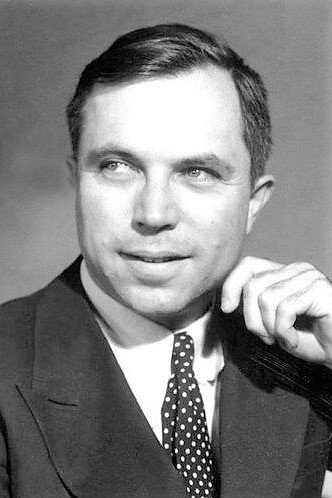
Profile via TMDB · Courtesy of TMDB
King Vidor
Sign in to saveAlso known as King Wallis Vidor, King W. Vidor
American film director, film producer, and screenwriter (1894-1982)
OverviewAI-generated
King Vidor was an American film director, producer, and screenwriter. Born in Galveston, Texas, in 1894, he began his work period in 1913. He was married to Florence Vidor and Eleanor Boardman. Vidor was a Christian Science adherent who spoke English.
His notable works include The Big Parade, The Crowd, Hallelujah!, The Champ, H. M. Pulham, esquire, Ruby Gentry, and Duel in the Sun. He also authored King Vidor on film making. Vidor received an Academy Honorary Award, a National Board of Review Award for Best Film, and a star on the Hollywood Walk of Fame. He was nominated for an Academy Award for Best Director.
Vidor died of cardiovascular disease in Paso Robles in 1982. His archives are held at the Harry Ransom Center, and his works are in the collection of the Museum of Modern Art.
Synthesized by Vinony from 32 facts across 5 sources: Wikidata, Open Library, TMDb, Europeana Sparql, Vinony collections. Generated from structured data (not the Wikipedia text) and checked against those facts — may still contain errors.
Person · Open Library
- Born
- 1894
- Died
- 1982
- Works
- 17
Top works
- H. M. Pulham, esquire
- Hallelujah (1929)
- Ruby Gentry
- Duel in the sun
- Duel in the sun
via Open Library + Wikidata
Film & TV
Galveston, Texas, USA
King Wallis Vidor (February 8, 1894 – November 1, 1982) was an American film director, film producer, and screenwriter whose career spanned nearly seven decades. In 1979, he was awarded an Honorary Academy Award for his "incomparable achievements as a cinematic creator and innovator." He was nominated five times for the Academy Award for Best Director, and won eight international film awards…
Known for
- Filmmakers vs. Tycoons — Self (archive footage)2005
- Federico Fellini's Autobiography — Self (archive footage)2000
- The Wonderful Wizard of Oz: The Making of a Movie Classic — Self (archive footage)1990
- Love & Money — Walter Klein1981
- Metaphor: King Vidor Meets with Andrew Wyeth1980
- Hollywood — Self1980
- Les Rendez-vous du dimanche — Self1975
- The Men Who Made the Movies: King Vidor — Self1973
- The Men Who Made the Movies1973
- Truth and Illusion: An Introduction to Metaphysics — Narration (as Nicholas Rodiv)1964
via TMDB
Key facts
- Born
- King Wallis Vidor , ( 1894-02-08 ) February 8, 1894, Galveston, Texas , U.S.
- Died
- November 1, 1982 (1982-11-01) (aged 88), Paso Robles, California , U.S.
- Other names
- King W. Vidor, John Vidor
- Occupations
- Film director producer screenwriter
- Years active
- 1913–1980
- Known for
- The Big Parade Northwest Passage Comrade X An American Romance Duel in the Sun
- Spouses
- Florence Arto , ( married</span>"}]]}'>m. 1915 ; divorced</span>"}]]}'>div. 1924 ) Eleanor Boardman , ( married</span>"}]]}'>m. 1926 ; divorced</span>"}]]}'>div. 1931 ) Elizabeth Hill ( married</span>"}]]}'>m. 1932 ; died 1978 )
- Awards
- Hollywood Walk of Fame
via Wikipedia infobox
Wikidata facts
- Instance of
- human
- Gender
- male
- Citizenship
- United States
- Place of birth
- Galveston
- Place of death
- Paso Robles
- Spouse
- Eleanor Boardman
- Occupation
- producer
- Languages spoken
- English language
- Religion
- Christian Science
- Notable work
- War and Peace
- Image
- King Vidor (1921).jpg
Show 10 more facts
- Commons category
- King Vidor
- date of birth
- 1894-02-08
- date of death
- 1982-11-01
- name in native language
- King Vidor
- cause of death
- cardiovascular disease
- related category
- Category:Films directed by King Vidor
- start of work period
- 1913-00-00
- archives at
- Harry Ransom Center
- Commons Creator page
- King Vidor
- manner of death
- natural causes
Sources (10)
via Wikidata · CC0
Works in European collections
1 object attributed to King Vidor, held across European museums, libraries & archives · via Europeana
~40 min read
Encyclopedic overview
King Wallis Vidor (/ˈviːdɔːr/ VEE-dor; February 8, 1894 – November 1, 1982) was an American film director, film producer, and screenwriter. His 67-year career spanned the silent and sound eras, with works distinguished by a sympathetic depiction of contemporary social issues. Considered an auteur director, Vidor approached multiple genres and allowed the subject matter to determine the style, often pressing the limits of film-making conventions.
His most acclaimed and successful film in the silent era was The Big Parade (1925). Vidor's sound films of the 1940s and early 1950s, such as Northwest Passage (1940), Comrade X (1940), An American Romance (1944), and The Fountainhead (1949), have been characterized as some of his best. His dramatic depictions of the American western landscape endow nature with a sinister force where his characters struggle for survival and redemption. Vidor's earlier films tend to identify with the common people in a collective struggle, whereas his later works place individualists at the center of his narratives.
Excerpted from Wikipedia’s “King Vidor” article, available under the CC BY-SA 4.0 licence.