Official website (http://www.visitknighton.co.uk/)
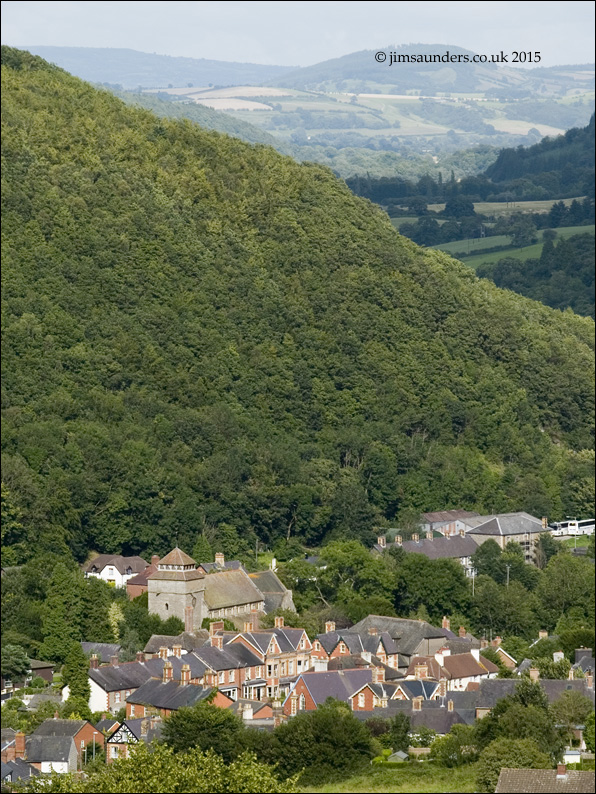
Knighton
Sign in to saveAlso known as Tref-y-clawdd, Trefyclo, Tref-y-Clawdd
town in Powys, Wales and Shropshire, England
Official website
Visit Knighton- the town on the Dyke - Visit Knighton
Knighton, the town on Offa's Dyke, a small market town in Powys
visitknighton.co.uk →Just a handful of miles over the border into England from Knighton lies the ruin of Hopton Castle, a modest medieval rectangular keep. Its peaceful and picturesque location today belies the violence it witnessed during the English Civil War. During the Civil War, in February 1644, Hopton Castle became an outlying garrison of the Parliamentary force holding Brampton Bryan Castle (see the Legend of Brilliana Harley for more details on that). The castle would have been larger in those days, with remains of a stone curtain wall and other substantial buildings within the bailey area. It had a very small initial garrison of 18 troops commanded by Samuel More. Ranged against them was a Royalist force under the command of Col. Sir Michael Woodhouse. The first Royalist attack got as far as the outer walls but was beaten back with losses. The defenders then declined a demand to surrender the castle and after a few days the main Royalist force pulled back. During this lull some Parliamentary reinforcements arrived, bringing the garrison up to 31, still not a large number to defend the castle area. Soon the Royalists returned with a larger force, which More recorded as 200 strong. With the defenders continued refusal to surrender, they attacked and forced a breach in the outer wall but were held there by close combat and may have suffered heavy losses. The Royalists retreated before again returning in even greater numbers and with heavy artillery. After once more refusing to surrender, the castle was again attacked and this time the Royalist weight of numbers and artillery told. The Parliamentarian defenders were pushed back into the castle itself, where the main door was set on fire and Royalists broke into the undercroft through a waste outlet, unpleasant though it must have been! The garrison were now in a desperate situation, being able to hear the attackers beneath them, and sought to parlay terms but were told that they would have to “yield to the Colonel’s mercy”. Escape being unlikely, they surrendered thinking they would be taken prisoner. Samuel More was led away but the rest of his soldiers were tied up and then killed in cold blood. However brutal it may seem to us today, in the 17th Century the killing of prisoners who had refused to surrender was accepted and in accordance with the rules of war as understood at the time. Nevertheless, it does seem a harsh and unjust end for the small number of defenders who fought so hard for the cause in which they believed. You can visit the remains of Hopton Castle today: the ruined keep was restored a few years ago and entry is free of charge. There is a small free car park at the site. Hopton Castle and its siege featured on a Channel 4 ‘Time Team’ TV programme broadcast in May 2010. Let’s take Offa first. Some 1200 years ago, Offa was king of the Anglo-Saxon kingdom of Mercia, reigning from 757 to his death in 796 – a long reign for the times and roughly 100 years before Alfred the Great. Under his kingship Mercia became the most powerful kingdom in Britain; though Mercia itself roughly covered what we today call ‘the Midlands’, King Offa also controlled Kent, Sussex, London and East Anglia. He was a powerful, ruthless and wealthy king: the recently discovered ‘Stafford Hoard’ gives us an idea of the skill of Anglo-Saxon craftsmen working in gold and jewels, and of the wealth of the nobility who owned such things. It may surprise us today, but this ‘Dark Ages’ king was also a European statesman who corresponded with Charlemagne (King of the Franks and first Holy Roman Emperor), mainly about trade and the safety of pilgrims and merchants. Where do we start with Offa’s Dyke? Well ‘Dyke’ refers to a high earth bank and it was almost certainly constructed at the height of Mercian power under the orders of King Offa, who had the will and money to make it happen. A number of uncertainties surround Offa’s Dyke, perhaps not so surprising given that it all happened 1200 years ago. One qu
Read more on their site →Excerpt from the official site · 3,040 chars · not written by Vinony
Wikidata facts
- Instance of
- market town
- Official name
- Trefyclo
- Country
- United Kingdom
- Located in
- Powys
- Population
- 3007
- Area
- 2622.29
- Shares border with
- Knucklas
- Official website
- www.visitknighton.co.uk
- Image
- Knighton - Broad Street - geograph.org.uk - 876640.jpg
Show 6 more facts
- twinned administrative body
- Varades
- Commons category
- Knighton, Powys
- OS grid reference
- SO285725
- postal code
- LD7
- historic county
- Radnorshire
- P12749
- Macello
via Wikidata · CC0
On the map
2 mapped locations