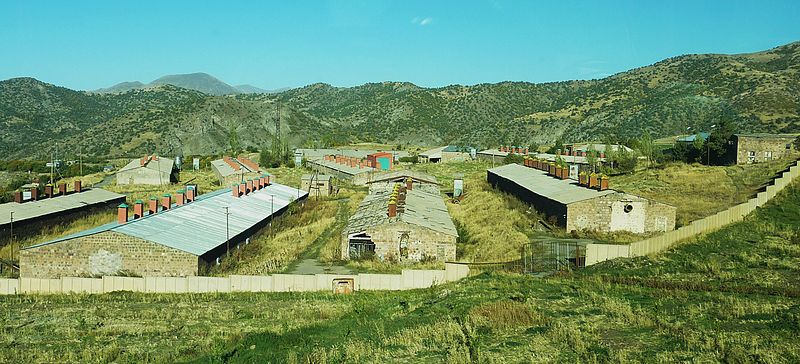
File:441_Ancien_kolkhoze_près_de_Djermouk.JPG · Wikimedia Commons · See Wikimedia Commons
kolkhoz
Sign in to saveAlso known as kolkhozy, kollektivnoye khozaystvo
thumb|A former kolkhoz near Jermuk, Armenia thumb|1931 propaganda poster: "Kolkhoznik, read the book! The book will help fulfill the plan of the second Bolsheviks|Bolshevik spring!" thumb|Cotton growers at the "Zarya Vostoka" (Eastern Dawn) kolkhoz, Checheno-Ingush ASSR, 1938 A kolkhoz (Russian plural: kolkhozy; anglicized plural: kolkhozes () was a form of collective farm in the Soviet Union. Kolkhozes existed along with state farms or sovkhozes. These were the major components of the agriculture in the Soviet Union. The term continued to exist in some post-Soviet states.
A kolkhoz was a form of collective farm in the Soviet Union where agricultural production was organized communally rather than by individual farmers. These collective farms, along with state farms called sovkhozes, formed the backbone of Soviet agriculture and the term persisted in some countries even after the Soviet Union's collapse.
AI-generated from the Wikipedia summary — may contain errors.
~13 min read
Encyclopedic overview
12 sectionsContents
- Name
- Organization of kolkhozes
- Work structure
- Brigade
- Zveno
- Kolkhoz conditions in the Stalin period
- Basic statistics for the Soviet Union
- Kolkhozes after 1991
- See also
- Notes
- References
- External links
thumb|A former kolkhoz near Jermuk, Armenia thumb|1931 propaganda poster: "Kolkhoznik, read the book! The book will help fulfill the plan of the second Bolsheviks|Bolshevik spring!" thumb|Cotton growers at the "Zarya Vostoka" (Eastern Dawn) kolkhoz, Checheno-Ingush ASSR, 1938 A kolkhoz (Russian plural: kolkhozy; anglicized plural: kolkhozes () was a form of collective farm in the Soviet Union. Kolkhozes existed along with state farms or sovkhozes. These were the major components of the agriculture in the Soviet Union. The term continued to exist in some post-Soviet states.
==Name== thumb|Map of the kolkhozes (kolūkis) of the Lithuanian SSR. The portmanteau is a contraction of . This Russian term was adopted into other languages as a loanword; however, some other languages calqued equivalents from native roots, such as Ukrainian , from . In Belarus, the term was known as , in Lithuania – .
Excerpted from Wikipedia’s “kolkhoz” article, available under the CC BY-SA 4.0 licence.
Gallery (8)
Available in 64 languages
- Español
- Français
- Deutsch
- 中文
- 日本語
- Русский
- Português
- Italiano
- العربية
- हिन्दी
- Armenian
- Asturian
- Azerbaijani
- Bahasa Indonesia
- Bashkir
- Basque
- bat_smg
- be_x_old
Show 45 more
- Belarusian
- Bosnian
- Bulgarian
- Catalan
- Chuvash
- Croatian
- Czech
- Danish
- Esperanto
- Estonian
- Finnish
- Galician
- Greek
- Hebrew
- Hungarian
- Irish
- Kazakh
- Kyrgyz
- Latin
- Latvian
- Lithuanian
- Nederlands
- Norwegian
- Norwegian Nynorsk
- Occitan
- Ossetic
- Polski
- Romanian
- Serbian
- Serbian (Latin)
- simple
- Slovak
- Svenska
- Tajik
- Tamil
- Tatar
- Tiếng Việt
- Türkçe
- Ukrainian
- Uzbek
- Wu Chinese
- Yakut
- zh_yue
- فارسی
- 한국어
via Wikidata sitelinks · CC0