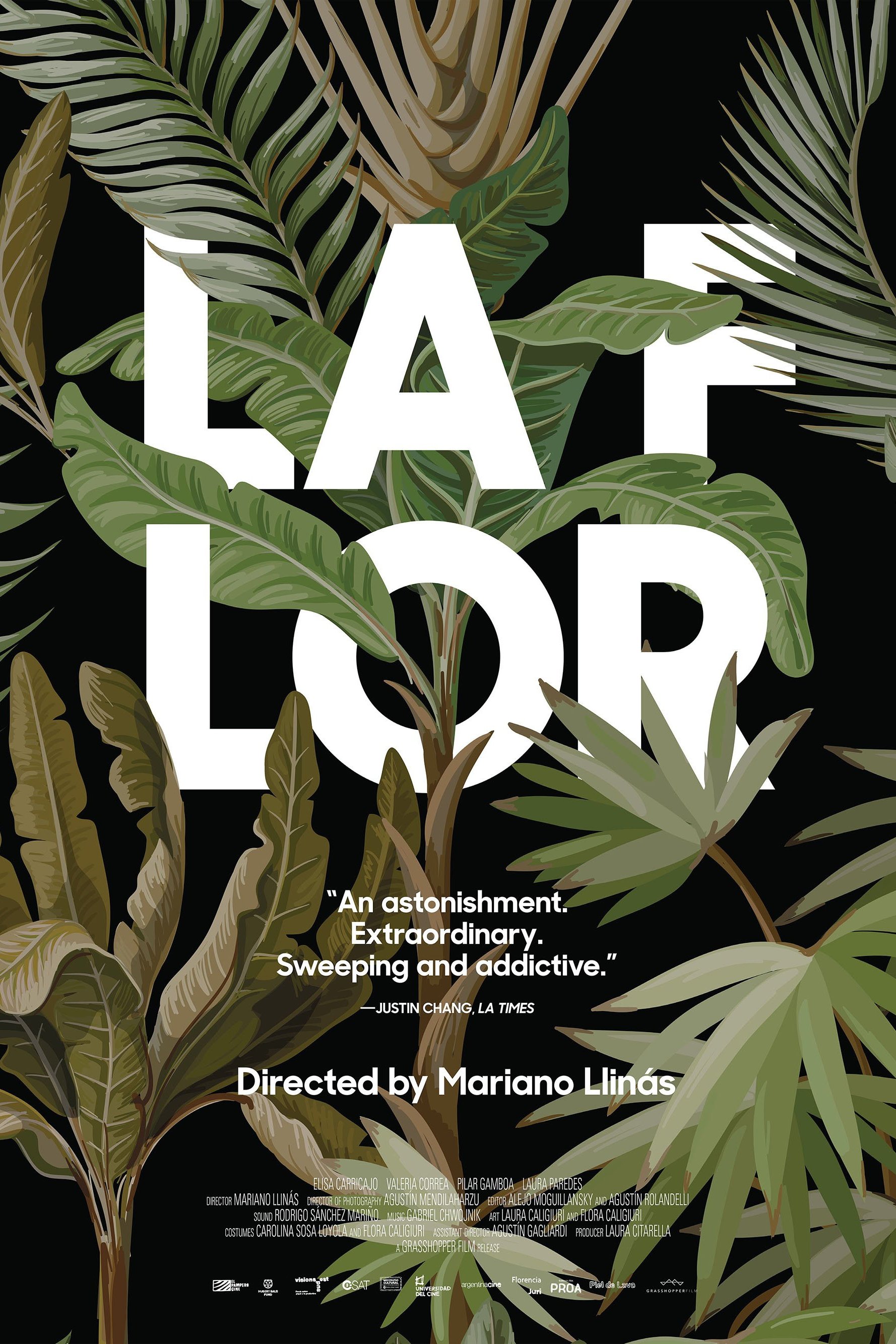
Poster from TMDB
La Flor
Sign in to saveAlso known as The Flower, Flower, The Flower (La flor)
2018 film by Mariano Llinás
Film · TMDB
7.2An enormous effort of narrative complexity made up of six independent, successive stories, connected by the same four actresses living very different experiences in very different universes…
Cast
- Elisa Carricajo as Marcela / Isabel / Agente 50 / Actriz
- Valeria Correa as Yanina / Andrea Nigro / La niña / Actriz
- Pilar Gamboa as Valeria / Daniela 'La Niña Cruz' / Actriz
- Laura Paredes as Lucia Conti / Flavia / La 301 / Actriz
- Esteban Lamothe as Turistic Gaucho 1
- Santiago Gobernori as Gaucho Turístico 2
This product uses the TMDB API but is not endorsed or certified by TMDB.
Described at
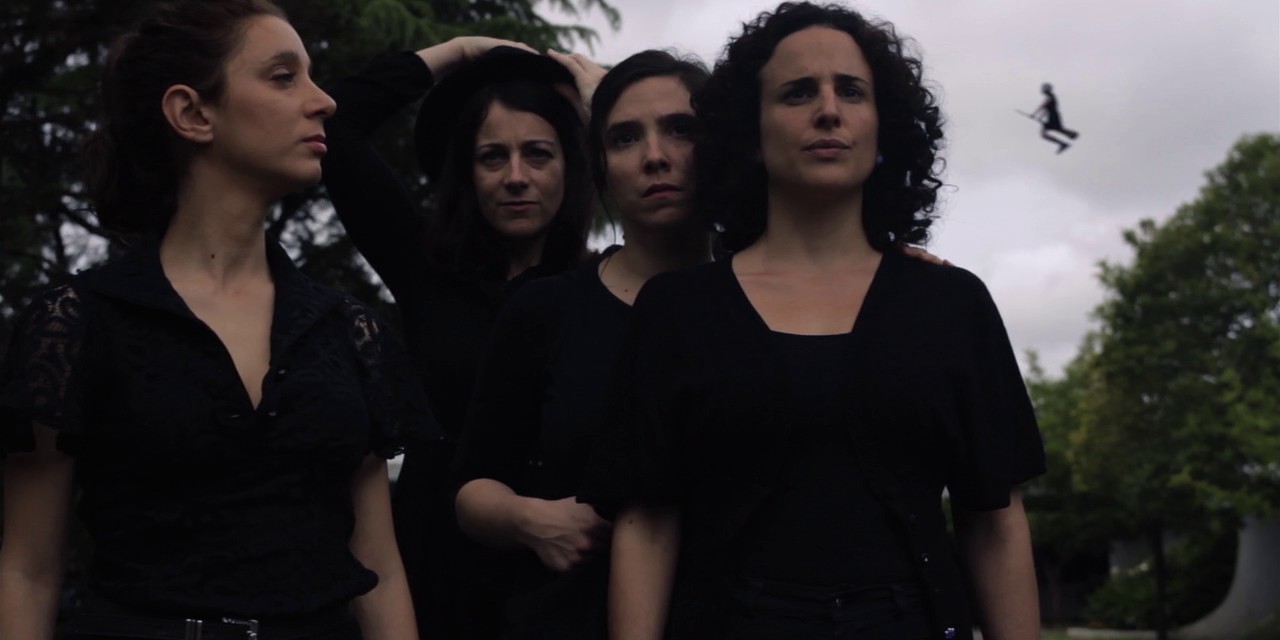
"La Flor:" Seven Propositions on Notebook | MUBI
New ways of exploring Mariano Llinás's genre-mutating, multi-part, multi-hour epic.
mubi.com →In the Argentinian film La Flor (2018), a certain kind of sight and a certain kind of sound predominate—spread right across its roughly thirteen-and-a-half hours and six major parts. First, the sight. There are various directors in cinema history known for their stubborn insistence on using a particular camera lens which becomes their veritable stylistic signature: for example, the 25-millimeter lens for deep focus effect in Jacques Rivette; or the split diopter in Brian De Palma. Mariano Llinás takes the exactly opposite position in La Flor : his lens-weapon of choice is a defiantly shallow one, plunging great expanses of any frame into blur (after a while, you’ll think you need an appointment at the optometrist). Sometimes there’s a relatively traditional bit of focus-pulling back and forth between two points in a scene (between several characters, for instance). Far more often, it’s a mise en scène based on characters slowly walking out of blur and into focus—that is, if they ever make it into focus. Oddly, one of the only “characters” to get a royal, deep-focus treatment is Margaret Thatcher (played by Susana Pampín)! Second, the sound. La Flor is a vast stream of different languages, accents, dialects, vocal tonalities. Talking, singing, laughing… but a great amount of it is post-synchronized. And the sync is deliberately off , hit-and-miss, like in some B movies (and in Orson Welles’s films, even when he’s doing Shakespeare). The lips and the words are often not matching (not to mention the framing segments where Llinás himself “speaks” to us in images where his mouth is resolutely closed!). It all has the sonic ambience of a studio recording. This sound design is not an accidental, coming-and-going effect: it’s total, from one end of this river-film to the other. From its beginning, there is a very particular (and peculiar) childlike fantasy air to La Flor . Llinás points to the “deliberately cliché, infantile, almost primitive” quality of (especially) the first of its six tales. Despite the globe-wide location shooting, there’s not the slightest attempt at realism. The film evokes the basic elements of fantastic or adventure genres—horror of the mummy, international espionage—in a merry but also quite vague way; it is absolutely not a film of detailed, expert pastiches (Coen brothers or Todd Haynes style). We never find ourselves exclaiming, what a Hitchcockian-Langian-Aldrichian-Godardian homage ! Because almost nothing of it proceeds in that way. It is reminiscent, on this level, of R.W. Fassbinder’s earliest shorts, The City Tramp (1966) and The Little Chaos (1967). More generally, there is an elaborate play on voice-over narration: different voices in a relay, some inside the fiction and some outside of it, raising all the classic questions of narrative knowledge, control, and power, who holds it and who loses it. In interviews, Llinás is at pains to downplay his own role as sovereign auteur of La Flor , so I’ll follow suit from now on. Not only is the production company that he’s part of, El Pampero Cine, a collective project, with many “creatives” attached at various levels, and their own accumulated stockpile of technical resources. La Flor , specifically, is a project devoted to, and devised in close collaboration with, its four major actors: Elisa Carricajo, Valeria Correa, Pilar Gamboa, and Laura Paredes, members since 2003 of the Buenos Aires experimental theater troupe, Piel de Lava (in their 2019 stage production Petróleo , they all played men). Llinás speaks of attempting to create a one-off genre across the scope of the project: that is to say, the genre of films starring these four actors, taking on vastly different roles from one episode to the next. In a sense, it’s just like watching Humphrey Bogart or Marilyn Monroe or any star in the olden-classical days slide from part to part, always themselves and always other. La Flor places special emphasis upon the fun of seeing—and appreciating—the vir
Excerpt from a page describing this subject · 38,166 chars · not written by Vinony
Wikidata facts
- Instance of
- film
- Genre
- drama film
- Country of origin
- Argentina
- Original language
- Spanish
- Director
- Mariano Llinás
- Screenwriter
- Mariano Llinás
- Cast member
- Mariano Llinás
- Producer
- Laura Citarella
- Duration
- 890
- FilmAffinity ID
- 930412
- Distribution format
- video on demand
- Official website
- elpamperocine.com.ar/laflor.html
- Image
- La Flor structure.png
Show 7 more facts
- Commons category
- La Flor
- publication date
- 2019-07-25
- title
- La flor
- number of parts of this work
- 6
- described at URL
- mubi.com/de/notebook/posts/nyff-what-is-one-to-do-with-mariano-llinas-s-14-hour-la-flor
- review score
- 8.9/10
- form of creative work
- anthology film
Sources (11)
via Wikidata · CC0