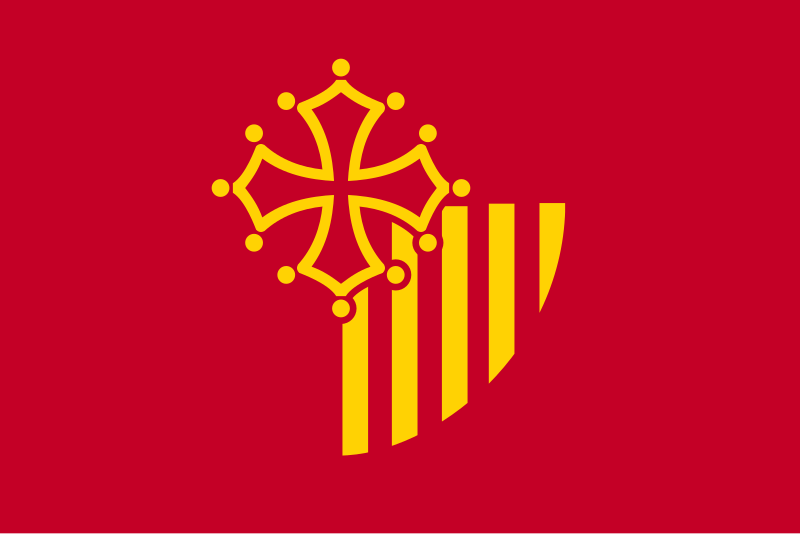
File:Flag_of_Languedoc-Roussillon.svg · Wikimedia Commons · See Wikimedia Commons
Languedoc-Roussillon
Sign in to saveLanguedoc-Roussillon (; ; ) is a former administrative region of France. On 1 January 2016, it joined with the region of Midi-Pyrénées to become Occitania. It comprised five departments, and bordered the other French regions of Provence-Alpes-Côte d'Azur, Rhône-Alpes, Auvergne, Midi-Pyrénées towards the north, and Spain, Andorra and the Mediterranean Sea towards the south. It was the southernmost region of mainland France.
Languedoc-Roussillon was a former administrative region in southern France that bordered Spain, Andorra, and the Mediterranean Sea, making it mainland France's southernmost region. In 2016, it merged with the neighboring region of Midi-Pyrénées to form a new region called Occitania.
AI-generated from the Wikipedia summary — may contain errors.
Key facts
- Settlement.official_name
- Languedoc-Roussillon
- Settlement.settlement_type
- Region of France
- Settlement.image_flag
- Flag of Languedoc-Roussillon.svg
- Settlement.flag_size
- 120px
- Settlement.image_shield
- Arms of the French Region of Languedoc-Roussillon.svg
- Settlement.image_blank_emblem
- Région Languedoc-Roussillon logo.svg
- Settlement.blank_emblem_size
- 75px
- Settlement.image_map
- Languedoc-Roussillon in France.svg
- Settlement.subdivision_type
- Country
- Settlement.extinct_title
- Dissolved
- Settlement.extinct_date
- 2016-01-01
- Settlement.seat_type
- Prefecture
- Settlement.seat
- Montpellier
- Settlement.parts_type
- Departments
- Settlement.parts_style
- list
- Settlement.parts
- 5
- Settlement.p1
- Aude (11)
- Settlement.p2
- Gard (30)
via Wikipedia infobox
Wikidata facts
- Instance of
- region of France
- Named after
- Roussillon
- Official name
- Languedoc
- Country
- France
- Located in
- metropolitan France
- Contains
- Gard
- Capital
- Montpellier
- Population
- 2729721
- Area
- 23376
- Time zone
- UTC+02:00
- Shares border with
- Auvergne
- Image
- Château d'eau du Peyrou, Montpellier 02.jpg
Show 9 more facts
- topic's main category
- Category:Languedoc-Roussillon
- Commons category
- Languedoc-Roussillon
- Commons gallery
- Languedoc-Roussillon
- replaced by
- Occitania
- native label
- Languedoc-Roussillon
- category of associated people
- Category:People from Languedoc-Roussillon
- language used
- Occitan
- inception
- 1960-06-04
- dissolved, abolished or demolished date
- 2015-12-31
via Wikidata · CC0
~16 min read
Encyclopedic overview
21 sectionsContents
- Toponymy
- History
- Population
- Religion
- Geography
- Politics
- Culture
- Language
- Literature
- Music
- Wine
- Sport
- Notable people
- Writers
- Illustrators
- Singers
- Comedians
- Major communities
- See also
- References
- External links
Languedoc-Roussillon (; ; ) is a former administrative region of France. On 1 January 2016, it joined with the region of Midi-Pyrénées to become Occitania. It comprised five departments, and bordered the other French regions of Provence-Alpes-Côte d'Azur, Rhône-Alpes, Auvergne, Midi-Pyrénées towards the north, and Spain, Andorra and the Mediterranean Sea towards the south. It was the southernmost region of mainland France.
==Toponymy== The first part of the name of the province of Languedoc-Roussillon comes from the French ("language of "), and is also a historical region. In southern France, the word for yes was the Occitan language word . Prior to the 16th century, the central area of France was referred to as , there the word for yes was in Old French, later becoming . These old place names referred to the areas where Occitan and Old French were spoken. The Edict of Villers-Cotterets made French the official national language in 1539. Roussillon was the name of the medieval County of Roussillon.
Excerpted from Wikipedia’s “Languedoc-Roussillon” article, available under the CC BY-SA 4.0 licence.
Gallery (23)
On the map
3 mapped locations
Available in 104 languages
- Español
- Français
- Deutsch
- 中文
- 日本語
- Русский
- Português
- Italiano
- العربية
- Afrikaans
- Albanian
- Amharic
- Aragonese
- Armenian
- Arpitan
- Asturian
- Aymara
- azb
Show 85 more
- Azerbaijani
- Bahasa Indonesia
- Bangla
- Basque
- be_x_old
- Belarusian
- Bosnian
- Breton
- Bulgarian
- Burmese
- Catalan
- Cebuano
- Chechen
- Corsican
- Croatian
- Czech
- Danish
- eml
- Esperanto
- Estonian
- Finnish
- Galician
- Georgian
- Greek
- Hakka Chinese
- Hebrew
- Hungarian
- Icelandic
- Ido
- Interlingua
- Javanese
- Kazakh
- Kurdish
- Latin
- Latvian
- Lithuanian
- Lombard
- Luxembourgish
- Macedonian
- Malagasy
- Malay
- Manx
- Marathi
- Mingrelian
- Nederlands
- Northern Sami
- Norwegian
- Norwegian Nynorsk
- nrm
- Occitan
- Ossetic
- Pampanga
- Piedmontese
- Polski
- Punjabi
- Quechua
- Romanian
- Sardinian
- Scots
- Scottish Gaelic
- Serbian
- Serbian (Latin)
- Sicilian
- simple
- Slovak
- Slovenian
- Svenska
- Swahili
- Tiếng Việt
- Türkçe
- Ukrainian
- Urdu
- Venetian
- Volapük
- Waray
- Welsh
- Western Frisian
- Western Panjabi
- Wu Chinese
- Zaza
- zh_min_nan
- zh_yue
- فارسی
- ไทย
- 한국어
via Wikidata sitelinks · CC0