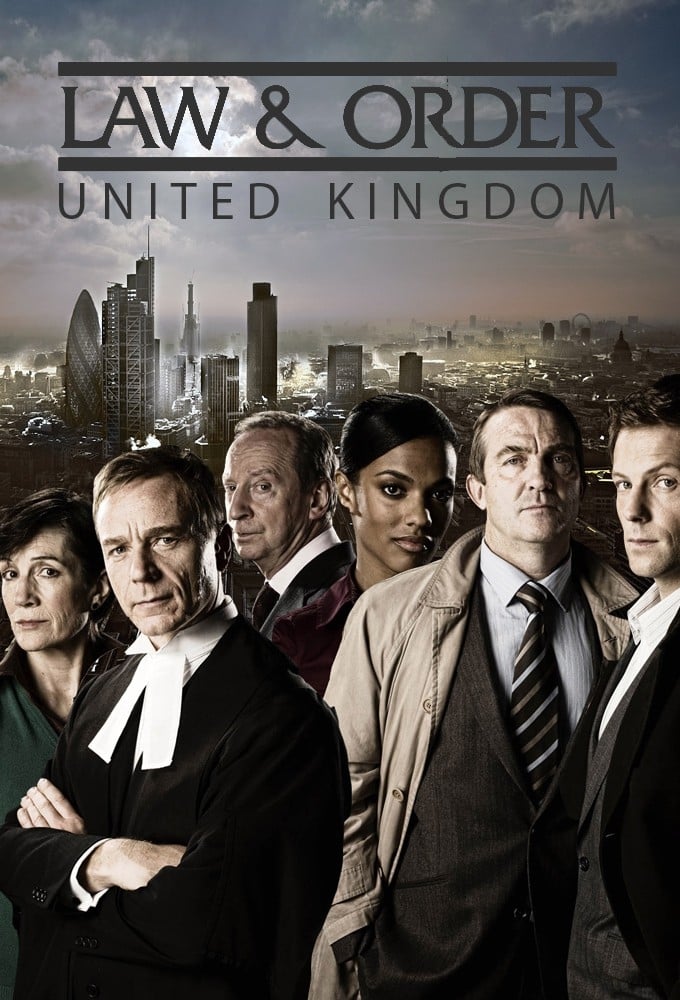
Poster from TMDB · Courtesy of TMDB
Law & Order: UK
Sign in to saveAlso known as L&O: UK, Law & Order: United Kingdom, Law & Order: London
British police procedural television series
TV series · TMDB
★ 7.0Adapted from the hit US series, Law & Order: UK follows a team of police detectives and prosecutors representing the public interest in the criminal justice system.
- Aired
- 2009–2014
- Seasons
- 8 · 53 episodes
- Status
- Ended
- Network
- ITV1
- Genres
- Drama
This product uses the TMDB API but is not endorsed or certified by TMDB.
Described at
Law & Order: UK | Law and Order | Fandom
"In the criminal justice system, the people are represented by two separate, yet equally important groups: the police who investigate crime, and the Crown Prosecutors who prosecute the offenders. These are their stories." Law & Order: UK (original working title Law & Order: London) is a British..., Only In Theaters July 10
lawandorder.wikia.com →"In the criminal justice system, the people are represented by two separate, yet equally important groups: the police who investigate crime, and the Crown Prosecutors who prosecute the offenders. These are their stories." Law & Order: UK (original working title Law & Order: London ) is a British television drama based on the original Law & Order each episode is based on an original script from that show with suitable changes for the English legal system, for example, the lack of felony murder and on occasion more major changes to the storyline. The "Law" is the fictional 'Central London Police' (although dialogue frequently refers to the Metropolitan Police) and the "Order" is the Crown Prosecution Service. The series airs on ITV and is produced by the independent production company Kudos. Fifty-three episodes have aired, with the final episode of Series 8 and the series airing on June 11, 2014. On June 4, 2014, ITV announced that the show would be "rested" after Bradley Walsh chose to leave the show and "Repeat to Fade" would be the final episode for the "foreseeable future". Law & Order: UK episodes are typically divided into two distinct parts, marked by a transition at the halfway point. The first part focuses on police and investigative work, while the second part explores the legal and courtroom proceedings. The show gives minimal attention to the characters' backstories or personal lives, maintaining a primary focus on their involvement in the cases presented in each episode. For most of Law & Order's run, episodes open with the discovery of a crime, usually a murder. These openings often depict a slice of everyday life, interrupted by civilians stumbling upon the crime or, occasionally, witnessing it. In earlier seasons, crimes were more commonly discovered by uniformed officers on patrol. In later seasons, the cold open sometimes featured a montage of the victim's final moments. The police are represented by a fictionalised unit of the Metropolitan Police Service. While the show primarily focuses on homicide cases, it also occasionally covers other crimes such as kidnappings, sexual offences, and fraud. In reality, these cases would typically be handled by specialised units. Viewers are introduced to two detectives: a senior detective (usually a Detective Chief Inspector or Detective Inspector) and a junior detective (often a Detective Sergeant or Detective Constable). They report to their superior officer, often a Detective Superintendent. At the crime scene, they are briefed by the first attending officer or a member of the forensic team. During their initial examination, they begin to form theories and often exchange witty remarks before the opening credits roll. Investigations usually begin with few or no strong leads. Detectives must often identify the victim and follow several dead ends before locating a viable suspect. Their work involves interviewing witnesses, collecting evidence with the assistance of Crime Scene Investigators (CSIs), and liaising with the pathologist's office. CSIs use tools and techniques to gather fingerprints, cast impressions, trace bullet trajectories, and uncover otherwise invisible evidence. They are trained to work in hazardous environments if necessary. The pathologist collects the body from the scene and determines the cause and manner of death through a post-mortem examination. The detectives use this information to learn about the victim's identity, time of death, and potential leads. Once the victim is identified, detectives notify their next of kin and gather details about the victim's life, relationships, and potential enemies. Detectives continue their work by interviewing witnesses and suspects, tracing the victim’s last movements, and, in modern episodes, using technology such as CCTV, ANPR (Automatic Number Plate Recognition), and mobile phone tracking. They may also consult with specialised units, such as the Flying Squad for armed robbery or SOCA (now the Nati
Excerpt from a page describing this subject · 40,000 chars · not written by Vinony
Wikidata facts
- Instance of
- television series
- Genre
- legal drama
- Country of origin
- United Kingdom
- Original language
- English language
- Creator
- Dick Wolf
- Cast member
- Freema Agyeman
- Narrative location
- London
- Duration
- 45
- Official website
- www.itv.com/lawandorderuk
Show 14 more facts
- Commons category
- Law & Order: UK
- topic's main category
- Category:Law & Order: UK
- aspect ratio (W:H)
- 16:9
- executive producer
- Dick Wolf
- number of seasons
- 8
- number of episodes
- 53
- title
- Law & Order: UK
- original broadcaster
- ITV
- list of episodes
- list of Law & Order: UK episodes
- start time
- 2009-02-23
- described at URL
- lawandorder.wikia.com/wiki/Law_%26_Order:_UK
- end time
- 2014-06-11
- media franchise
- Law & Order
- set in environment
- island
Sources (2)
via Wikidata · CC0