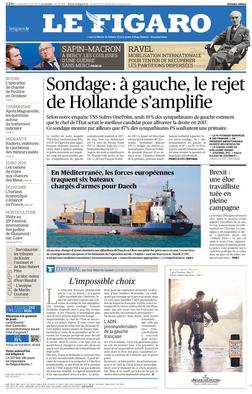
File:Le_Figaro_front_page.jpg · Wikimedia Commons · See Wikimedia Commons
Le Figaro is one of France's major daily newspapers, known for covering national and international news. It matters because it has long been an influential source of information and commentary shaping public discourse in France.
AI-generated from the Wikipedia summary — may contain errors.
Wikidata facts
- Instance of
- newspaper
- Country
- France
- Headquarters
- 9th arrondissement of Paris
- Owned by
- Dassault Group
- Country of origin
- France
- Follows
- Le Gaulois
- Main subject
- information
- Official website
- gallica.bnf.fr/ark:/12148/cb34355551z/date
- Image
- Figaro 4 aout 1914.jpg
- Political ideology
- conservatism
Show 11 more facts
- place of publication
- Paris
- Commons category
- Le Figaro
- inception
- 1826-01-15
- language of work or name
- English language
- topic's main category
- Category:Le Figaro
- social media followers
- 865000
- title
- Figaro
- newspaper format
- Berliner
- publication interval
- 1
- quantity
- 322497
- start time
- 1826-01-15
Sources (7)
via Wikidata · CC0
~17 min read
Encyclopedic overview
Le Figaro ( French: [l(ə) fiɡaʁo] ) is a French daily morning newspaper founded in 1826. The oldest national newspaper in France, Le Figaro is considered a French newspaper of record, along with Le Monde and (to a lesser extent) Libération. Le Figaro is the second-largest national newspaper nationally, after Le Monde. It was named after Figaro, a character in several plays by polymath Beaumarchais (1732–1799): Le Barbier de Séville, La Mère coupable, and the eponymous Le Mariage de Figaro. One of his lines became the paper's motto: "Without the freedom to criticise, there is no flattering praise".
It has a centre-right editorial stance, and has published writing by renowned contributors such as Émile Zola, Anatole France, Marcel Proust, François Mauriac, as well as Raymond Aron.
Excerpted from Wikipedia’s “Le Figaro” article, available under the CC BY-SA 4.0 licence.
Gallery (8)
Available in 58 languages
- Español
- Français
- Deutsch
- 中文
- 日本語
- Русский
- Português
- Italiano
- العربية
- Albanian
- Aragonese
- Armenian
- Arpitan
- Asturian
- Azerbaijani
- Bahasa Indonesia
- Basque
- Belarusian
Show 39 more
- Breton
- Bulgarian
- Catalan
- Chuvash
- Czech
- Danish
- Egyptian Arabic
- Esperanto
- Estonian
- Finnish
- Georgian
- Greek
- Hebrew
- Hungarian
- Icelandic
- Ido
- Kazakh
- Kurdish
- Kyrgyz
- Latin
- Lithuanian
- Mongolian
- Nederlands
- Norwegian
- Norwegian Nynorsk
- Polski
- Quechua
- roa_tara
- Romanian
- Sicilian
- Svenska
- Tiếng Việt
- Türkçe
- Ukrainian
- Wu Chinese
- zh_min_nan
- zh_yue
- فارسی
- 한국어
via Wikidata sitelinks · CC0