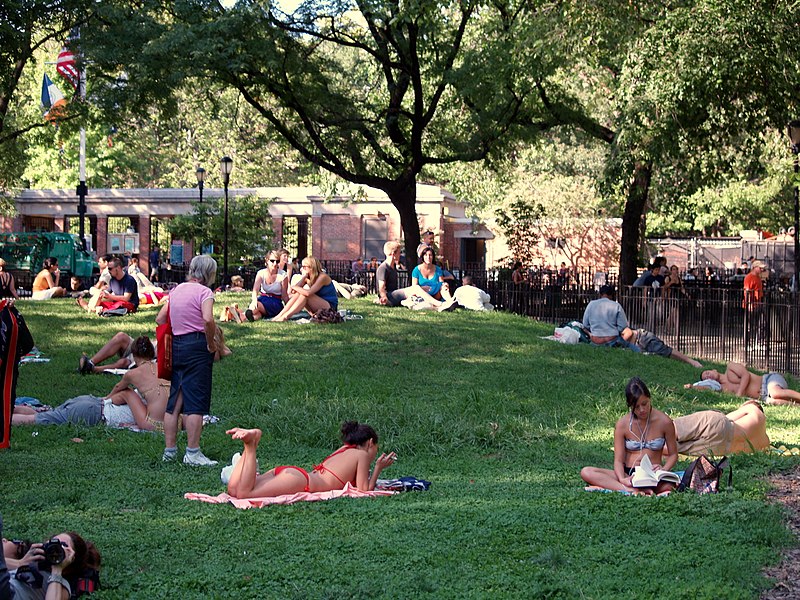
File:Tompkins_Square_Park_Central_Knoll.jpg · Wikimedia Commons · See Wikimedia Commons
leisure
Sign in to saveAlso known as free time
thumb|Public parks were initially set aside for leisure, recreation and [[sport.]] thumb|A man relaxing on a couch thumb|Leisure time swimming at an oasis
Leisure is free time that people use for activities they enjoy, like recreation, sports, or relaxation, rather than work or obligations. It matters because public spaces like parks and natural areas have been specifically created to provide people with opportunities for these leisure activities.
AI-generated from the Wikipedia summary — may contain errors.
Described at

Tempo libero - Enciclopedia - Treccani
Nell'Enciclopedia Treccani troverai tutto quello che devi sapere su Tempo libero. Entra subito su Treccani.it, il portale del sapere.
treccani.it →Vuoi navigare il sito Treccani senza limiti e pubblicità? Scarica l'APP e abbonati ora per accedere su tutti i tuoi dispositivi! La struttura economico-sociale creava però contemporaneamente le condizioni e i mezzi materiali per occupare effettivamente il tempo libero, offrendo una gamma sempre più ampia di scelte. Ma anche altre condizioni, almeno parzialmente indipendenti, hanno reso possibile questa rivoluzione di valori che è qui al centro dell'attenzione. Per cominciare, la decadenza della bimillenaria religione dell'Occidente, che, come abbiamo visto, orientava gli uomini in tutt'altra direzione. Inoltre, lo sviluppo della scienza e dell'istruzione popolare, che non sono state solo componenti del progresso economico-sociale di cui si è detto, ma hanno anche contribuito a generalizzare la conoscenza delle condizioni più favorevoli per la salute, la longevità e l'equilibrio psicofisico e hanno proposto questi ultimi come fini espliciti per le masse. La democrazia medesima, infine, ha fortemente contribuito a questa rivoluzione di valori, facendo dell'uomo la misura della società, affermando l'eguaglianza di tutti e concedendo a tutti una certa misura di potere con il voto; senza la democrazia, milioni di uomini non avrebbero potuto progettare e imporre la loro crescente partecipazione al tempo libero. Prima di passare a esaminare alcuni aspetti di queste connessioni, e soprattutto di quella fondamentale tra tempo libero e struttura socioeconomica e più in generale tra tempo libero e industrialismo, occorre definire meglio il tempo libero. L'opinione comune considera il tempo libero come delimitato dal tempo di lavoro, il quale con il suo carattere di necessità assume un ruolo centrale nella giornata dell'uomo. A una prima riflessione risulta però evidente che la divisione tra tempo di lavoro e tempo libero non è sufficiente; se l'attenzione è rivolta, come accade evidentemente anche nel nostro caso, al tempo effettivamente libero, occorreranno ulteriori distinzioni. E, d'altra parte, se si vuole comprendere la vita di un uomo o d'un gruppo sociale non è possibile considerare astrattamente solo il tempo libero, ma occorre considerarlo nel quadro generale del tempo: occorre avere come riferimento il time budget. Sul primo punto soprattutto si è molto insistito; dal tempo libero dal lavoro (che, in questa accezione amplissima, alcuni propongono di chiamare altrimenti: per esempio, ‛tempo liberato'), occorre sottrarre il tempo che va impiegato per i bisogni fisiologici, e quindi per dormire, mangiare, ecc.; il tempo per la cura della persona e della casa; il tempo per recarsi al lavoro e ritornarne; e forse anche altre, più discutibili frazioni di tempo, come quella per la partecipazione politica. Il tempo che resta così disponibile per scelte effettivamente libere, è il ‛tempo libero' propriamente detto, che forse si potrebbe anche chiamare, come alcuni suggeriscono, con nomi restrittivi come leisure o loisir. Si noti che anche così si è data una definizione eminentemente residuale, si è delimitato uno spazio vuoto da riempire. Da riempire, in teoria, con libere scelte. Non occorre essere particolarmente pessimisti per riconoscere che in realtà queste scelte possono essere assai meno libere di quanto non sembri forse a prima vista. La società può determinare in molti modi queste scelte: con i suoi valori, con la manipolazione consumistica o ideologico-politica, e con altri mezzi ancora. Forse soprattutto per rispondere al senso di insoddisfazione che lo studioso può provare da questo punto di vista, sono state prospettate altre definizioni più stringenti, elencando quelle che sarebbero le caratteristiche ulteriori del leisure. Ciò facendo, quasi tutti gli studiosi moderni sono però finiti nella via senza sbocco delle ‟definizioni del loisir con attributi soggettivi", come ha osservato M.-F. Lanfant, confrontando le proposte di autori diversi come M. Kaplan, Tomoo Sato, J. Dumazedier, A. Touraine e B. Filipcova. In particol
Excerpt from a page describing this subject · 40,000 chars · not written by Vinony
Wikidata facts
- Subclass of
- human behavior
- Has part
- recreation
- Image
- Week-end pleasure.jpg
Show 8 more facts
- topic's main category
- Category:Leisure
- does not have cause
- parenting
- has cause
- reduction of working hours
- Commons category
- Leisure
- described at URL
- www.loisirquebec.com/index.asp?id=983
- on focus list of Wikimedia project
- Wikipedia:Vital articles/Level/4
- opposite of
- work
- studied by
- sociology of leisure
via Wikidata · CC0
~18 min read
Encyclopedic overview
18 sectionsContents
- History
- Canada
- France
- United Kingdom
- Types
- Serious leisure
- Reading
- Casual leisure
- Project-based leisure
- Cultural differences
- Family leisure
- Aging
- See also
- References
- Further reading
- History of leisure
- Historiography
- External links
thumb|Public parks were initially set aside for leisure, recreation and [[sport.]] thumb|A man relaxing on a couch thumb|Leisure time swimming at an oasis
Leisure (, ) has often been defined as a quality of experience or as free time. Free time is time spent away from business, work, job hunting, domestic chores, and education, as well as necessary activities such as eating and sleeping. Leisure as an experience usually emphasizes dimensions of perceived freedom and choice. It is done for "its own sake", for the quality of experience and involvement. Other classic definitions include Thorstein Veblen's (1899) of "nonproductive consumption of time." Free time is not easy to define due to the multiplicity of approaches used to determine its essence. Different disciplines have definitions reflecting their common issues: for example, sociology on social forces and contexts and psychology as mental and emotional states and conditions. From a research perspective, these approaches have an advantage of being quantifiable and comparable over time and place.
Excerpted from Wikipedia’s “leisure” article, available under the CC BY-SA 4.0 licence.
Gallery (15)
Available in 71 languages
- Español
- Français
- Deutsch
- 中文
- 日本語
- Русский
- Português
- Italiano
- العربية
- हिन्दी
- Albanian
- Aragonese
- Armenian
- Asturian
- Azerbaijani
- Bangla
- Basque
- Bulgarian
Show 52 more
- Catalan
- Chuvash
- Croatian
- Czech
- Danish
- eml
- Esperanto
- Estonian
- Filipino
- Finnish
- Friulian
- Galician
- Greek
- Guarani
- Hebrew
- Hungarian
- Icelandic
- Ido
- Kannada
- Kyrgyz
- Latin
- Lithuanian
- Malay
- Mirandese
- Mongolian
- nds_nl
- Nederlands
- Newari
- Norwegian
- Norwegian Nynorsk
- Polski
- Scots
- Serbian
- Serbian (Latin)
- simple
- Slovak
- Svenska
- Tamil
- Tiếng Việt
- Türkçe
- Ukrainian
- Walloon
- Welsh
- Western Frisian
- Wu Chinese
- Yakut
- Yiddish
- zh_min_nan
- zh_yue
- فارسی
- ไทย
- 한국어
via Wikidata sitelinks · CC0