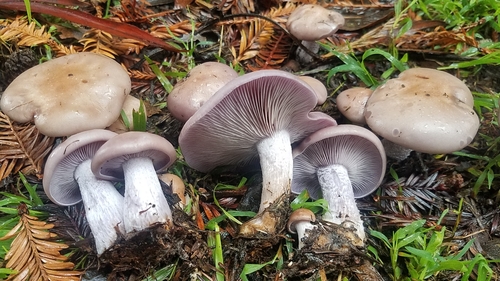
(c) Alan Rockefeller, some rights reserved (CC BY), uploaded by Alan Rockefeller · cc-by
Lepista
Sign in to saveLepista is a genus of mushroom-forming fungi. According to the Dictionary of the Fungi (10th edition, 2008), the widespread genus contains approximately 50 species. In 1969, Howard Bigelow and Alex H. Smith designated the group as subgenus of Clitocybe.
Species
Blewit
species
Die Rötelritterlinge (Lepista) sind meist mittelgroße bis große, fleischige Pilze aus der Ordnung der Champignonartigen, die vor allem im Herbst recht zahlreich erscheinen. Sie stehen vom Habitus her zwischen Ritterlingen und Trichterlingen. Auffällig ist bei ihnen die Bildung von zum Teil recht großen Hexenringen. Sie bilden keine Mykorrhiza.
via
Museum specimens
- Specimen records
- 347
- With media
- 389
- Family
- Tricholomataceae
- Collections
- MICH, F, ECOSUR, DUKE
- Recorded in
- France, India, Costa Rica, Mexico, United States, Ecuador, Czechoslovakia
Wikidata facts
- Instance of
- taxon
- Parent taxon
- Tricholomataceae
- Image
- Lepista flaccida 041024.jpg
Show 6 more facts
- Commons category
- Lepista
- taxon rank
- genus
- taxon name
- Lepista
- Commons gallery
- Lepista
- topic's main category
- Category:Lepista
- homonymous taxon
- Lepista
Sources (2)
via Wikidata · CC0
~2 min read
Encyclopedic overview
5 sectionsContents
- Selected species
- Former species
- See also
- References
- Further reading
Lepista is a genus of mushroom-forming fungi. According to the Dictionary of the Fungi (10th edition, 2008), the widespread genus contains approximately 50 species. In 1969, Howard Bigelow and Alex H. Smith designated the group as subgenus of Clitocybe.
A genetic study conducted in 2015 revealed that the genera Collybia and Lepista were closely related to the core clade of Clitocybe. However, all three genera were found to be polyphyletic, with several members located in lineages distinct from other members within the same genus. Instead, they were more closely related to members of the other two genera. Alvarado and colleagues chose not to define the genera but presented various options and emphasized the necessity for a broader analysis.
Excerpted from Wikipedia’s “Lepista” article, available under the CC BY-SA 4.0 licence.