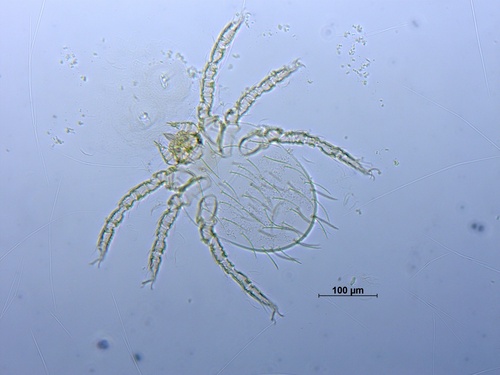
(c) Paisin Lekcharoen, all rights reserved, uploaded by Paisin Lekcharoen
Leptotrombidium
Sign in to saveLeptotrombidium () is a genus of mites in the family Trombiculidae, that are able to infect humans with scrub typhus (Orientia tsutsugamushi infection) through their bite. The larval form (called chiggers) feeds on rodents, but also occasionally humans and other large mammals. They are related to the harvest mites of the North America and Europe.
Species
GENUS
- KingdomAnimalia
- PhylumArthropoda
- ClassArachnida
- OrderTrombidiformes
- FamilyTrombiculidae
via GBIF
Museum specimens
- Specimen records
- 2,110
- With media
- 23
- Family
- Trombiculidae
- Collections
- USNM, OHIO STATE UNIVERSITY ACAROLOGY LABORATORY, COLUMBUS, OH (OSAL), QM
- Recorded in
- Malaysia, Pakistan, Thailand, Mexico, India, Brazil, Vietnam, Netherlands
Wikidata facts
- Instance of
- taxon
- Parent taxon
- Trombiculidae
Show 3 more facts
- taxon name
- Leptotrombidium
- taxon rank
- genus
- taxon author citation
- Nagayo et al.,1916
Sources (1)
via Wikidata · CC0
~3 min read
Encyclopedic overview
3 sectionsContents
- Life history
- Taxonomy
- References
Leptotrombidium () is a genus of mites in the family Trombiculidae, that are able to infect humans with scrub typhus (Orientia tsutsugamushi infection) through their bite. The larval form (called chiggers) feeds on rodents, but also occasionally humans and other large mammals. They are related to the harvest mites of the North America and Europe.
Originally, rodents were thought to be the main reservoir for O. tsutsugamushi and the mites were merely vectors of infection: that is, the mites only transferred the contagion from the rodents to humans. However, the mites are now known to only feed once in their lifetimes, which means that transmission from rodent to human via the mites is impossible (for it to have been possible, the mite would have to feed at least twice, once on the infected rodent and again on the human who would then be infected). Instead, the bacterium persists in the mites through transovarial transmission, where infected mites transmit the infection to their unborn offspring. Leptotrombidium mites are therefore both vector and reservoir for O. tsutsugamushi. The infection predominantly affects female mites, and does not appear to otherwise harm the mites.
Excerpted from Wikipedia’s “Leptotrombidium” article, available under the CC BY-SA 4.0 licence.