Libro de los Epítomes
Sign in to saveAlso known as The Book of Epitomes, Book of the Epitomes
catalogue summarising part of Ferdinand Columbus's library
Described at
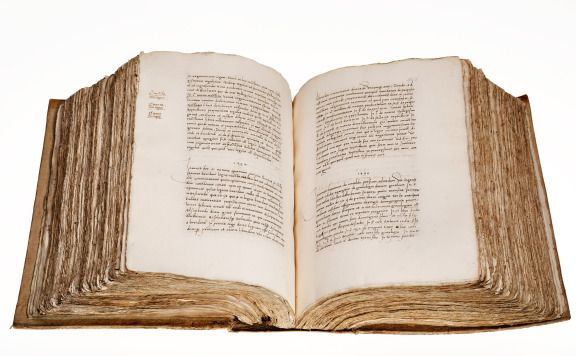
Book of Lost Books Discovered in Danish Archive
The index is part of the Libro de los Epítomes, an effort by Christopher Columbus' illegitimate son to create a searchable index of the world's knowledge
smithsonianmag.com →After Colón’s death in 1539, his massive collection ultimately ended up in the Seville Cathedral, where neglect, sticky-fingered bibliophiles, and the occasional flood reduced the library to just 4,000 volumes over the centuries. Luckily, 14 of the volumes of the Libro de los Epítomes index survived, and are now held at the Biblioteca Colombina in Seville, an institution that manages the collection. Thousands of miles away from Seville, though, one of the lost copies survived, tucked away at the Arnamagnæan Institute at the University of Copenhagan, which houses the vast library of Icelandic scholar Árni Magnússon. Professor Guy Lazure of the University of Windsor in Canada was there when he realized the foot-thick, 2,000-page tome he was looking at may have been one of the lost volumes. Most of the Arnamagnæan Collection houses manuscripts in Icelandic and Scandinavian languages, with only 22 volumes in Spanish or by Spanish authors. That’s why the massive volume was likely overlooked for centuries until Lazure spotted it. Experts later confirmed that it was, indeed, part of Colón’s project. Edward Wilson-Lee of Cambridge University, whose biography of Colón, The Catalogue of Shipwrecked Books , was recently released, calls the find nothing less than extraordinary in an interview with Alison Flood of The Guardian . "It’s a discovery of immense importance, not only because it contains so much information about how people read 500 years ago, but also, because it contains summaries of books that no longer exist, lost in every other form than these summaries,” he says. Unlike other book-obsessed collectors from the time period, Colón wasn’t just interested in volumes from classical authors or other well-trodden texts. Fortunately for present-day scholars, he bought everything he could find in print, including political pamphlets, guidebooks and posters from taverns. How the index came into Magnússon’s collection is unclear. According to the press release, it’s possible that it was part of a group of manuscripts brought to Denmark from Spain via Cornelius Lerche, an envoy to the Spanish court, though for now that’s just speculation. For now, Wilson-Lee says that he and fellow scholar Pérez Fernández are currently working on a comprehensive work about Colón's entire library and plan to collaborate with the Arnamagnæan Institute to digitize the newly discovered volume. Jason Daley is a Madison, Wisconsin-based writer specializing in natural history, science, travel, and the environment. His work has appeared in Discover , Popular Science , Outside , Men’s Journal , and other magazines. 1. In the extension bar, click the AdBlock icon 2. Under "Pause on this site" click "Always" If the prompt is still appearing, please disable any tools or services you are using that block internet ads (e.g. DNS Servers).
Excerpt from a page describing this subject · 8,136 chars · not written by Vinony
Wikidata facts
- Instance of
- manuscript
- Creator
- Ferdinand Columbus
- Collection
- Arnamagnæan Manuscript Collection
- Location
- University of Copenhagen
- Image
- AM 377 fol. 14v.jpg
- Height
- 14
Show 7 more facts
- inception
- 1501-00-00
- inventory number
- AM 377 fol
- described at URL
- www.theguardian.com/books/2019/apr/10/extraordinary-500-year-old-library-catalogue-reveals-books-lost-to-time-libro-de-los-epitomes
- number of pages
- 1964
- title
- Libro de los Epítomes
- language of work or name
- Spanish
- work available at URL
- digitalesamlinger.hum.ku.dk/Home/Samlingerne/25258
via Wikidata · CC0