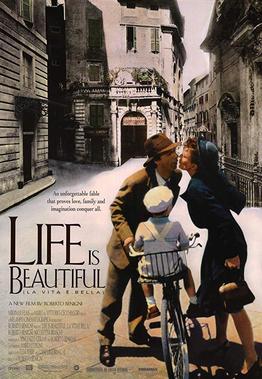
File:Vitaebella.jpg · Wikimedia Commons · See Wikimedia Commons
Life is Beautiful
Sign in to saveAlso known as La vita è bella, La vita e bella
1997 film by Roberto Benigni
OverviewAI-generated
*Life is Beautiful* (Italian: *La vita è bella*) is a 1997 Italian comedy-drama film directed by Roberto Benigni. The screenplay was written by Benigni and Vincenzo Cerami, with production handled by Gianluigi Braschi and Elda Ferri. The cast includes Benigni, Nicoletta Braschi, Giorgio Cantarini, and Giustino Durano. The film’s main subjects are the Holocaust, Italian Fascism, fantasy, and love. It was filmed in Rome and produced by Miramax, Mario e Vittorio Cecchi Gori - C.E.I.A.D., and Melampo Cinematografica.
The film has a runtime of 116 minutes and was released on December 20, 1997. It features music by Nicola Piovani, cinematography by Tonino Delli Colli, and editing by Simona Paggi. Danilo Donati served as both costume designer and production designer. The film received the David di Donatello for Best Film, the Cannes Film Festival Grand Prix, the César Award for Best Foreign Film, and the Academy Award for Best Actor. It was also nominated for the Academy Awards for Best Director, Best Film Editing, and Best Writing, Original Screenplay.
Synthesized by Vinony from 40 facts across 4 sources: Wikidata, TMDb, IMDb, Vinony graph. Generated from structured data (not the Wikipedia text) and checked against those facts — may still contain errors.
Film · TMDB
8.4A touching story of an Italian book seller of Jewish ancestry who lives in his own little fairy tale. His creative and happy life would come to an abrupt halt when his entire family is deported to a concentration camp during World War II. While locked up he tries to convince his son that the whole thing is just a game.
Cast
- Roberto Benigni as Guido
- Nicoletta Braschi as Dora
- Giorgio Cantarini as Giosué
- Giustino Durano as Zio
- Sergio Bini Bustric as Ferruccio
- Marisa Paredes as Dora's Mother
Themes
- dying and death
- bookshop
- love of one's life
- nazi
- self sacrifice
- loss of loved one
- italy
- riddle
- mass murder
- concentration camp
This product uses the TMDB API but is not endorsed or certified by TMDB.
Wikidata facts
- Instance of
- film
- Participant in
- 11th European Film Awards
- Genre
- drama film
- Country of origin
- Italy
- Original language
- German
- Main subject
- Italian Fascism
- Director
- Roberto Benigni
- Screenwriter
- Vincenzo Cerami
- Composer
- Nicola Piovani
- Producer
- Elda Ferri
- Production company
- Miramax
- Cinematographer
- Tonino Delli Colli
- Narrative location
- Arezzo
- Filming location
- Rome
- Duration
- 116
- FilmAffinity ID
- 594480
- Distribution format
- video on demand
- Official website
- www.miramax.com/movie/life-is-beautiful-la-vita-e-bella
Show 13 more facts
- publication date
- 1999-01-22
- film editor
- Simona Paggi
- title
- La vita è bella
- costume designer
- Danilo Donati
- production designer
- Danilo Donati
- distributed by
- Disney+
- executive producer
- Vittorio Cecchi Gori
- set in period
- 1945
- box office
- 57563264
- review score
- 8.6/10
- characters
- Victor Emmanuel III of Italy
- capital cost
- 19000000
- Commons category
- La vita è bella
Sources (15)
via Wikidata · CC0
~18 min read
Encyclopedic overview
Life Is Beautiful (Italian: La vita è bella, pronounced [la ˈviːta ˌɛ bˈbɛlla]) is a 1997 Italian period comedy-drama film directed by and starring Roberto Benigni, who co-wrote the film with Vincenzo Cerami. Benigni plays Guido Orefice, a Jewish Italian bookshop owner, who employs his imagination to shield his son from the horrors of internment in a Nazi concentration camp. The film was partially inspired by the book In the End, I Beat Hitler by Rubino Romeo Salmonì and by Benigni's father, who spent two years in the Bergen-Belsen concentration camp during World War II.
The film was an overwhelming critical and commercial success. Despite some criticisms of using the subject matter for comedic purposes, it received widespread acclaim, with critics praising its story, performances and direction, and the union of drama and comedy. The movie grossed over $230 million worldwide, including $57.6 million in the United States, is the second-highest-grossing foreign-language film in the U.S. (after Crouching Tiger, Hidden Dragon) and one of the highest-grossing non-English-language movies of all time. The National Board of Review included it in the top five best foreign films of 1998.
Excerpted from Wikipedia’s “Life is Beautiful” article, available under the CC BY-SA 4.0 licence.
Gallery (11)
Available in 72 languages
- Español
- Français
- Deutsch
- 中文
- 日本語
- Русский
- Português
- Italiano
- العربية
- Albanian
- Armenian
- Asturian
- azb
- Azerbaijani
- Bahasa Indonesia
- Bangla
- Basque
- Belarusian
Show 53 more
- Bosnian
- Bulgarian
- Catalan
- Central Kurdish
- Croatian
- Czech
- Danish
- Egyptian Arabic
- Esperanto
- Finnish
- Galician
- Georgian
- Greek
- Haitian Creole
- Hebrew
- Hungarian
- Kazakh
- Kurdish
- Kyrgyz
- Latin
- Latvian
- Lithuanian
- Macedonian
- Malayalam
- Mingrelian
- Nederlands
- Nepali
- Norwegian
- Polski
- Punjabi
- Quechua
- Romanian
- Serbian
- Serbian (Latin)
- Sicilian
- simple
- Slovak
- Slovenian
- Svenska
- Tamil
- Tiếng Việt
- Türkçe
- Ukrainian
- Urdu
- Uzbek
- Western Panjabi
- Wu Chinese
- Zaza
- zh_yue
- Zhuang
- فارسی
- ไทย
- 한국어
via Wikidata sitelinks · CC0