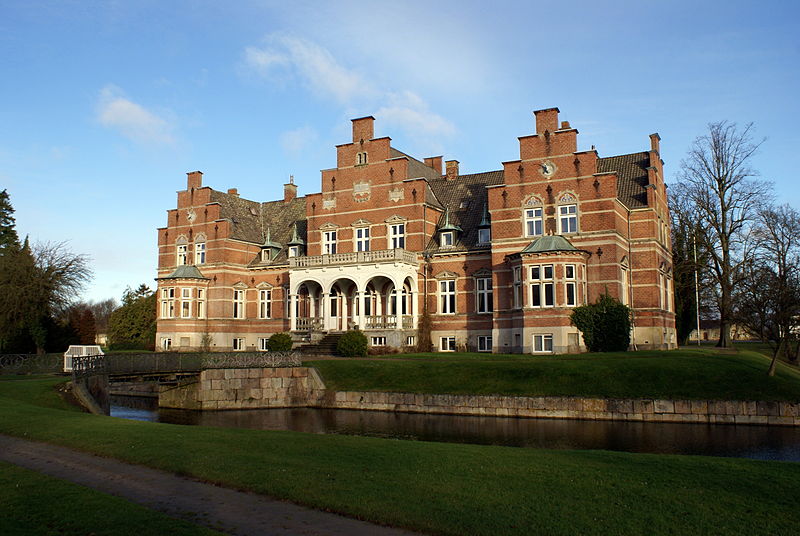
File:Fuglsang_2008.jpg · Wikimedia Commons · See Wikimedia Commons
Lolland
Sign in to saveLolland (; formerly spelled Laaland, literally "low land") is the fourth largest island of Denmark, with an area of . Located in the Kattegat, Belts and Sund area, it is part of Region Sjælland (Region Zealand). As of 1 January 2022, it has 57,618 inhabitants. Lolland is closely connected to the island of Falster to its east. The locality of Sundby forms a cross-island urban area with Nykøbing Falster, the largest conurbation partially on Lolland. The most populated settlement on Lolland proper is Nakskov.
Lolland is Denmark's fourth-largest island, located in the southeastern part of the country with about 57,600 residents, and is closely linked to the neighboring island of Falster through shared urban areas. The island is notable as part of the greater Copenhagen region and serves as an important population and economic center in southeastern Denmark.
AI-generated from the Wikipedia summary — may contain errors.
Key facts
- Islands.name
- Lolland
- Islands.image_name
- Fuglsang 2008.jpg
- Islands.image_caption
- Fuglsang Manor, now a major cultural centre on the island
- Islands.map_image
- Location map Lolland.svg
- Islands.location
- Kattegat, Belts and Sund
- Islands.area_km2
- 1243
- Islands.country
- Denmark
- Islands.country_admin_divisions_title
- Region
- Islands.country_admin_divisions
- Region Zealand
- Islands.country_admin_divisions_title_1
- Municipality
- Islands.country_admin_divisions_1
- Lolland Municipality, Guldborgsund Municipality
- Islands.country_largest_city
- Nakskov
- Islands.country_largest_city_population
- 12,661 (2018)
- Islands.population
- 57,618
- Islands.population_as_of
- 2022
- Islands.density_km2
- 46.35
via Wikipedia infobox
Wikidata facts
- Instance of
- island
- Demonym
- lollik
- Country
- Denmark
- Located in
- Guldborgsund Municipality
- Population
- 59456
- Area
- 1242.86
- Image
- Case IH tractor with Hardi field sprayer, Lolland.jpg
- Width
- 20
- Length
- 58
Show 4 more facts
- native label
- Lolland
- Commons category
- Lolland
- topic's main category
- Category:Lolland
- category of associated people
- Category:People from Lolland
Sources (3)
via Wikidata · CC0
~5 min read
Encyclopedic overview
8 sectionsContents
- Overview
- Transport
- Demography
- Towns and villages
- Attractions
- See also
- References
- External links
Lolland (; formerly spelled Laaland, literally "low land") is the fourth largest island of Denmark, with an area of . Located in the Kattegat, Belts and Sund area, it is part of Region Sjælland (Region Zealand). As of 1 January 2022, it has 57,618 inhabitants. Lolland is closely connected to the island of Falster to its east. The locality of Sundby forms a cross-island urban area with Nykøbing Falster, the largest conurbation partially on Lolland. The most populated settlement on Lolland proper is Nakskov.
==Overview== Lolland is also known as the "pancake island" because of its flatness: the highest point of the entire island is above sea level, just outside the village of Horslunde. The island has been an important communication highway, among others for Nazi Germany during World War II. Historically, sugar beet has been grown in Lolland. Sugar is still a major industry, visible from the large number of sugar beet fields.
Excerpted from Wikipedia’s “Lolland” article, available under the CC BY-SA 4.0 licence.
Gallery (4)
On the map
2 mapped locations
Available in 57 languages
- Español
- Français
- Deutsch
- 中文
- 日本語
- Русский
- Português
- Italiano
- العربية
- Armenian
- Bahasa Indonesia
- Basque
- Belarusian
- Bosnian
- Breton
- Bulgarian
- Catalan
- Cebuano
Show 38 more
- Croatian
- Czech
- Danish
- Esperanto
- Estonian
- Finnish
- Galician
- Georgian
- Greek
- Hebrew
- Hungarian
- Icelandic
- Interlingue
- Latin
- Latvian
- Lithuanian
- Lombard
- Macedonian
- Malagasy
- Nederlands
- Northern Frisian
- Norwegian
- Norwegian Nynorsk
- Old English
- Ossetic
- Polski
- Romanian
- Serbian
- Serbian (Latin)
- simple
- Svenska
- Tiếng Việt
- Türkçe
- Ukrainian
- Welsh
- Western Frisian
- فارسی
- 한국어
via Wikidata sitelinks · CC0