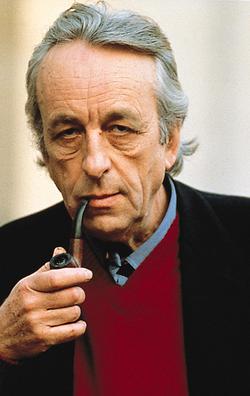
File:Althusser.jpg · Wikimedia Commons · See Wikimedia Commons
Louis Althusser
Sign in to saveAlso known as Althusser, Louis Pierre Althusser
French Marxist philosopher (1918–1990)
OverviewAI-generated
Louis Althusser was a French philosopher, politician, university teacher, and editor. He was a member of the French Communist Party and worked within the fields of political philosophy, epistemology, metaphysics, and philosophy of science. His intellectual approach was associated with Marxism, structuralism, and structural Marxism. He was influenced by Karl Marx, Vladimir Lenin, Antonio Gramsci, and Claude Lévi-Strauss.
Althusser was born on 16 October 1918 in Bir Mourad Rais and educated at the lycée du Parc and École Normale Supérieure. He studied under Jean Guitton and Jean Hyppolite. Among his students were Michel Foucault, Bernard-Henri Lévy, and Marta Harnecker. He authored numerous works, including *Lenin y la filosofía*, *Être marxiste en philosophie*, and *Pour Marx*.
He died of myocardial infarction, classified as natural causes, on 22 October 1990 in Paris, La Verrière. He spoke and wrote in French.
Synthesized by Vinony from 27 facts across 2 sources: Wikidata, Open Library. Generated from structured data (not the Wikipedia text) and checked against those facts — may still contain errors.
Person · Open Library
- Born
- 16 October 1918
- Died
- 22 October 1990
- Works
- 107
Top works
- בשביל מרקס
- 自我批評論文集
- Lenin y la filosofía
- Être marxiste en philosophie
- Sur Althusser passages
via Open Library + Wikidata
Wikidata facts
- Instance of
- human
- Given name
- Pierre
- Gender
- male
- Citizenship
- France
- Place of birth
- Bir Mourad Rais
- Place of death
- La Verrière
- Spouse
- Hélène Rytmann
- Occupation
- editor
- Educated at
- lycée du Parc
- Employer
- École Normale Supérieure
- Political party
- French Communist Party
- Languages spoken
- French
- Native language
- French
- Student of
- Jean Hyppolite
- Doctoral student
- Mileva Filipović
- Field of work
- philosophy of science
- Movement
- structural Marxism
- Conflict
- World War II
- Image
- Louis Althusser sketch (8420987781) (cropped).jpg
Show 10 more facts
- cause of death
- myocardial infarction
- date of birth
- 1918-10-16
- date of death
- 1990-10-22
- influenced by
- Georges Canguilhem
- described by source
- Pax Leksikon
- manner of death
- natural causes
- Commons category
- Louis Althusser
- name in native language
- Louis Althusser
- student
- Marta Harnecker
- birth name
- Louis Pierre Althusser
via Wikidata · CC0
~40 min read
Encyclopedic overview
Louis Pierre Althusser ( UK: /ˌæltʊˈsɛər/, US: /ˌɑːltuːˈsɛər/; French: [altysɛʁ]; 16 October 1918 – 22 October 1990) was a French Marxist philosopher who studied at the École Normale Supérieure in Paris, where he eventually became professor of philosophy. Althusser's life was marked by periods of intense mental illness. In 1980, he killed his wife, the sociologist Hélène Rytmann, by strangling her. He was declared unfit to stand trial due to insanity and committed to a psychiatric hospital for three years. He did little further academic work, dying in 1990.
Althusser was a long-time member and sometimes a strong critic of the French Communist Party. His arguments and theses were set against the threats that he saw attacking the theoretical foundations of Marxism. These included both the influence of empiricism on Marxist theory, and humanist and reformist orientations which manifested as divisions in the European communist parties, as well as the problem of the cult of personality and of ideology. Althusser is commonly referred to as a structural Marxist, although his relationship to other schools of French structuralism is not a simple affiliation and he was critical of many aspects of structuralism. He later described himself as a social anarchist.
Excerpted from Wikipedia’s “Louis Althusser” article, available under the CC BY-SA 4.0 licence.
Gallery (6)
Available in 65 languages
- Español
- Français
- Deutsch
- 中文
- 日本語
- Русский
- Português
- Italiano
- العربية
- हिन्दी
- Afrikaans
- Armenian
- Azerbaijani
- Bahasa Indonesia
- Bangla
- Basque
- Bulgarian
- Catalan
Show 46 more
- Croatian
- Czech
- Danish
- Egyptian Arabic
- Esperanto
- Estonian
- Finnish
- Galician
- Greek
- Hebrew
- Hungarian
- Ido
- Interlingua
- Irish
- Javanese
- Kazakh
- Kyrgyz
- Latin
- Latvian
- Malayalam
- Nederlands
- Norwegian
- Occitan
- Pashto
- Polski
- Punjabi
- Romanian
- Scots
- Serbian
- Serbian (Latin)
- simple
- Slovak
- Slovenian
- Svenska
- Swahili
- Tamil
- Tatar
- Tiếng Việt
- Türkçe
- Ukrainian
- Urdu
- Welsh
- Western Panjabi
- Wu Chinese
- فارسی
- 한국어
via Wikidata sitelinks · CC0