LRGB
Sign in to saveAlso known as Luminance, Red, Green and Blue
thumb|LRGB Photo of the Eagle Nebula. LRGB, short for Luminance, Red, Green and Blue, is a photographic technique used in amateur astronomy for producing good quality color photographs by combining a high-quality black-and-white image with a lower-quality color image.thumb|left|Deep View of the Large and Small Magellanic Clouds captured using the LRGB method.In astrophotography, it is easier and cheaper to obtain good quality, high signal-to-noise ratio images in black and white. The LRGB method is used to work around this to get good color images. The color (chrominance) information from the
Described at
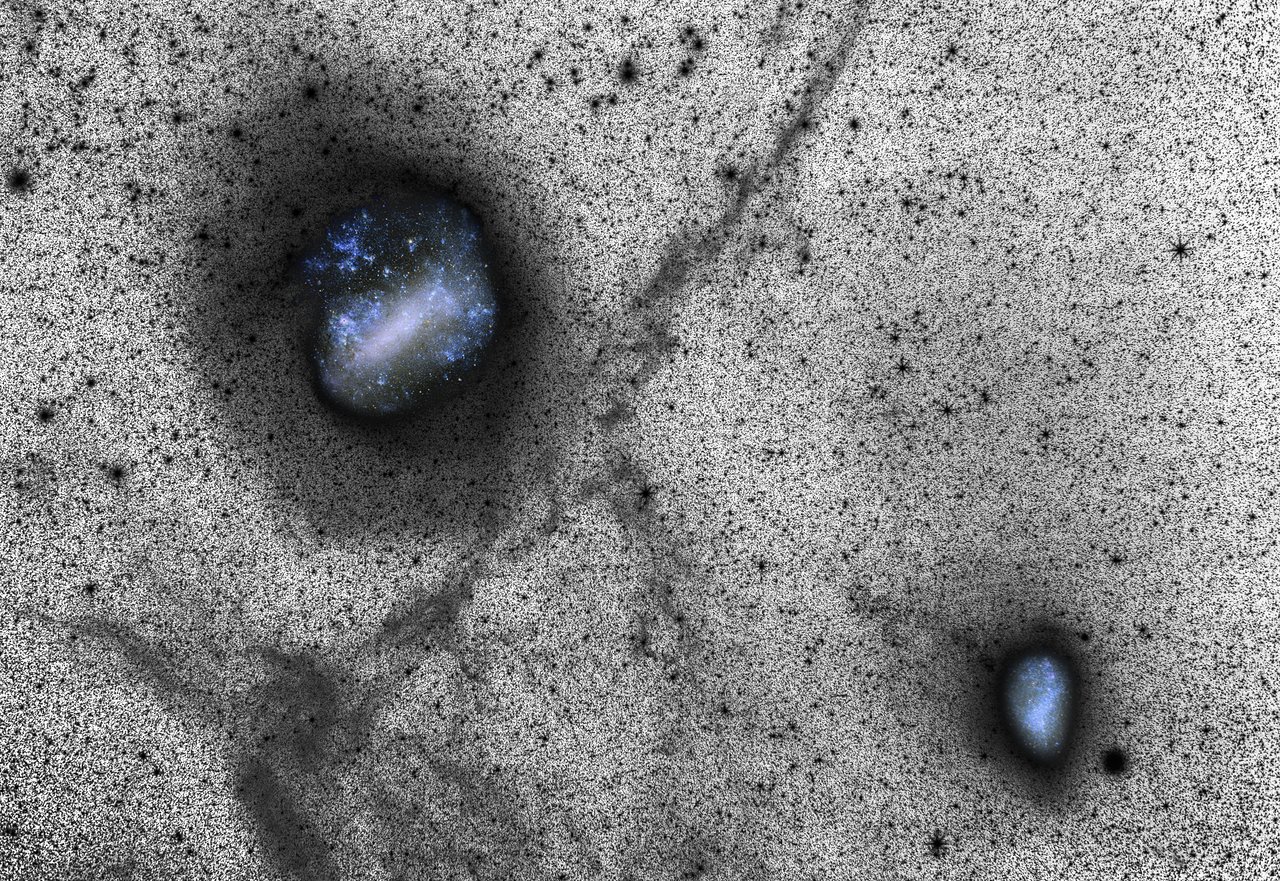
Deep view of the Large and Small Magellanic Clouds | ESO
Image Archive, ESO, European Organisation for Astronomical Research in the Southern Hemisphere
eso.org →This deep image was captured using the LRGB method , and provides an insight into the actual process of creating spectacular astrophotography . Many challenges face those attempting to photograph the night sky, including interference from light sources other than the object being photographed, and capturing objects in sufficient depth. Trying to maximise the signal received from the target, whilst minimising input from other sources — known as noise — is a crucial aspect of astrophotography. The optimisation of the signal to noise ratio is far more easily achieved in black-and-white than in colour. Therefore a clever trick often employed to capture a high-quality image is the use of a luminance exposure, which produces richly detailed monochrome images like the one seen here. Colour details from images taken through colour filters can then be overlaid or inset, as the Magellanic Clouds have been here. On behalf of ESO, Matomo will use this information for the purpose of evaluating your use of the website, compiling reports on website activity and providing other services relating to website activity and internet usage. Stores attribution information (the referrer that brought the visitor to the website). As ESO public webpages are managed by our Department of Communication, your questions will be dealt with the support of the said Department.
Excerpt from a page describing this subject · 13,455 chars · not written by Vinony
Wikidata facts
- Instance of
- technology
- Part of
- photography
- Image
- Eagle Nebula M16 LRGB Composite.jpg
Show 1 more fact
- described at URL
- www.eso.org/public/images/potw1630a
via Wikidata · CC0
~1 min read
Encyclopedic overview
2 sectionsContents
- See also
- References
thumb|LRGB Photo of the Eagle Nebula. LRGB, short for Luminance, Red, Green and Blue, is a photographic technique used in amateur astronomy for producing good quality color photographs by combining a high-quality black-and-white image with a lower-quality color image.thumb|left|Deep View of the Large and Small Magellanic Clouds captured using the LRGB method.In astrophotography, it is easier and cheaper to obtain good quality, high signal-to-noise ratio images in black and white. The LRGB method is used to work around this to get good color images. The color (chrominance) information from the color image is combined with the overall brightness from the black-and-white image.
The theory behind the effectiveness behind LRGB techniques has been related to the working of human color vision. The rod cells in human eyes are sensitive to luminance and spatial data, while the cone cells are sensitive to color. There are three types of cones: those sensitive to red, those sensitive to green, and those sensitive to blue. Thus, each element of LRGB targets one type of photoreceptor cell in the human eye.
Excerpted from Wikipedia’s “LRGB” article, available under the CC BY-SA 4.0 licence.