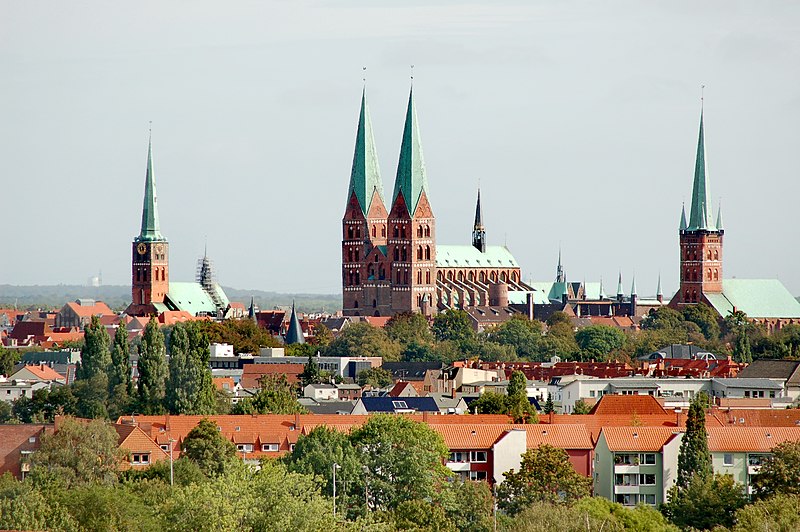
File:Lübeck_-_panoramio.jpg · Wikimedia Commons · See Wikimedia Commons
Lübeck
Sign in to saveAlso known as Hanseatic City of Lübeck, Lubeck, Lybeck, Kreisfreie Stadt Lübeck
Lübeck (; or ; Latin: ), officially the Hanseatic City of Lübeck (), is a city in Northern Germany. With around 220,000 inhabitants, it is the second-largest city on the German Baltic coast and the second-largest city in the state of Schleswig-Holstein, after its capital of Kiel. It is the 36th-largest city in Germany.
Lübeck is a city in northern Germany with around 220,000 residents, making it the second-largest city on the German Baltic coast and the second-largest in the state of Schleswig-Holstein. It ranks as the 36th-largest city in all of Germany.
AI-generated from the Wikipedia summary — may contain errors.
Key facts
- German place.name
- Lübeck
- German place.type
- City
- German place.image_coa
- DEU Luebeck COA.svg
- German place.image_flag
- Flagge Luebeck.svg
- German place.state
- Schleswig-Holstein
- German place.district
- Urban district
- German place.elevation
- 13
- German place.area
- 214.13
- German place.postal_code
- 23501−23570
- German place.area_code
- 0451, 04502
- German place.licence
- HL
- German place.Gemeindeschlüssel
- 01 0 03 000
- German place.divisions
- 35
- German place.mayor
- Jan Lindenau
- German place.party
- SPD
- German place.ruling_party1
- SPD
- German place.ruling_party2
- CDU
- UNESCO World Heritage Site.Name
- Hanseatic City of Lübeck
via Wikipedia infobox
Official website

Lübeck.de – Offizielles Stadtportal für die Hansestadt Lübeck
luebeck.de →Link to the official site · 14,555 chars · not written by Vinony
Wikidata facts
- Official name
- Lübeck
- Demonym
- Lübecker
- Country
- Holy Roman Empire
- Located in
- Bouches-de-l'Elbe
- Population
- 219044
- Area
- 214.19
- Elevation
- 13
- Time zone
- UTC+02:00
- Body of water
- Wakenitz
- Shares border with
- Ratekau
- Official website
- www.luebeck.de
- Image
- Holstentor in Lübeck Frontseite - Zuschnitt.jpg
- Dialing code
- 451
- Licence plate code
- HL
- Coat of arms
- coat of arms of Lübeck
Show 19 more facts
- twinned administrative body
- Kotka
- Commons gallery
- Lübeck
- postal code
- 23552–23570
- Commons category
- Lübeck
- topic's main category
- Category:Lübeck
- category for people born here
- Category:People from Lübeck
- category for people who died here
- Category:Deaths in Lübeck
- category of associated people
- Category:People of Lübeck
- located in/on physical feature
- North German Plain
- P6482
- Lübeck
- short name
- Lue
- vehicles per thousand people
- 401
- native label
- Lübeck
- owner of
- Stadion an der Lohmühle
- P8168
- Corona Australis
- P11012
- Hydropsyche brevis
- P12749
- 361
- hashtag
- Lübeck
Sources (11)
via Wikidata · CC0
~32 min read
Encyclopedic overview
36 sectionsContents
- History
- Hanseatic city
- Decline
- From the Napoleonic wars to the Franco-Prussian war
- 20th century
- Climate
- Notes
- Population
- Politics
- Culture
- Tourism
- Buildings
- Music, literature and the arts
- Museums
- Food and drink
- Sports
- Education
- Districts
- International relations
- Twin towns – sister cities
- Friendly cities
- Transport
- Notable people
- Religion
- Politics
- Art
- Music
- Science
- Writing
- Sport
- Other
- See also
- References
- Citations
- General and cited references
- External links
Lübeck (; or ; Latin: ), officially the Hanseatic City of Lübeck (), is a city in Northern Germany. With around 220,000 inhabitants, it is the second-largest city on the German Baltic coast and the second-largest city in the state of Schleswig-Holstein, after its capital of Kiel. It is the 36th-largest city in Germany.
The city lies in the Holsatian part of Schleswig-Holstein, on the mouth of the Trave, which flows into the Bay of Lübeck in the borough of Travemünde, and on the Trave's tributary Wakenitz. The island with the historic old town and the districts north of the Trave are also located in the historical region of Wagria. Lübeck is the southwesternmost city on the Baltic Sea, and the closest point of access to the Baltic from Hamburg. The city lies in the Holsatian dialect area of Low German.
Excerpted from Wikipedia’s “Lübeck” article, available under the CC BY-SA 4.0 licence.
Gallery (53)
On the map
3 mapped locations
Available in 117 languages
- Español
- Français
- Deutsch
- 中文
- 日本語
- Русский
- Português
- Italiano
- العربية
- Afrikaans
- Akan
- Albanian
- Aragonese
- Aramaic
- Armenian
- Asturian
- azb
- Azerbaijani
Show 98 more
- Bahasa Indonesia
- Balinese
- Basque
- Bavarian
- be_x_old
- Belarusian
- Bosnian
- Breton
- Bulgarian
- Burmese
- Catalan
- Cebuano
- Central Kurdish
- Chechen
- Chuvash
- Corsican
- Croatian
- Czech
- Danish
- Egyptian Arabic
- Esperanto
- Estonian
- Extremaduran
- Finnish
- Galician
- Georgian
- Greek
- Hausa
- Hebrew
- Hungarian
- Icelandic
- Ido
- Interlingua
- Interlingue
- Irish
- Javanese
- Kashubian
- Kotava
- Kurdish
- Kyrgyz
- Latin
- Latvian
- Limburgish
- Lithuanian
- lld
- Lombard
- Low German
- Lower Sorbian
- Luxembourgish
- Macedonian
- Malagasy
- Maltese
- Marathi
- Mingrelian
- nds_nl
- Nederlands
- Northern Frisian
- Norwegian
- Norwegian Nynorsk
- Occitan
- Old English
- Ossetic
- Piedmontese
- Polski
- Romanian
- Saterland Frisian
- Scottish Gaelic
- Serbian
- Serbian (Latin)
- Silesian
- simple
- Slovak
- Slovenian
- Svenska
- Swahili
- Tatar
- Tiếng Việt
- Tumbuka
- Türkçe
- Ukrainian
- Upper Sorbian
- Urdu
- Uzbek
- Venetian
- Volapük
- Waray
- Welsh
- West Flemish
- Western Frisian
- Western Panjabi
- Wu Chinese
- Zaza
- Zeelandic
- zh_min_nan
- zh_yue
- فارسی
- ไทย
- 한국어
via Wikidata sitelinks · CC0