
File:Count_von_Waldstein.jpg · Wikimedia Commons · See Wikimedia Commons
Ludwig van Beethoven
Sign in to saveAlso known as L. van Beethoven, Ludvig van Beethoven, L. Bethovenas, Ludwik van Beethoven, Louis van Beethoven, L. v. Beethoven, L. van Betkhoven, Ludwig von Beethoven
German composer (1770-1827)
OverviewAI-generated
Ludwig van Beethoven was a German-Austrian composer, pianist, conductor, and music educator. Born in Bonn, he worked in Bonn, Vienna, Mödling, and Baden. His notable works include Für Elise, Symphony No. 9, Piano Sonata No. 14, and Missa Solemnis. He was associated with the Classical period and Romantic music movements.
Beethoven studied under Christian Gottlob Neefe, Joseph Haydn, Antonio Salieri, and Johann Baptist Schenk. He was influenced by Johann Joseph Fux, Johann Sebastian Bach, Joseph Haydn, and Wolfgang Amadeus Mozart. His students included Carl Czerny, Dorothea von Ertmann, Ferdinand Ries, and Archduke Rudolf of Austria. He played the piano and violin.
He suffered from liver cirrhosis, iron overload, syphilis, and alcoholic hepatitis. Beethoven died in Vienna in 1827. His archives are held at the Beethoven House, Berlin State Library, and University Library Johann Christian Senckenberg. He is described in sources such as the Brockhaus and Efron Encyclopedic Dictionary and the Encyclopædia Britannica 11th edition.
Synthesized by Vinony from 48 facts across 7 sources: Wikidata, Last.fm, TMDb, MusicBrainz, Open Library, Europeana Sparql, VIAF. Generated from structured data (not the Wikipedia text) and checked against those facts — may still contain errors.
Person · Open Library
- Born
- 1770
- Died
- 1827
- Works
- 1202
Top works
- Ouverture d'Egmont
- Heiligenstädter Testament
- Briefe
- Beethoven-Studien
- פסטיבל המילניום
via Open Library + Wikidata
Film & TV
Bonn, Germany
Ludwig van Beethoven was a German composer. As a crucial figure in the transition between the Classical and Romantic eras in Western art music, he remains one of the most famous and influential of all composers. By his late 20s his hearing began to deteriorate, and by the last decade of his life he was almost totally deaf. In 1811 he gave up conducting and performing in public but continued to…
Known for
- Beethoven Piano Concerto No. 1 with Sir András Schiff2023
- Prelúdio — Self (archive footage)2022
- Ludwig van Beethoven - Fidelio — Self - Composer2004
- Eroica — Composer1972
via TMDB
Music · MusicBrainz
- Type
- Person
- Gender
- Male
- Origin
- Germany
- Active from
- 1770
- Active to
- 1827
Discography
- Chorus of Dervishes1918
- Kreutzer Sonata1918
- Missa solemnis, op. 1231928
- Piano Concerto no. 5 in E‐flat “Emperor”1941
- Leonore Overture in C major1945
- Overture to Prometheus / Fêtes1945
- Beethoven: Symphony no. 9 in D minor, op. 125 (“Choral”) / Brahms: Song of Destiny, op. 54 (Schicksalslied)1949
- Fidelio1950
- Symphony no. 3 in E flat major, op. 55 "Eroica"1950
- Symphony no. 71950
via MusicBrainz · CC0
Listeners · Last.fm
- Listeners
- 2,747,306
- Total plays
- 57,040,919
Tags
Similar artists
Ludwig van Beethoven (baptised 17 December 1770 – 26 March 1827) was a German composer and pianist. He is regarded as a central figure in the history of Western art music, and his works are among the most frequently performed in the classical repertoire. His career spans the transition from the Classical period to the Romantic era. Beethoven’s early period, generally dated to about 1802, reflects his development within established Classical forms. <a href="https://www.last.fm/music/Ludwig+van+Beethoven">Read more on Last.fm</a>
Authority record · VIAF
- Lifespan
- 1770–1827
- Nationality
- DE, AT, DEU, AUT
- Role / Field
- Pianists, Composers, Pianistas, Pianist, Compositores, Music
- Language
- ger, zxx, deu
- Gender
- Male
Recorded by 46 libraries
via VIAF · OCLC
Wikidata facts
- Instance of
- human
- Given name
- Ludwig
- Gender
- male
- Citizenship
- Austrian Empire
- Place of birth
- Bonn
- Place of death
- Vienna
- Father
- Johann van Beethoven
- Occupation
- writer
- Languages spoken
- German
- Native language
- German
- Religion
- Catholicism
- Notable work
- Fidelio
- Participant in
- Beethoven concert of 22 December 1808
- Student of
- Muzio Clementi
- Genre
- sonata
- Movement
- Romantic music
- Instrument
- violin
- Official website
- beethoven.de
- Image
- Beethoven.jpg
- Number of children
- 0
- Work location
- Baden
- Residence
- Beethoven House
Show 28 more facts
- Significant event
- death of Ludwig van Beethoven
- date of baptism
- 1770-12-17
- medical condition
- epilepsy
- Commons category
- Ludwig van Beethoven
- date of death
- 1827-01-01
- topic's main category
- Category:Ludwig van Beethoven
- Commons Creator page
- Ludwig van Beethoven
- Commons gallery
- Ludwig van Beethoven
- influenced by
- Wolfgang Amadeus Mozart
- name in native language
- Ludwig van Beethoven
- start of work period
- 1782-00-00
- end of work period
- 1827-00-00
- date of birth
- 1770-01-01
- writing language
- German
- cause of death
- liver cirrhosis
- related category
- Category:Compositions by Ludwig van Beethoven
- last words
- Schade, schade, zu spät!
- social media followers
- 208000
- relative
- Karl van Beethoven
- topic has template
- Template:Ludwig van Beethoven
- manner of death
- natural causes
- ethnic group
- Flemish people
- different from
- Beethoven
- depicted by
- Portrait of Beethoven
- P12749
- Monte Carasso
- name
- Bối Đa Phần
Sources (15)
via Wikidata · CC0
Works in European collections
36 objects attributed to Ludwig van Beethoven, held across European museums, libraries & archives · via Europeana
Symphonie in C Dur [Música notada]
L. van Beethoven's Quartetten für zwei Violinen, Viola u. Violoncello [Música notada]
L. van Beethoven's Quartetten für zwei Violinen, Viola u. Violoncello [Música notada]
[L. van Beethoven's Quartetten für zwei Violinen, Viola u. Violoncello] [Música notada]
L. van Beethoven's sämmtliche Trios für Violin, Viola, Violoncello, Flöt, Violin, Viola, zwei Hoboen u englisch Horn [Música notada]
L. van Beethoven's Quintteten für 2 Violinen, 2 Bratschen u. Violoncell, op. 4 u 29 [Música notada] ;]Septett für Violine, Bratsche, Horn, Clarinette, Fagott, Violoncell u. Contrabass, op. 20 ; Sextett für 2 Violinen, Bratsche, Violoncell u. 2 Horns obligat, op. 81
Sonates pour piano seul [Música notada]
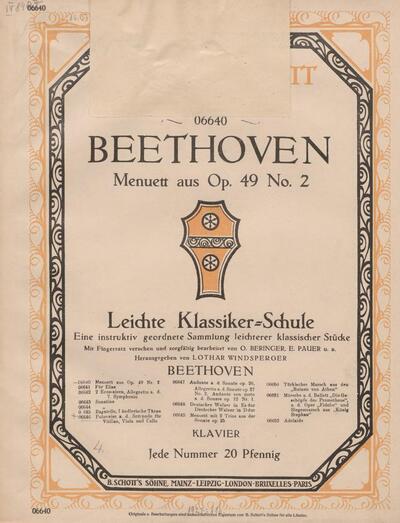
Menuett aus Op. 49 No 2

Kleines Trio für Pianoforte, Violine und Violoncell: b

Marsch aus der Oper: Fidelio
Kleines Trio für Pianoforte, Violine und Violoncell: a
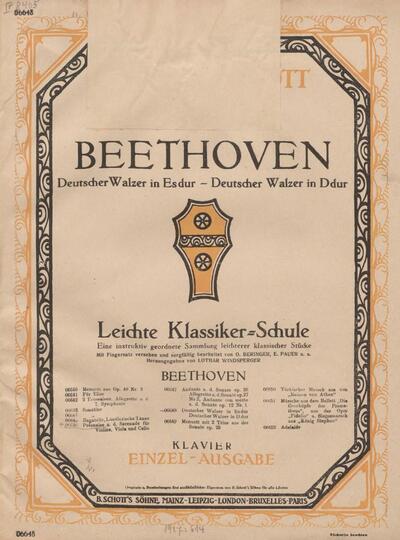
Deutscher Walzer in Es major - Deutscher Walzer in D major

Sonatine: Klavier
Studi ossia Trattato di armonia e di composizione [Música notada]
Grande sonate pathetique pour le piano, œuvre 13 [Música notada]
Méditation et Ave María [Música notada] : sur la célèbre adagio de la sonate en UT muneur de L. V. Beethoven
Andante varié de la sonate à Kreutzer de Beetoven [Música notada]
Allegretto scherzando de la 8ª sinfonía en fa mayor, op. 93 [Música notada]
Himno a la naturaleza [Música notada]
5 Sinfonía heróica.. Fuga de la marcha fúnebre [Música notada]
La louange de Dieu par la nature [Música notada]
Ouverture du ballet de Prométhée [Música notada]
Ouverture de Prométhée [Música notada]
Coriolan’s Ouverture [Noted Music]
Ouverture Coriolan [Música notada]
3me. symphonie en mi bémol [Música notada] : (L'héroïque)
3 Sonaten, (oeuvre 1), n 3 [Music Noted]
Colección de waltzes para piano forte [Música notada]
1re. symphonie en ut majeur [Música notada]
PuisPude Dieu [Music Noted]
Thème et variations de 4e. quintette [sic] de L.V. Beethoven [Música notada]
Trois sonates pour le clavecin ou piano-forte, oeuvre II [Música notada]
Large Sonata and a Funeral Walk for the Piano [Música notada]
Adagio de la Sonate en ut mineur de Beethoven [Música notada]
Marcha triunfal de Tarpeya
Benedictus [Música notada]:] with four voices and chorus ad libitum, with accompaniment with large orchestra or organ
~40 min read
Encyclopedic overview
Ludwig van Beethoven (baptised 17 December 1770 – 26 March 1827) was a German composer, conductor, and pianist. Mentored during the Classical period, Beethoven's musical style was a key driver of the transition to Romantic music, and the expansion of popular forms such as the symphony and string quartet. His compositions have attracted casual and scholarly interest, and remain among the most performed in the world.
Born in Bonn, Beethoven was a musical prodigy. He was initially taught intensively by his father, Johann van Beethoven, and later by Christian Gottlob Neefe. He found relief from a dysfunctional home life with the family of Helene von Breuning, whose children he loved, befriended, and taught piano. At age 21, he moved to Vienna, which subsequently became his base, and studied composition with Joseph Haydn. Beethoven gained a reputation as a virtuoso pianist, and was soon patronized by Karl Alois, Prince Lichnowsky for compositions, which resulted in his three Piano Trios, Op. 1, (the earliest works to which he accorded an opus number) in 1795. His Pathétique Sonata was composed in 1798. Around this time, Beethoven began experiencing symptoms of hearing loss.
Excerpted from Wikipedia’s “Ludwig van Beethoven” article, available under the CC BY-SA 4.0 licence.
Gallery (13)
Available in 216 languages
- Español
- Français
- Deutsch
- 中文
- 日本語
- Русский
- Português
- Italiano
- العربية
- हिन्दी
- Abkhazian
- Afrikaans
- Albanian
- Albanian
- Amharic
- Aragonese
- Aramaic
- Armenian
Show 197 more
- Assamese
- Asturian
- Avaric
- Aymara
- azb
- Azerbaijani
- Bahasa Indonesia
- Balinese
- Bangla
- Bashkir
- Basque
- bat_smg
- Bavarian
- be_x_old
- Belarusian
- Betawi
- Bhojpuri
- Bikol
- Bislama
- Bosnian
- Breton
- btm
- Bulgarian
- Buriat
- Burmese
- Catalan
- cbk_zam
- cdo
- Cebuano
- Central Kurdish
- Chamorro
- Chechen
- Chuvash
- Cornish
- Corsican
- Crimean Tatar
- Croatian
- Czech
- Danish
- Egyptian Arabic
- eml
- Erzya
- Esperanto
- Estonian
- Extremaduran
- Faroese
- Fiji Hindi
- Fijian
- Filipino
- Finnish
- fiu_vro
- Friulian
- Gagauz
- Galician
- Gan Chinese
- gcr
- Georgian
- Gilaki
- Goan Konkani
- Gorontalo
- Greek
- Guarani
- Haitian Creole
- Hakka Chinese
- Hausa
- Hawaiian
- Hebrew
- Hungarian
- hyw
- Icelandic
- Ido
- Igbo
- Iloko
- Interlingua
- Interlingue
- Irish
- Jamaican Creole English
- Javanese
- Jju
- Kabardian
- Kabyle
- Kannada
- Kanuri
- Kara-Kalpak
- Karachay-Balkar
- Kazakh
- kbp
- Kurdish
- Kyrgyz
- Ladino
- Latin
- Latvian
- Lezghian
- Ligurian
- Limburgish
- Lingua Franca Nova
- Lithuanian
- Lojban
- Lombard
- Low German
- Luxembourgish
- Macedonian
- Madurese
- Malagasy
- Malay
- Malayalam
- Maltese
- Manx
- map_bms
- Marathi
- Mari
- Minangkabau
- Mingrelian
- Mirandese
- Mongolian
- Moroccan Arabic
- nah
- nds_nl
- Nederlands
- Newari
- Northern Frisian
- Norwegian
- Norwegian Nynorsk
- Novial
- Obolo
- Occitan
- Old English
- olo
- Ossetic
- Pampanga
- Pangasinan
- Pashto
- Pennsylvania German
- Picard
- Piedmontese
- Polski
- ppl
- Punjabi
- Quechua
- rki
- roa_rup
- Romanian
- Romansh
- Rusyn
- Sardinian
- Saterland Frisian
- Scots
- Scottish Gaelic
- Serbian
- Serbian (Latin)
- Sicilian
- Silesian
- simple
- Sindhi
- Sinhala
- Slovak
- Slovenian
- Somali
- Standard Moroccan Tamazight
- Sundanese
- Svenska
- Swahili
- szy
- Tajik
- Tamil
- Telugu
- Tiếng Việt
- Toki Pona
- Türkçe
- Tuvinian
- Udmurt
- Ukrainian
- Upper Sorbian
- Urdu
- Uyghur
- Uzbek
- Venetian
- Veps
- Volapük
- Walloon
- Waray
- Welsh
- Western Frisian
- Western Panjabi
- Wu Chinese
- Yakut
- Yiddish
- Yoruba
- Zaza
- Zeelandic
- zh_classical
- zh_min_nan
- zh_yue
- Zhuang
- فارسی
- ไทย
- 한국어
via Wikidata sitelinks · CC0