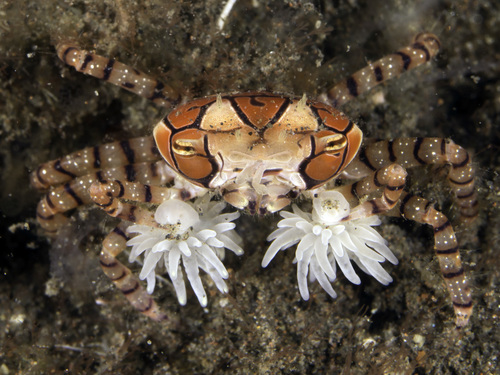
(c) jim-anderson, all rights reserved, uploaded by jim-anderson
Lybia
Sign in to saveLybia is a genus comprising eight species of small marine crabs from the family Xanthidae. Commonly known as boxer crabs and pom-pom crabs, these crabs are famous for their symbiosis with small aquatic invertebrates, particularly sea anemones, which they hold in their specialized claws for defense, and in some cases, feeding. The genus has a diverse distribution, ranging across the Indo-Pacific and existing as early as the Middle Miocene.
Species
キンチャクガニ属
GENUS
- KingdomAnimalia
- PhylumArthropoda
- ClassMalacostraca
- OrderDecapoda
- FamilyXanthidae
via GBIF
Museum specimens
- Specimen records
- 97
- With media
- 17
- Family
- Xanthidae
- Collections
- USNM, CAS, NHMUK, MCZ, MNHN, NMV
- Recorded in
- French Polynesia, Guam, Kenya, Tanzania, Australia, Papua New Guinea, Samoa, Nouvelle-Caledonie
Wikidata facts
- Instance of
- taxon
- Image
- Lybia edmondsoni 2.jpg
Show 4 more facts
- Commons category
- Lybia
- taxon name
- Lybia
- taxon rank
- genus
- topic's main category
- Category:Lybia
Sources (1)
via Wikidata · CC0
~11 min read
Encyclopedic overview
12 sectionsContents
- Morphology
- Distribution
- Ecology
- Behaviour
- Fighting
- Feeding
- Reproduction
- Taxonomy
- Human use
- Further reading
- References
- External links
Lybia is a genus comprising eight species of small marine crabs from the family Xanthidae. Commonly known as boxer crabs and pom-pom crabs, these crabs are famous for their symbiosis with small aquatic invertebrates, particularly sea anemones, which they hold in their specialized claws for defense, and in some cases, feeding. The genus has a diverse distribution, ranging across the Indo-Pacific and existing as early as the Middle Miocene.
== Morphology == Lybia crabs are small, achieving a maximum size of in adulthood. Each chela (claw) is equipped with a set of small hooks, which aid the crab in maintaining its grasp on the anemone. These claws are decidedly specialized for carrying anemones, which appears to be their only function for the crab; when anemones are absent, Lybia chelae have not been observed in use for burrowing, defence, or prey capture. They are devoid of any stereotypical features commonly associated with crab chelae. Thus, food gathering, burrowing, intraspecific relations, and anemone collection must instead be done with the crab's walking limbs. Chelae are delicate and have no recorded observations of sexual dimorphism.
Excerpted from Wikipedia’s “Lybia” article, available under the CC BY-SA 4.0 licence.