
File:MFHussain2.jpg · Wikimedia Commons · See Wikimedia Commons
M. F. Husain
Sign in to saveAlso known as Maqabūla Fidā Husaina, Maqbool Fida Husain, M. Fida Hosain, Ema. Epha. Husena, M. F. Husena, Maqbul Fida Husain, Makabūla Phidā Husena, M.F. Husain
Indian artist (1915–2011)
OverviewAI-generated
M. F. Husain (1915–2011) was an Indian painter, film director, politician, and artist. Born in Pandharpur, he was educated at the Sir Jamsetjee Jeejebhoy School of Art. His notable works include the portrait *Meenaxi: A Tale of Three Cities* and the mural *MF Husain: Untitled (Gram Yatra)*. His art is held in the collections of the National Museum of World Cultures, Yale University Art Gallery, Slovak National Gallery, and National Gallery of Modern Art.
Husain served as a member of the Rajya Sabha and received the Padma Bhushan and Padma Vibhushan awards. He held citizenship in India, Qatar, the British Raj, and the Dominion of India. A Muslim who spoke English, he died of myocardial infarction in London. He is buried at Brookwood Cemetery and had one child, Shamshad Hussain.
Synthesized by Vinony from 27 facts across 2 sources: Wikidata, Firecrawl. Generated from structured data (not the Wikipedia text) and checked against those facts — may still contain errors.
Key facts
- Born
- Maqbool Fida Husain , ( 1915-09-17 ) 17 September 1915, Pandharpur , Bombay Presidency , British India
- Died
- 9 June 2011 (2011-06-09) (aged 95), London , England
- Education
- Sir J. J. School of Art
- Known for
- Painting
- Notable work
- Meenaxi: A Tale of Three Cities , Through the Eyes of a Painter
- Movement
- Bombay Progressive Artists' Group
- Spouse
- Fazila Bibi ( married</span>"}]]}'>m. 1941 ; died 1998 )
- Children
- 6, including Owais Husain and Shamshad Hussain
- Awards
- Padma Bhushan (1973) , Padma Vibhushan (1991)
via Wikipedia infobox
Described at
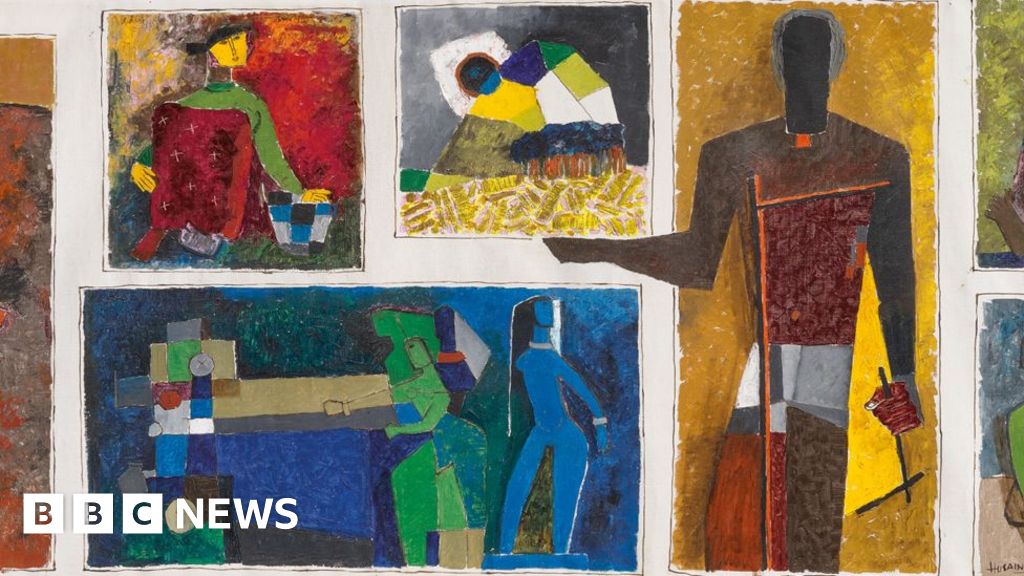
MF Husain: Untitled (Gram Yatra), mural which spent decades on Norwegian hospital wall sells for record $13.8m
The 14-foot-wide mural by MF Husain sold for an unprecedented $13.8m (£10.6m) in New York last week.
bbc.com →Indian mural that spent decades on Norwegian hospital wall sells for record $13.8m A forgotten oil-on-canvas masterpiece by Indian painter MF Husain, rediscovered decades later, has rewritten the record books for Indian art. Husain, who died in 2011, aged 95, was a pioneer of Indian modernism and remains a lasting inspiration for Indian artists. In 2006, he left India after death threats from Hindu hardline groups over his depictions of deities. For nearly five decades, the record-breaking painting unassumingly adorned the walls of a Norwegian hospital, overlooked and undervalued. Now, it stands as a defining work of modern South Asian art. Its 13 vignettes - vivid snapshots of Indian village life - reflect his distinctive blend of Indian folk traditions and modernist influences. They are reminiscent of narrative paintings in India's miniature tradition, in which small pictures weave a story. In Gram Yatra, Husain used vibrant, earthy tones to bring the frames to life, depicting women in everyday scenes, such as cooking, caring for children and riding a cart. "If you're looking for a single artwork that defines modern South Asian art, this is it," said Nishad Avari, head of South Asian Modern and Contemporary Art at Christie's. The painting, he added, also showed how Husain was influenced by his foreign travels, notably his 1952 trip to China, which introduced him to the calligraphic brushwork of artists like Xu Beihong - traces of which can be seen in the painting's expressive strokes. In the years following India's independence, he sought inspiration not in Paris or New York, but in India's villages, mirroring Mahatma Gandhi's belief that the heart of the nation lay in its rural roots. According to Husain's biographer Akhilesh (who uses only one name), the painter's deep engagement with India's cultural fabric helped shape how the country saw itself - "how people live, what they like and what they think". The painting also shows the early signs of Husain's modified cubist style - where geometric shapes and bold lines stood out in his works. It was purchased in 1954 for just $295 by Ukrainian doctor Leon Elias Volodarsky, who was in India on a World Health Organization (WHO) mission. After he took it to Norway, the piece adorned the walls of Oslo University Hospital for nearly half a century, largely unnoticed by the art world. It stayed that way for several decades until auction house Christie's was alerted to it in 2013 - two years after Husain's death - leading to its global exhibitions before this record-smashing sale. Ashish Anand, CEO of DAG (formerly the Delhi Art Gallery), believes this will elevate the value of Husain's entire body of work and "lead to Indian art being viewed beyond just its aesthetic value to a tangible and serious financial asset".
Excerpt from a page describing this subject · 5,635 chars · not written by Vinony
Wikidata facts
- Instance of
- human
- Gender
- male
- Citizenship
- Dominion of India
- Place of birth
- Pandharpur
- Place of death
- London
- Child
- Shamshad Hussain
- Occupation
- screenwriter
- Position held
- member of Rajya Sabha
- Educated at
- Sir Jamsetjee Jeejebhoy School of Art
- Languages spoken
- English language
- Religion
- Islam
- Award
- Padma Vibhushan
- Notable work
- Meenaxi: A Tale of Three Cities
- Field of work
- film direction
- Genre
- portrait
- Official website
- www.mfhussain.com
- Image
- Husain with Rammanohar (cropped).jpg
- Work location
- India
Show 9 more facts
- Commons category
- M. F. Husain
- date of birth
- 1915-09-17
- date of death
- 2011-06-09
- cause of death
- myocardial infarction
- manner of death
- natural causes
- place of burial
- Brookwood Cemetery
- Commons Creator page
- M. F. Husain
- name in native language
- Maqbool Fida Husain
- described at URL
- www.bbc.com/news/articles/cyvedl95l79o
Sources (11)
via Wikidata · CC0
~14 min read
Encyclopedic overview
Maqbool Fida Husain (17 September 1915 – 9 June 2011) was an Indian painter and film director who painted narrative paintings in a modified Cubist style. One of the founding members of Bombay Progressive Artists' Group, Husain is associated with Indian modernism in the 1940s. His early association with the Bombay Progressive Artists' Group used modern technique, and was inspired by the "new" India after the partition of 1947. His narrative paintings, executed in a modified Cubist style, can be caustic and funny as well as serious and sombre. His themes—sometimes treated in series—included topics as diverse as Gandhi, Mother Teresa, the Ramayana, the Mahabharata, the British Raj, and motifs of Indian urban and rural life. In September 2020, his painting titled Voices, auctioned for a record $2.5 million.
Husain's later works have stirred controversy, which included nude portrayals of Hindu deities, and a nude portrayal of Bharat Mata. Right-wing organisations called for his arrest, and several lawsuits were filed against him for hurting religious sentiments. He remained in a self imposed exile from 2006 until his death in 2011, accepting Qatari citizenship in 2010.
Excerpted from Wikipedia’s “M. F. Husain” article, available under the CC BY-SA 4.0 licence.