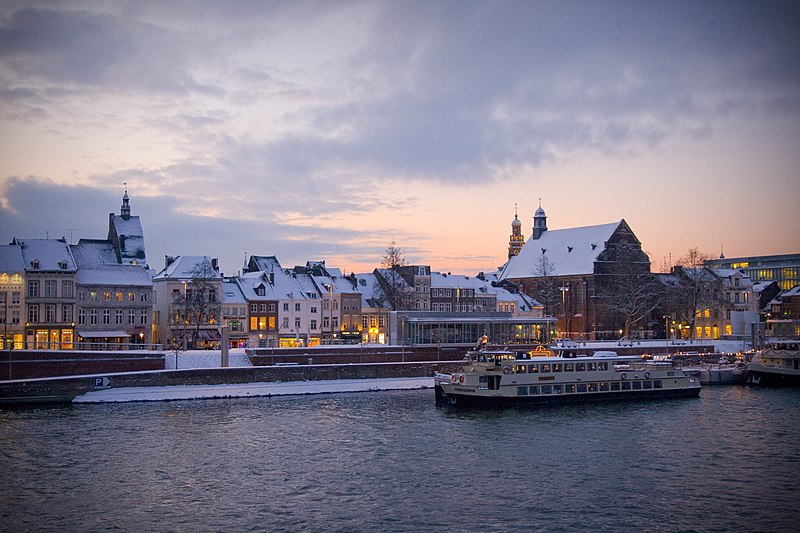
File:Maastricht_sunset.jpg · Wikimedia Commons · See Wikimedia Commons
Maastricht
Sign in to saveMaastricht ( , , ; ) is a city and a municipality in the southeastern Netherlands. It is the capital and largest city of the province of Limburg. Maastricht is located on both sides of the Meuse (), at the point where the river is joined by the Jeker. Mount Saint Peter (Sint-Pietersberg) is largely situated within the city's municipal borders. Maastricht is adjacent to the border with Belgium and is part of the Meuse-Rhine Euroregion, an international metropolis with a population of about 3.9 million, which includes the nearby German and Belgian cities of Aachen, Liège, and Hasselt.
Maastricht is a city in the southeastern Netherlands and the capital of the province of Limburg, strategically located on the Meuse River at a point where it meets the Jeker River. The city sits near the borders with Belgium and Germany and is part of a larger international region called the Meuse-Rhine Euroregion, which has a combined population of about 3.9 million people.
AI-generated from the Wikipedia summary — may contain errors.
Key facts
- Settlement.name
- Maastricht
- Settlement.settlement_type
- City and municipality
- Settlement.image_flag
- Flag of Maastricht.svg
- Settlement.flag_size
- 100x67px
- Settlement.image_shield
- Maastricht wapen.svg
- Settlement.shield_size
- 100x80px
- Settlement.image_blank_emblem
- Logo of the Municipality of Maastricht.svg
- Settlement.blank_emblem_type
- Logo
- Settlement.anthem
- Mestreechs Volksleed
- Settlement.image_map
- Map - NL - Municipality code 0935 (2009).svg
- Settlement.map_alt
- Highlighted position of Maastricht in a municipal map of Limburg
- Settlement.map_caption
- Location in Limburg
- Settlement.pushpin_map
- Netherlands#Europe
- Settlement.pushpin_map_caption
- Location within the Netherlands##Location within Europe
- Settlement.pushpin_relief
- 1
- Settlement.subdivision_type
- Country
- Settlement.subdivision_name
- Netherlands
- Settlement.subdivision_type1
- Province
via Wikipedia infobox
Research organization · ROR
- Type
- Government
- Location
- Maastricht, The Netherlands
- Also known as
- Gem Maastricht, Municipality of Maastricht
- Status
- Active
ISNI 0000 0004 0447 5601
Wikidata facts
- Named after
- Meuse
- Official name
- Maastricht
- Demonym
- Maastrichtčanka
- Award
- Good City
- Country
- Netherlands
- Located in
- Limburg
- Official language
- Limburgish language
- Population
- 120227
- Area
- 60.06
- Elevation
- 49
- Time zone
- Central European Time
- Body of water
- Juliana Canal
- Shares border with
- Visé
- Official website
- www.gemeentemaastricht.nl
- Image
- 00 6191 Maastricht - Niederlande.jpg
- Households
- 62236
- Dialing code
- 043
- Licence plate code
- M
Show 19 more facts
- described by source
- Encyclopædia Britannica 11th edition
- postal code
- 6200–6229
- twinned administrative body
- Liège
- Commons category
- Maastricht
- topic's main category
- Category:Maastricht
- category for people born here
- Category:Births in Maastricht
- category for people who died here
- Category:Deaths in Maastricht
- category of associated people
- Category:People from Maastricht
- Commons gallery
- Maastricht
- water as percent of area
- 5.36
- streaming media URL
- balticlivecam.com/cameras/netherlands/maastricht/maastricht-city-view
- native label
- Maastricht
- email address
- mailto:[email protected]
- phone number
- +31043
- WordLift URL
- data.wordlift.io/wl01254/entity/maastricht
- P12749
- Matthias Alban
- located in/on physical feature
- South Limburg
- number of viewers/listeners
- 357540
Sources (15)
via Wikidata · CC0
~55 min read
Encyclopedic overview
55 sectionsContents
- History
- Toponymy
- Early history
- Middle Ages
- 16th to 18th centuries
- 19th and early 20th century
- After World War II
- Geography
- Neighbourhoods
- Neighbouring municipalities
- Border
- Climate
- Demographics
- Inhabitants by nationality
- Inhabitants by country of birth
- Languages
- Religion
- Economy
- Private companies based in Maastricht
- Public institutions
- Culture and tourism
- Sights of Maastricht
- Museums in Maastricht
- Events and festivals
- Nature
- Parks
- Natural areas
- Sports
- Politics
- City council
- Aldermen and mayors
- Cannabis
- Transport
- By bike
- By car
- By train
- By bus
- By air
- By boat
- Distances to other cities
- Education
- Secondary education
- Tertiary education
- Other
- International relations
- Twin towns
- Notable people
- Born in Maastricht
- Residing in Maastricht
- Local anthem
- Gallery
- See also
- References
- Bibliography
- External links
Maastricht ( , , ; ) is a city and a municipality in the southeastern Netherlands. It is the capital and largest city of the province of Limburg. Maastricht is located on both sides of the Meuse (), at the point where the river is joined by the Jeker. Mount Saint Peter (Sint-Pietersberg) is largely situated within the city's municipal borders. Maastricht is adjacent to the border with Belgium and is part of the Meuse-Rhine Euroregion, an international metropolis with a population of about 3.9 million, which includes the nearby German and Belgian cities of Aachen, Liège, and Hasselt.
Maastricht developed from a Roman settlement (Trajectum ad Mosam) to a medieval river trade and religious centre. In the 16th century it became a garrison town and in the 19th century an early industrial centre. Today, the city is a thriving cultural and regional hub. It became well known through the Maastricht Treaty and as the birthplace of the euro. Maastricht has 1,677 national heritage buildings (rijksmonumenten), the second highest number in the Netherlands, after Amsterdam. The city is visited by tourists for shopping and recreation, and has a large international student population. The last stage of the Cretaceous period and the Mesozoic era, the Maastrichtian, is named after this city, at the end of which was the Cretaceous–Paleogene extinction event, which resulted in the extinction of the non-avian dinosaurs.
Excerpted from Wikipedia’s “Maastricht” article, available under the CC BY-SA 4.0 licence.
Gallery (52)
On the map
3 mapped locations
Available in 111 languages
- Español
- Français
- Deutsch
- 中文
- 日本語
- Русский
- Português
- Italiano
- العربية
- Afrikaans
- Albanian
- Aragonese
- Armenian
- Arpitan
- Asturian
- Azerbaijani
- Bahasa Indonesia
- Balinese
Show 92 more
- Bashkir
- Basque
- be_x_old
- Belarusian
- Breton
- Bulgarian
- Catalan
- cbk_zam
- Cebuano
- Central Kurdish
- Colognian
- Corsican
- Croatian
- Czech
- Danish
- Egyptian Arabic
- Esperanto
- Estonian
- Faroese
- Finnish
- Galician
- Georgian
- Greek
- Hebrew
- Hungarian
- hyw
- Icelandic
- Ido
- Interlingue
- Irish
- Javanese
- Kurdish
- Latin
- Latvian
- Limburgish
- Lithuanian
- lld
- Lombard
- Low German
- Luxembourgish
- Malagasy
- Malay
- Maltese
- Marathi
- Mongolian
- nds_nl
- Nederlands
- Northern Frisian
- Norwegian
- Norwegian Nynorsk
- Occitan
- Ossetic
- Papiamento
- Pashto
- Piedmontese
- Polski
- Quechua
- Romanian
- Saterland Frisian
- Scots
- Scottish Gaelic
- Serbian
- Serbian (Latin)
- Silesian
- simple
- Slovak
- Slovenian
- Somali
- Svenska
- Swahili
- Tamil
- Tatar
- Tiếng Việt
- Toki Pona
- Türkçe
- Ukrainian
- Urdu
- Venetian
- Volapük
- Walloon
- Waray
- Welsh
- West Flemish
- Western Frisian
- Western Panjabi
- Wu Chinese
- Zeelandic
- zh_min_nan
- zh_yue
- فارسی
- ไทย
- 한국어
via Wikidata sitelinks · CC0