Encyclopedia of Life · EOL (see source)
OverviewAI-generated
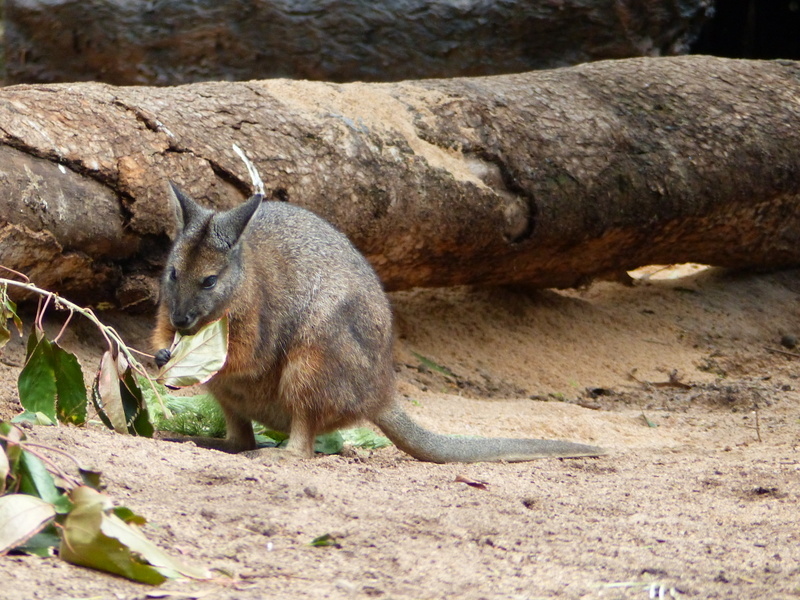
Macropus eugenii is a species of mammal belonging to the family Macropodidae within the order Diprotodontia. It is classified under the class Mammalia, phylum Chordata, and kingdom Animalia. The organism is commonly known as the Tamar Wallaby, Tammar Wallaby, Dama Wallaby, or Derbywallaby. It is endemic to Australia and is recognized as a model organism and a Lazarus taxon.
Records indicate that the longest observed lifespan for this species is 15.1 years. Its genome has been sequenced, with data available through various biological databases. Occurrence records number 43,846, while additional records from institutions such as MSB, RBINS-SCIENTIFIC HERITAGE, CMN, ASNHC, and AMNH total 231, including 52 media items. These records are associated with the United States and Australia.
Synthesized by Vinony from 24 facts across 5 sources: Wikidata, GBIF, Gbif Occ, iDigBio, Vinony graph. Generated from structured data (not the Wikipedia text) and checked against those facts — may still contain errors.
Species
SPECIES
- KingdomAnimalia
- PhylumChordata
- ClassMammalia
- OrderDiprotodontia
- FamilyMacropodidae
Maximum longevity: 15.1 years (captivity) Observations: In the wild these animals live up to 14 years (Bernhard Grzimek 1990). One specimen lived 15 years in captivity (Richard Weigl 2005).
via GBIF
Museum specimens
- Specimen records
- 231
- With media
- 52
- Family
- Macropodidae
- Collections
- MSB, RBINS-SCIENTIFIC HERITAGE, CMN, ASNHC, AMNH
- Recorded in
- United States, Australia
Wikidata facts
- Instance of
- Lazarus taxon
- Image
- Macropus eugenii.jpg
Show 9 more facts
- taxon rank
- species
- taxon name
- Macropus eugenii
- Commons category
- Macropus eugenii
- Commons gallery
- Macropus eugenii
- taxon common name
- Tammar-Wallaby
- endemic to
- Australia
- longest observed lifespan
- 15.1
- sequenced genome URL
- www.dnazoo.org/assemblies/Macropus_eugenii
- short name
- M. eugenii
via Wikidata · CC0
~21 min read
Encyclopedic overview
The tammar wallaby (Notamacropus eugenii), also known as the dama wallaby or darma wallaby, is a small macropod native to South and Western Australia. Though its geographical range has been severely reduced since European colonisation, the tammar wallaby remains common within its reduced range and is listed as "Least Concern" by the International Union for Conservation of Nature (IUCN). It has been introduced to New Zealand and reintroduced to some areas of Australia where it had been previously extirpated. Skull variations differentiate between tammar wallabies from Western Australia, Kangaroo Island, and mainland South Australia, making them distinct population groups.
The tammar wallaby is among the smallest of the wallabies in the genus Notamacropus. Its coat colour is largely grey. The tammar wallaby has several notable adaptations, including the ability to retain energy while hopping, colour vision, and the ability to drink seawater. A nocturnal species, it spends the nighttime in grassland habitat and the daytime in shrubland. It is also very gregarious and has a seasonal, promiscuous mating pattern. A female tammar wallaby can nurse a joey in her pouch while keeping an embryo in her uterus. The tammar wallaby is a model species for research on marsupials, and on mammals in general. Its genome was sequenced in 2011.
Excerpted from Wikipedia’s “Macropus eugenii” article, available under the CC BY-SA 4.0 licence.