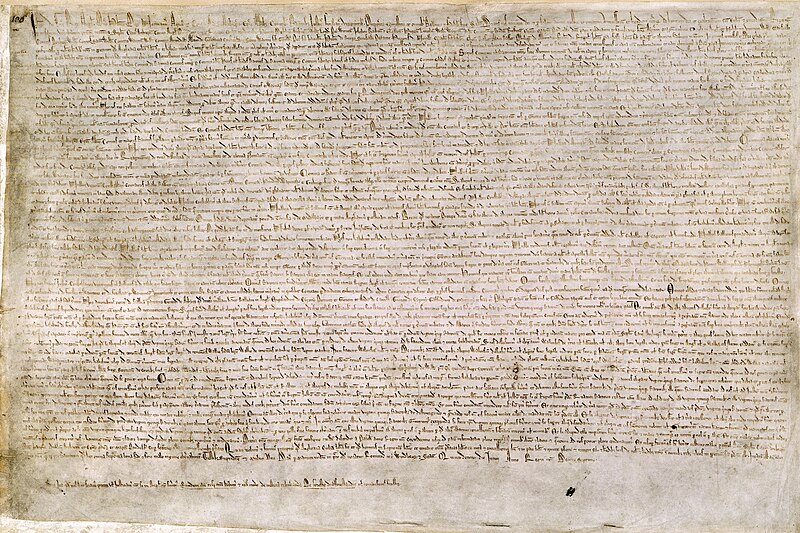
File:Magna_Carta_(British_Library_Cotton_MS_Augustus_II.106).jpg · Wikimedia Commons · See Wikimedia Commons
Magna Carta
Sign in to saveAlso known as Magna Carta Libertatum, The Great Charter of the Liberties of England, Great Charter, Magna Charta
charter of rights agreed between King John of England and the nobility in 1215
Magna Carta was a document created in 1215 in which King John of England agreed to recognize certain rights and limitations on his power in response to pressure from the nobility. It is considered historically significant as an early written statement establishing that even a king was subject to the law rather than above it.
AI-generated from the Wikipedia summary — may contain errors.
Wikidata facts
- Read free · Project Gutenberg
- #10000
- Instance of
- manuscript
- Country
- Kingdom of England
- Country of origin
- Kingdom of England
- Image
- Magna Carta (British Library Cotton MS Augustus II.106).jpg
Show 9 more facts
- significant person
- Robert Fitzwalter
- on focus list of Wikimedia project
- WikiProject Human rights
- title
- Magna charta libertatum
- Commons category
- Magna Carta
- topic's main category
- Category:Magna Carta
- inception
- 1215-06-15
- Commons gallery
- Magna Carta
- language of work or name
- medieval Latin
- copyright status
- public domain
via Wikidata · CC0
~40 min read
Encyclopedic overview
Magna Carta (Medieval Latin for "Great Charter"), sometimes spelled Magna Charta, is a royal charter of rights sealed by King John of England at Runnymede, near Windsor, on 15 June 1215. First drafted by the Archbishop of Canterbury, Cardinal Stephen Langton, to make peace between the unpopular king and a group of rebel barons who demanded that the King confirm the Charter of Liberties, it promised the protection of church rights, protection for the barons from illegal imprisonment, access to swift and impartial justice, and limitations on feudal payments to the Crown, to be implemented through a council of 25 barons. Neither side stood by their commitments, and the charter was annulled by Pope Innocent III, leading to the First Barons' War.
After John's death, the regency government of his young son, Henry III, reissued the document in 1216, stripped of some of its more radical content, in an unsuccessful bid to build political support for their cause. At the end of the war in 1217, it formed part of the peace treaty agreed at Lambeth, where the document acquired the name "Magna Carta", to distinguish it from the smaller Charter of the Forest, which was issued at the same time. Short of funds, Henry reissued the charter again in 1225 in exchange for a grant of new taxes. His son, Edward I, repeated the exercise in 1297, this time confirming it as part of England's statute law. However, Magna Carta was not unique; other legal documents of its time, both in England and beyond, made broadly similar statements of rights and limitations on the powers of the Crown. The charter became part of English political life and was typically renewed by each monarch in turn. As time went by and the fledgling Parliament of England passed new laws, it lost some of its practical significance.
Excerpted from Wikipedia’s “Magna Carta” article, available under the CC BY-SA 4.0 licence.
Gallery (12)
Available in 96 languages
- Español
- Français
- Deutsch
- 中文
- 日本語
- Русский
- Português
- Italiano
- العربية
- हिन्दी
- Afrikaans
- Albanian
- Albanian
- Amharic
- Aragonese
- Armenian
- Asturian
- Azerbaijani
Show 77 more
- Bahasa Indonesia
- Bangla
- Basque
- Belarusian
- Bikol
- Bosnian
- Breton
- Bulgarian
- Burmese
- Catalan
- Central Kurdish
- Croatian
- Czech
- Danish
- Egyptian Arabic
- Esperanto
- Estonian
- Faroese
- Filipino
- Finnish
- Friulian
- Galician
- Georgian
- Greek
- Hebrew
- Hungarian
- Icelandic
- Ido
- Irish
- Javanese
- Kyrgyz
- Latin
- Latvian
- Ligurian
- Lithuanian
- Macedonian
- Malay
- Malayalam
- Marathi
- Minangkabau
- Nederlands
- Nepali
- Newari
- Norwegian
- Norwegian Nynorsk
- Occitan
- Pashto
- Piedmontese
- Polski
- Punjabi
- Romanian
- Scots
- Serbian
- Serbian (Latin)
- Sicilian
- simple
- Slovak
- Slovenian
- Svenska
- Tamil
- Telugu
- Tiếng Việt
- Türkçe
- Ukrainian
- Urdu
- Uzbek
- Venetian
- Waray
- Welsh
- Western Panjabi
- Wu Chinese
- zh_classical
- zh_min_nan
- zh_yue
- فارسی
- ไทย
- 한국어
via Wikidata sitelinks · CC0