Maianthemum · Kew POWO · Kew Plants of the World Online
Maianthemum
Sign in to saveMaianthemum includes the former genus Smilacina and is a genus of perennial herbaceous flowering plants with fleshy, persistent rhizomes. It is widespread across much of North America, Europe and Asia, and may be terrestrial, aquatic or epiphytic. It is characterized by simple, unbranched stems that are upright, leaning or hanging down and have 2–17 foliage leaves. Leaves are simple and may clasp the stem or be short-petiolate. The inflorescence is terminal and either a panicle or a raceme with few to many pedicelate flowers. Most species have 6 tepals and 6 stamens; a few have parts in 4s. Te
Species
GENUS
- KingdomPlantae
- PhylumTracheophyta
- ClassLiliopsida
- OrderAsparagales
- FamilyAsparagaceae
via GBIF · Kew POWO
Museum specimens
- Specimen records
- 831
- With media
- 668
- Family
- Asparagaceae
- Collections
- SD, UNICACH, STDOM, MSC, OSU, BRIT
- Recorded in
- United States, Mexico, China
Research
55 papers- Molecular systematics and historical biogeography of Maianthemum s.s.American journal of botany · 2017
- Phylogeny and biogeography of Maianthemum (Asparagaceae: Nolinoideae) revisited with emphasis on its divergence pattern in SW China.Plant diversity · 2021
- Nutraceutical Study on Maianthemum atropurpureum, a Wild Medicinal Food Plant in Northwest Yunnan, China.Frontiers in pharmacology · 2021
- Cytotoxic steroidal saponins from the roots and rhizomes of Maianthemum henryi.Natural product research · 2021
- Phylogeny and biogeographic diversification of Maianthemum (Ruscaceae: Polygonatae).Molecular phylogenetics and evolution · 2008
via PubMed
Wikidata facts
- Instance of
- taxon
- Image
- Maianthemum bifolium oravanmarja.jpg
Show 7 more facts
- taxon rank
- genus
- Commons category
- Maianthemum
- taxon name
- Maianthemum
- topic's main category
- Category:Maianthemum
- taxon common name
- 舞鹤草属
- has fruit type
- berry
Sources (2)
via Wikidata · CC0
~11 min read
Encyclopedic overview
12 sectionsContents
- Vegetative
- Reproductive
- Morphology
- Taxonomy
- Phylogeny
- Etymology
- Distribution and habitat
- Ecology
- Conservation
- Species
- See also
- References
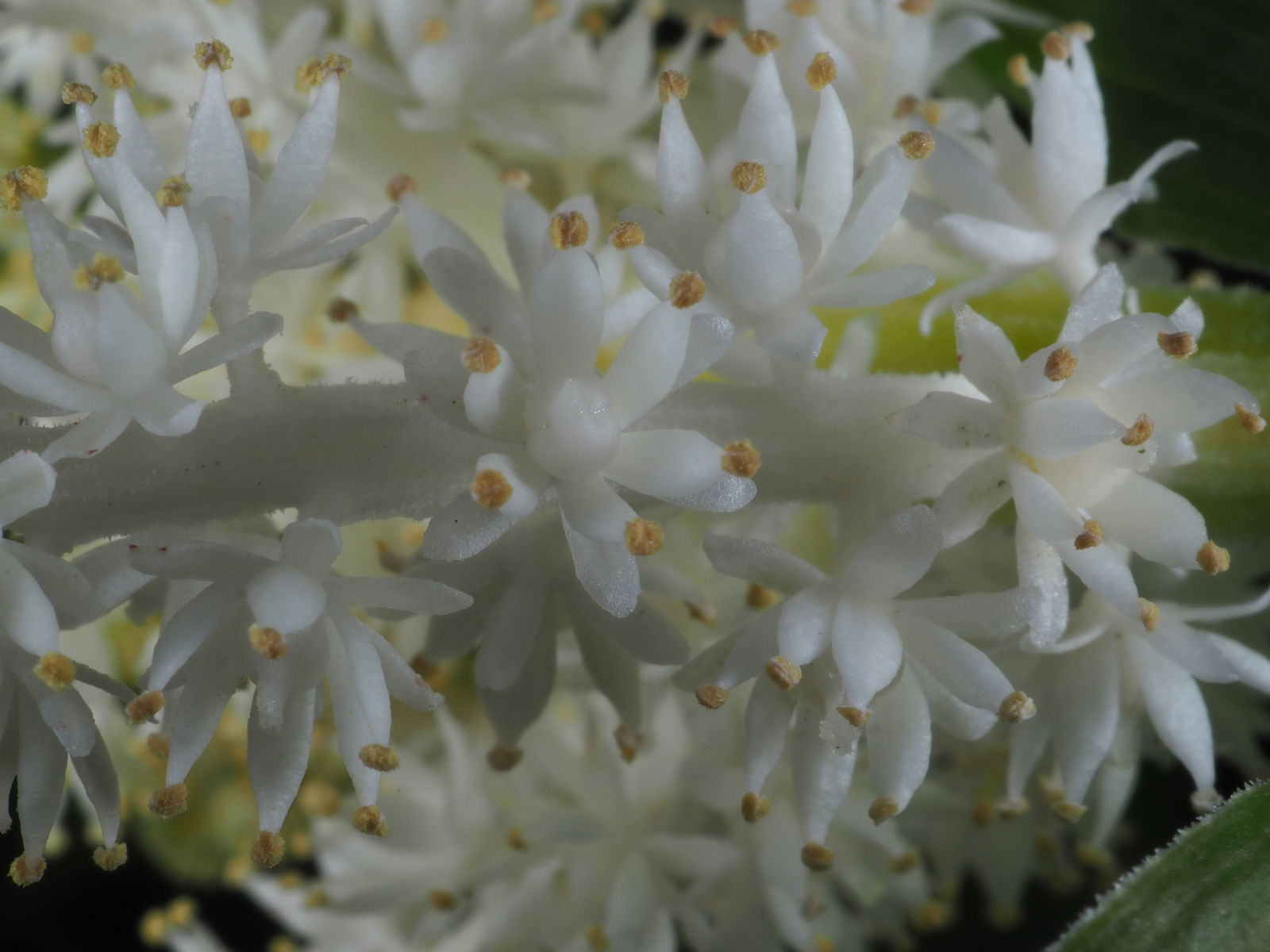
Maianthemum includes the former genus Smilacina and is a genus of perennial herbaceous flowering plants with fleshy, persistent rhizomes. It is widespread across much of North America, Europe and Asia, and may be terrestrial, aquatic or epiphytic. It is characterized by simple, unbranched stems that are upright, leaning or hanging down and have 2–17 foliage leaves. Leaves are simple and may clasp the stem or be short-petiolate. The inflorescence is terminal and either a panicle or a raceme with few to many pedicelate flowers. Most species have 6 tepals and 6 stamens; a few have parts in 4s. Tepals are distinct in most species and all of similar size. Flowers are spreading, cup-shaped or bell-shaped and usually white, but lavender to red or green in some species. Fruits are rounded to lobed berries containing few to several seeds.
== Vegetative == Rhizomes and roots Rhizomes are persistent and have scale leaves. They can be sympodial; spreading and thread-like, or cylindric, clumped and fleshy. Maianthemum paludicola has an unusual woody, upright sympodial rhizome set above ground. Roots may be spread along the rhizome, clumped at the nodes, or clumped near the base of leafy shoots. The rhizome is the perennial part of the plant and growth is by branching of the rhizome. Flowering/fruiting shoots are attached to the rhizome by a discreet internode, are short-lived and wither at the end of the growing season. Stems and leaves The stems are unbranched and pendant to arching or upright. Fertile plants have 2 to 17 or more stem (cauline) leaves (arising from the stem) that are alternate along the stem. Most species produce fertile shoots seasonally. A few species such as Maianthemum canadense and Maianthemum dilatatum also have a vegetative phase, producing a solitary leaf on sterile shoots; plants may continue in this vegetative phase for up to six years. Maianthemum trifolium produces two petiolate foliage leaves the first year, then a flowering shoot the second year with 2-4 sessile leaves. In most species, leaves have a large midvein, dividing the leaves in half, then each half is again divided by a slightly smaller vein; each quarter again divided by progressively finer veins. The resulting pattern is that the leaves have three prominent veins, and adjacent veins are of different diameters. A few species, such as Maianthemum stellatum, have leaves with veins that are often all of roughly the same diameter. Leaf edges may be flat or wavy (undulate) and sometimes have small, outward-pointing teeth.
Excerpted from Wikipedia’s “Maianthemum” article, available under the CC BY-SA 4.0 licence.