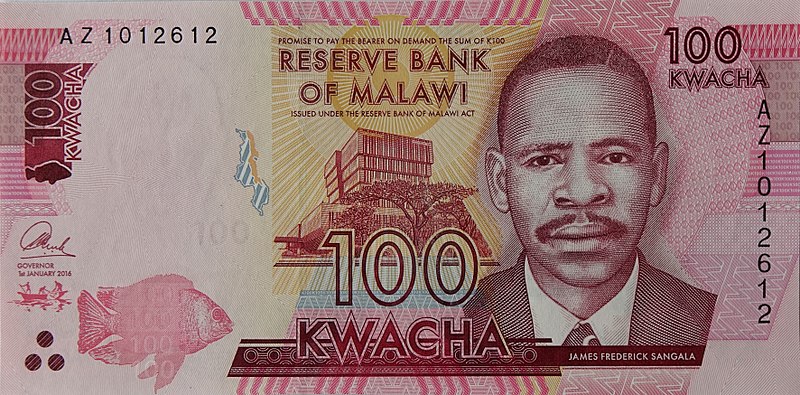
File:MWK0100v.jpg · Wikimedia Commons · See Wikimedia Commons
Malawian kwacha
Sign in to saveAlso known as Malawi kwacha, Kwacha (1971-date), MWK
currency of Malawi
Wikidata facts
Show 7 more facts
- Commons category
- Money of Malawi
- central bank/issuer
- Reserve Bank of Malawi
- start time
- 1971-00-00
- replaces
- Malawian pound
- unit symbol
- MK
- conversion to standard unit
- 0.0046825686698695
- applies to jurisdiction
- Malawi
Sources (2)
via Wikidata · CC0
~5 min read
Encyclopedic overview
ISO 4217 CodeMWK (numeric: 454) Subunit0.01 Unit SymbolK Denominations Subunit 1⁄100tambala Banknotes20, 50, 100, 200, 500, 1,000, 2,000, 5,000 kwacha Coins Freq. used1, 5, 10 kwacha Rarely used1, 2, 5, 10, 20, 50 tambala Demographics Date of introduction1971 ReplacedMalawian pound User(s) Malawi Issuance Central bankReserve Bank of Malawi Websitewww.rbm.mw Valuation Inflation19.90% SourceRbm Nov 2016
The kwacha (/ˈkwætʃə/; ISO 4217: MWK, official name Malawi Kwacha) is the currency of Malawi as of 1971, replacing the Malawian pound. It is divided into 100 tambala. The kwacha replaced other types of currency, namely the British pound sterling, the South African rand, and the Rhodesian dollar, that had previously circulated through the Malawian economy. The exchange rate of the kwacha undergoes fixed periodical adjustments, but since 1994 the exchange rate has floated. In 2005, administrative measures were put in place by Bingu wa Mutharika to peg the exchange rate with other currencies. Banknotes are issued by the Reserve Bank of Malawi. In May 2012, the Reserve Bank of Malawi devalued the kwacha by 34% and unpegged it from the United States dollar. The currency was further devalued by 25% by the central bank in May 2022 followed by another 44% devaluation in November 2023 raising inflation rate in Malawi.
Excerpted from Wikipedia’s “Malawian kwacha” article, available under the CC BY-SA 4.0 licence.