
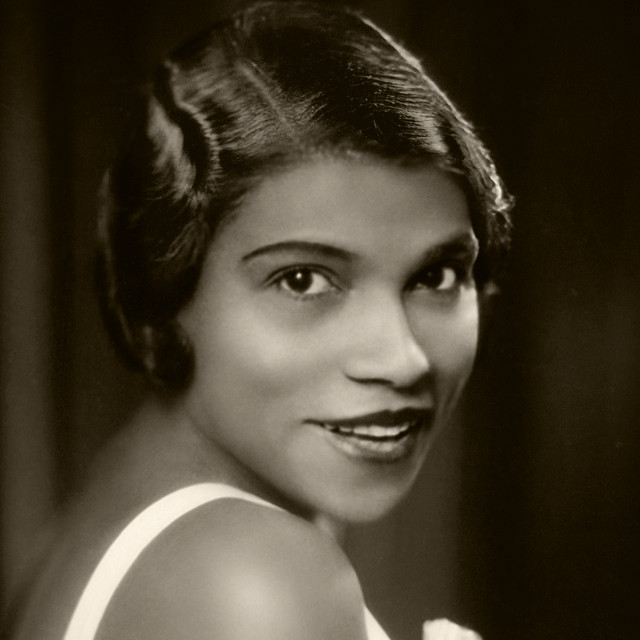
File:Marian_Anderson_by_Carl_Van_Vechten_(cropped).jpg · Wikimedia Commons · See Wikimedia Commons
Marian Anderson
Sign in to saveAfrican-American contralto (1897–1993)
OverviewAI-generated
Marian Anderson was an American opera singer and contralto. Born in Philadelphia, she began her work period in 1925 and performed for RCA Victor. Her vocal repertoire included opera, classical music, gospel, and spirituals. She was a member of the American Academy of Arts and Sciences and is recognized in collections for the Hollywood Walk of Fame, the Presidential Medal of Freedom, the Congressional Gold Medal, and the Kennedy Center Honors.
Anderson received the Spingarn Medal, the Presidential Medal of Freedom, the Grammy Lifetime Achievement Award, and induction into the National Women's Hall of Fame. She was an African American citizen of the United States who spoke English. Her archives are held at Smith College. She died of myocardial infarction and heart failure in Portland on April 8, 1993, from natural causes. Her relative was James DePreist.
Synthesized by Vinony from 33 facts across 5 sources: Wikidata, MusicBrainz, Last.fm, TMDb, Vinony collections. Generated from structured data (not the Wikipedia text) and checked against those facts — may still contain errors.
Film & TV
Known for
- Dead Side Manor: Prescription for Fear2021
- The Haunting of Malaga Inn — Paranormal Investigator2020
- Ghost Keepers of the Light2019
via TMDB
Music · MusicBrainz
- Type
- Person
- Gender
- Female
- Origin
- United States
- Active from
- 1897
- Active to
- 1993
Discography
- Let Us Break Bread Together / Sometimes I Feel Like a Motherless Child / Ave Maria1944
- Deep River / I Don't Feel No-Ways Tired1946
- Sings Christmas Carols1951
- Christmas Carols1962
- Snoopycat (The Adventures of Marian Anderson's Cat "Snoopy")1963
- Marian Anderson Performing "Jus' Keep on Singin'" & 11 More Spirituals1965
- He's Got the Whole World in His Hands: Spirituals1994
- The Lady From Philadelphia1995
- Prima Voce: Marian Anderson1996
- Prima Voce, Volume 21998
via MusicBrainz · CC0
Listeners · Last.fm
- Listeners
- 11,713
- Total plays
- 73,219
Tags
Marian Anderson (February 27, 1897 – April 8, 1993) was an African-American contralto best remembered for her performance on Easter Sunday, 1939 on the steps of the Lincoln Memorial in Washington D.C. Anderson was born in Philadelphia, Pennsylvania. She joined a junior church choir at the age of six, and applied to an all-white music school after her graduation from high school in 1921, but was turned away because she was black. The woman working the admissions counter replied, "We don't take c
Wikidata facts
- Instance of
- human
- Family name
- Anderson
- Gender
- female
- Citizenship
- United States
- Place of birth
- Philadelphia
- Place of death
- Portland
- Occupation
- opera singer
- Languages spoken
- English language
- Student of
- Amanda Aldridge
- Field of work
- singing
- Movement
- Harlem Renaissance
- Instrument
- voice
- Record label
- RCA Victor
- Image
- Marian Anderson 1933 (121327138).jpg
- Voice type
- contralto
Show 12 more facts
- Commons category
- Marian Anderson
- cause of death
- myocardial infarction
- date of birth
- 1897-02-27
- date of death
- 1993-04-08
- manner of death
- natural causes
- ethnic group
- African Americans
- name in native language
- Marian Anderson
- on focus list of Wikimedia project
- Wikipedia:Vital articles/Level/4
- start of work period
- 1925-00-00
- relative
- James DePreist
- influenced by
- Sol Hurok
Sources (6)
via Wikidata · CC0
~32 min read
Encyclopedic overview
Marian Anderson (February 27, 1897 – April 8, 1993) was an American contralto. She performed a wide range of music, from opera to spirituals. Anderson performed with renowned orchestras in major concert and recital venues throughout the United States and Europe between 1925 and 1965.
Anderson was an important figure in the struggle for African-American artists to overcome racial prejudice in the United States during the mid-twentieth century. In 1939, during the period of racial segregation, the Daughters of the American Revolution (DAR) refused to allow Anderson to sing to an integrated audience in Constitution Hall in Washington, D.C. The incident placed Anderson in the spotlight of the international community on a level unusual for a classical musician. With the aid of First Lady Eleanor Roosevelt and her husband, President Franklin D. Roosevelt, Anderson performed a critically acclaimed open-air concert on Easter Sunday, April 9, 1939, on the Lincoln Memorial steps in the capital. The event was featured in the documentary Marian Anderson: The Lincoln Memorial Concert. She sang before an integrated crowd of more than 75,000 people and a radio audience in the millions.
Excerpted from Wikipedia’s “Marian Anderson” article, available under the CC BY-SA 4.0 licence.