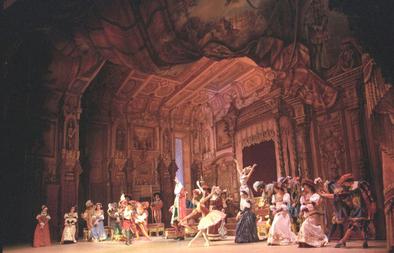
File:GSB022.jpg · Wikimedia Commons · See Wikimedia Commons
Marius Petipa
Sign in to saveAlso known as Marius Ivanovich Petipa, Victor Marius Alphonse Petipa
French-Russian ballet dancer and choreographer (1818–1910)
Film & TV
Marseilles, France
Marius Ivanovich Petipa was a French-Russian ballet dancer, pedagogue and choreographer. Petipa is one of the most influential ballet masters and choreographers in ballet history.
via TMDB
Key facts
- Born
- Marius Alphonse Petipa , ( 1818-03-11 ) 11 March 1818, Marseille , France
- Died
- 14 July 1910 (1910-07-14) (aged 92), Gurzuf , Taurida Governorate , Russian Empire
- Resting place
- Tikhvin Cemetery , St. Petersburg
- Education
- Brussels Conservatory , Grand Théâtre de Bordeaux
- Known for
- Ballet, choreography
via Wikipedia infobox
Wikidata facts
- Instance of
- human
- Given name
- Marius
- Gender
- male
- Citizenship
- Russian Empire
- Place of death
- Saint Petersburg
- Father
- Jean-Antoine Petipa
- Sibling
- Lucien Petipa
- Occupation
- teacher
- Educated at
- Royal Conservatory of Brussels
- Employer
- Bolshoi Kamenny Theatre
- Languages spoken
- French
- Notable work
- Don Quixote
- Field of work
- dance
- Genre
- classical ballet
- Image
- Marius Petipa -1898.jpg
Show 9 more facts
- Commons category
- Marius Petipa
- date of birth
- 1818-03-11
- date of death
- 1910-07-14
- name in native language
- Michel-Victor-Marius-Alphonse Petipa
- place of burial
- Tikhvin Cemetery
- pseudonym
- Marius Ivánovich Petipa
- on focus list of Wikimedia project
- Wikipedia:Vital articles/Level/4
- birth name
- Victor Alphonse Petipa
- P12674
- Jerez
Sources (2)
via Wikidata · CC0
~40 min read
Encyclopedic overview
Marius Ivanovich Petipa (Russian: Мариус Иванович Петипа; born Victor Marius Alphonse Petipa; 11 March 1818 – 14 July [O.S. 1 July] 1910) was a French and Russian ballet dancer, pedagogue and choreographer. He is considered one of the most influential ballet masters and choreographers in ballet history.
Petipa is noted for his long career as Premier maître de ballet (First Ballet Master) of the St. Petersburg Imperial Theatres, making him Ballet Master and principal choreographer of the Imperial Ballet (today known as the Mariinsky Ballet), a position he held from 1871 until 1903. Petipa created over fifty ballets, some of which have survived in versions either faithful to, inspired by, or reconstructed from his originals. He is most noted for The Pharaoh's Daughter (1862); Don Quixote (1869); La Bayadère (1877); Le Talisman (1889); The Sleeping Beauty (1890); The Nutcracker (choreographed jointly with Lev Ivanov) (1892); Le Réveil de Flore (1894); La Halte de cavalerie (1896); Raymonda (1898); Les Saisons (1900), and Les Millions d'Arlequin (a.k.a. Harlequinade) (1900).
Excerpted from Wikipedia’s “Marius Petipa” article, available under the CC BY-SA 4.0 licence.