File:Mars_global_surveyor.jpg · Wikimedia Commons · See Wikimedia Commons
Mars Global Surveyor
Sign in to saveAlso known as MGS
US spacecraft developed by NASA's Jet Propulsion Laboratory
Key facts
- Mission type
- Mars orbiter
- Operator
- NASA / JPL
- Cospar id
- 1996-062A
- Website
- science.nasa.gov
- Mission duration
- 9 years, 11 months and 26 days
- Dry mass
- 1,030.5 kg (2,272 lb)
- Power
- 980 watts
- Launch date
- 7 November 1996, 17:00 ( 1996-11-07UTC17Z ) UTC
- Rocket
- Delta II 7925, D-239
- Launch site
- Cape Canaveral LC-17A
- Contractor
- Boeing IDS
- Disposal
- Derelict
- Declared
- 28 January 2007
- Last contact
- 2 November 2006 ( 2006-11-03 )
- Decay date
- 2050 (estimated)
- Reference system
- Areocentric
- Regime
- Sun-synchronous
- Semi major axis
- 3,769 km (2,342 mi)
via Wikipedia infobox
Wikidata facts
- Instance of
- orbiter
- Part of
- Mars Exploration Program
- Operator
- NASA
- Followed by
- Mars Surveyor '98
- Developer
- Jet Propulsion Laboratory
- Parent body
- Mars
- Mass
- 1030
- Orbital period
- 1.95
- Official website
- mars.jpl.nasa.gov/mgs
- Image
- Mars global surveyor.jpg
Show 13 more facts
- start point
- Cape Canaveral Space Launch Complex 17
- Commons gallery
- Mars Global Surveyor
- Commons category
- Mars Global Surveyor
- UTC date of spacecraft launch
- 1996-11-07
- space launch vehicle
- Delta II
- service retirement
- 2006-11-02
- nominal power output
- 980
- launch contractor
- Boeing Defense, Space & Security
- semi-major axis of an orbit
- 3769
- orbital eccentricity
- 0.008
- periapsis
- 372.8
- apoapsis
- 436.5
- orbital inclination
- 92.9
Sources (2)
via Wikidata · CC0
~23 min read
Encyclopedic overview
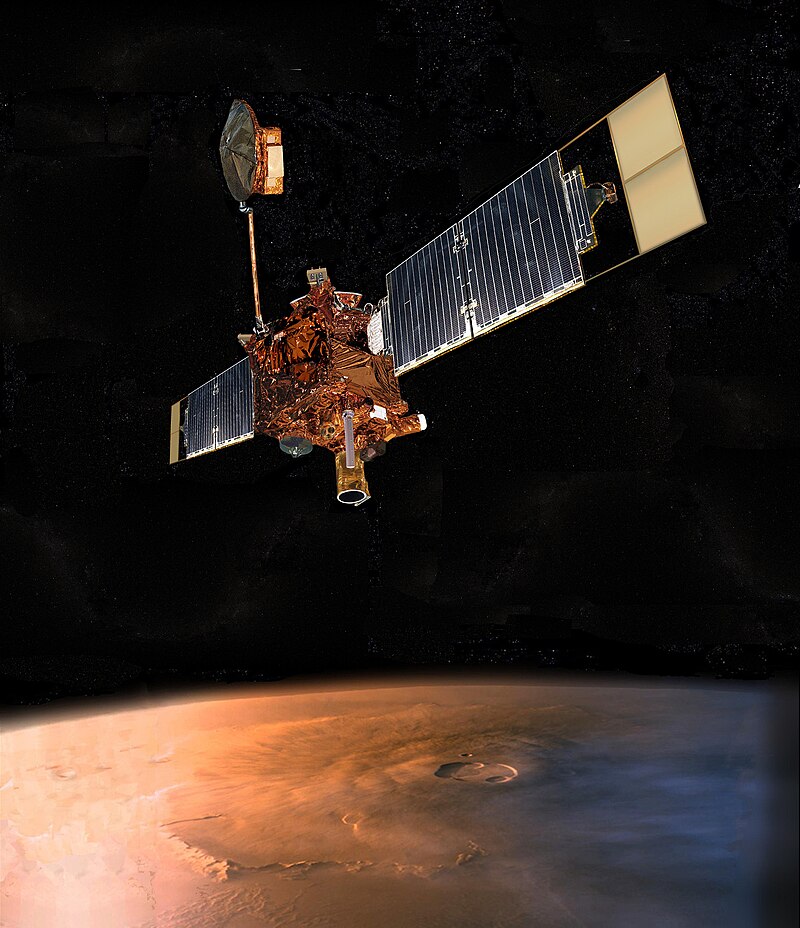
Mars Global Surveyor (MGS) was an American robotic space probe developed by NASA's Jet Propulsion Laboratory. It was launched on November 7, 1996, and collected data in orbit around Mars from 1997 to 2006. MGS was a global mapping mission that examined the entire planet, from the ionosphere down through the atmosphere to the surface. As part of the larger Mars Exploration Program, Mars Global Surveyor performed atmospheric monitoring for sister orbiters during aerobraking, and helped Mars rovers and lander missions by identifying potential landing sites and relaying surface telemetry.
The spacecraft completed its primary mission in January 2001 and was in its third extended mission phase when, on 2 November 2006, it failed to respond to messages and commands. A faint signal was detected three days later which indicated that it had gone into safe mode. Attempts to recontact the spacecraft and resolve the problem failed, and NASA officially ended the mission in January 2007. An investigation attributed the loss of the spacecraft to a flaw in an update to its system software. MGS remains in a stable near-polar circular orbit at about 450 km altitude and as of 1996, was expected to crash onto the surface of the planet in 2050.
Excerpted from Wikipedia’s “Mars Global Surveyor” article, available under the CC BY-SA 4.0 licence.