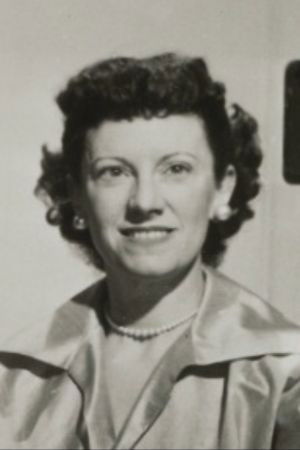
Profile via TMDB · Courtesy of TMDB
Mary Ellen Bute
Sign in to saveAmerican film director and animator (1906–1983)
Film & TV
Houston, Texas
A pioneer of visual music and electronic art, Mary Ellen Bute directed along with her husband Ted Nemeth over a dozen short abstract animations between the 1930s to the 1950s. Set to classical music by the likes of Bach, Saint-Saens or Shostakovich, and filled with colorful forms, elegant design and sprightly, dance-like-rhythms, Bute's filmmaking is at once formally rigorous and energetically…
via TMDB
Listeners · Last.fm
- Listeners
- 6
- Total plays
- 7
<a href="https://www.last.fm/music/Mary+Ellen+Bute">Read more on Last.fm</a>
Described at
Mary Ellen Bute: Seeing Sound
awn.com →As with many pioneer animators, Mary Ellen Bute is hardly known today, primarily because her films are not easily available in good prints. This was not always true. During a 25-year period, from 1934 until about 1959, the 11 abstract films she made played in regular movie theaters around the country, usually as the short with a first-run prestige feature, such as Mary of Scotland , The Barretts of Wimpole Street , or Hans Christian Andersen --which means that millions saw her work, many more than most other experimental animators. The diminutive Mary Ellen grew up in Texas, and retained a soft southern accent and genteel demeanor throughout her life. She studied painting in Texas and Philadelphia, but felt frustrated by the inability to wield light in a flowing time-continuum. She studied stage lighting at Yale in an attempt to gain the technical expertise to create a "color organ" which would allow her to paint with living light-and also haunted the studios of electronic genius Leo Theremin and Thomas Wilfred whose Clavilux instrument projected sensuous streams of soft swirling colors. She was drawn into filmmaking by a collaboration with the musician Joseph Schillinger, who had developed an elaborate theory about musical structure, which reduced all music to a series of mathematical formulae. Schillinger wanted to make a film to prove that his synchronization system worked in illustrating music with visual images, and Mary Ellen undertook the project of animating the visuals. The film was never completed, and a still published with an article by Schillinger in the magazine Experimental Cinema No. 5 (1934) makes it clear why: the intricate image, reminiscent of Kandinsky's complex paintings, would have taken a single animator years to redraw thousands of times. Mary Ellen continued to use the Schillinger system in her subsequent films, often to their detriment, for Schillinger's insistence on the mathematics of musical quantities fails to deal with musical qualities, much as John Whitney's later Digital Harmony theories. Many pieces of music may share exactly the same mathematics quantities, but the qualities that make one of them a memorable classic and another rather ordinary or forgettable involves other non-mathematical factors, such as orchestral tone color, nuance of mood and interpretation. In Mary Ellen's weakest works, like the 1951 Color Rhapsodie , she is betrayed precisely by this problem, using gaudily-colored, percussive images of fireworks explosions during a soft, sensuous passage--perfectly timed mathematically, but unsuited to mood and tone color. Egg Beaters, Bracelets and Sparklers Mary Ellen made her own first film, Rhythm in Light , together with Melville Webber, who had collaborated with James Watson on two classic live-action experimental films, The Fall of the House of Usher (1928) and Lot in Sodom (1933). Webber contributed his experience on those films with making models of paper and cardboard and filming them through such things as mirrors and a cut-glass ashtray to get multiple parallel reflections of the shape. The cameraman, Ted Nemeth, who worked commercially on advertising and documentary films, would soon marry Mary Ellen, and worked on all her subsequent films. Rhythm in Light , with black-and-white images tightly synchronized to "Anitra's Dance" from Grieg's music for Peer Gynt , uses not only Webber's models, but also cellophane, ping-pong balls, egg beaters, bracelets and sparklers to create abstract light forms and shadows. Many of these images are "out of focus" or filmed reflected on a wall for soft nuance and distortion that conceals the origin of the abstract apparition. Mary Ellen made two more similar black-and-white films, Synchromy No. 2 (1936) and Parabola (1938), which also are not exactly animation, nor completely abstract in the sense of Oskar Fischinger's films. Synchromy No. 2 , synchronized to the "Evening Star" aria from Wagner's Tannhäuser , uses a statue of Venus
Excerpt from a page describing this subject · 13,941 chars · not written by Vinony
Wikidata facts
- Instance of
- human
- Given name
- Mary
- Gender
- female
- Citizenship
- United States
- Place of birth
- Houston
- Place of death
- New York City
- Occupation
- director
- Educated at
- Pennsylvania Academy of the Fine Arts
- Participant in
- 1965 Cannes Film Festival
- Work location
- New York City
Show 7 more facts
- cause of death
- myocardial infarction
- manner of death
- natural causes
- date of birth
- 1906-11-21
- date of death
- 1983-10-17
- archives at
- Beinecke Rare Book & Manuscript Library
- described at URL
- www.awn.com/mag/issue1.2/articles1.2/moritz1.2.html
- has works in the collection
- Whitney Museum of American Art
Sources (8)
via Wikidata · CC0