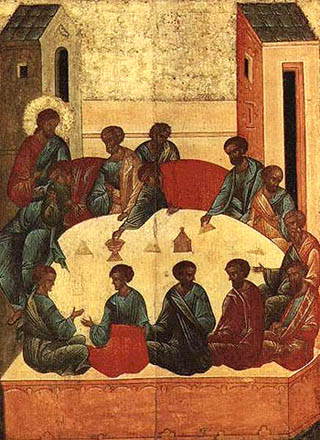
Maundy Thursday
Sign in to saveAlso known as Holy Thursday, Covenant Thursday, Great and Holy Thursday, Sheer Thursday, Thursday of Mysteries, Maunday-Thursday
Maundy Thursday, also referred to as Holy Thursday, or Thursday of the Lord's Supper, among other names, is a Christian feast during Holy Week that marks the beginning of the Paschal Triduum, and commemorates the Washing of the Feet (Maundy) and Last Supper of Jesus Christ with the Apostles, as described in the canonical gospels.
Maundy Thursday is a Christian holiday during Holy Week that commemorates Jesus Christ's Last Supper with his Apostles and his washing of their feet, as recorded in the gospels. The day marks the start of the Paschal Triduum, the most sacred period in the Christian calendar leading up to Easter.
AI-generated from the Wikipedia summary — may contain errors.
Wikipedia views (30d)
16,298 totalvia Wikimedia Pageviews API
Wikidata facts
- Instance of
- public holidays in the Philippines
- Part of
- Paschal Triduum
- Named after
- Thursday
- Followed by
- Good Friday
- Follows
- Holy Wednesday
- Main subject
- Last Supper
- Image
- Benedetto Caliari - Last Supper - WGA03772.jpg
Show 6 more facts
- Commons category
- Maundy Thursday
- described by source
- Wikitólica
- day of week
- Thursday
- color
- white
- commemorates
- Last Supper
- native label
- Dies Cenae Domini
via Wikidata · CC0
~24 min read
Encyclopedic overview
Maundy Thursday, also referred to as Holy Thursday, or Thursday of the Lord's Supper, among other names, is a Christian feast during Holy Week that marks the beginning of the Paschal Triduum, and commemorates the Washing of the Feet (Maundy) and Last Supper of Jesus Christ with the Apostles, as described in the canonical gospels.
It is the fifth day of Holy Week, preceded by Holy Wednesday (Spy Wednesday) and followed by Good Friday. "Maundy" comes from the Latin word mandatum, or commandment, reflecting Jesus' words "I give you a new commandment." The date of the day will vary according to whether the Gregorian calendar or the Julian calendar is used. Eastern churches generally use the Julian system.
Excerpted from Wikipedia’s “Maundy Thursday” article, available under the CC BY-SA 4.0 licence.
Gallery (13)
Available in 85 languages
- Español
- Français
- Deutsch
- 中文
- 日本語
- Русский
- Português
- Italiano
- العربية
- हिन्दी
- abstract
- Afrikaans
- Albanian
- Aragonese
- Bahasa Indonesia
- Banjar
- Basque
- Bavarian
Show 66 more
- Bikol
- Bosnian
- Breton
- Bulgarian
- Catalan
- Croatian
- Czech
- Danish
- Egyptian Arabic
- Esperanto
- Estonian
- Faroese
- Filipino
- Finnish
- Fon
- Friulian
- Galician
- Georgian
- Greek
- Guarani
- Hebrew
- Hungarian
- hyw
- Iban
- Icelandic
- Irish
- Javanese
- Latin
- Latvian
- Limburgish
- Lithuanian
- Lombard
- Low German
- Luxembourgish
- Macedonian
- Malay
- Malayalam
- Mingrelian
- Nederlands
- Norwegian
- Norwegian Nynorsk
- Pennsylvania German
- Picard
- Polski
- Romanian
- Scots
- Serbian
- Serbian (Latin)
- simple
- Slovak
- Slovenian
- Svenska
- Swahili
- Tamil
- Tiếng Việt
- Türkçe
- Ukrainian
- Urdu
- Walloon
- Waray
- Welsh
- Western Frisian
- Wu Chinese
- zh_yue
- فارسی
- 한국어
via Wikidata sitelinks · CC0