
mellotron
Sign in to saveAlso known as novatron
The Mellotron is an electro-mechanical musical instrument developed in Birmingham, England, in 1963. It is played by pressing its keys, each of which causes a length of magnetic tape to contact a capstan, which pulls it across a playback head. As the key is released, the tape is retracted by a spring to its initial position. Different portions of the tape can be played for different sounds.
Key facts
- Synthesizer.synth_name
- Mellotron
- Synthesizer.names
- Novatron
- Synthesizer.image
- Mellotron.jpg
- Synthesizer.image_caption
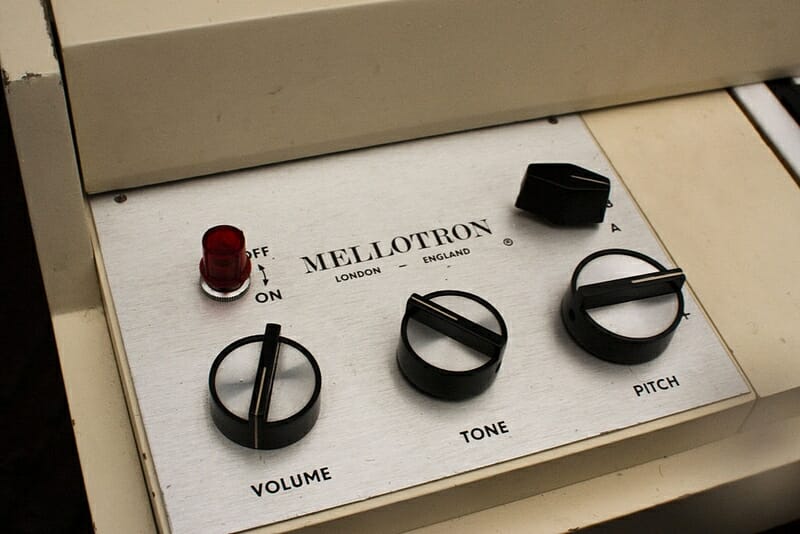
- A Mellotron Mk VI
- Synthesizer.synth_manufacturer
- Bradmatic/Mellotronics (1963–70)Streetly Electronics (1970–1986, 2007–present)
- Synthesizer.background
- keyboard
- Synthesizer.classification
- Keyboard
- Synthesizer.inventors
- Frank, Norman and Les Bradley
- Synthesizer.dates
- 1963 (Mk I)1964 (Mk II)1968 (M300)1970 (M400)2007 (M4000)
- Synthesizer.keyboard
- 1 or 2 × 35 note manuals (G2–F5)
- Synthesizer.polyphony
- Full
- Synthesizer.oscillator
- Audio tape
- Synthesizer.synthesis_type
- Sample-based synthesis
- Synthesizer.related
- Chamberlin, Birotron
via Wikipedia infobox
Official website
Mellotron, Mark VI, Mark VII, M4000D, Original, App, Rack
mellotron.com →Link to the official site · 4,508 chars · not written by Vinony
Described at
Mellotron: The Retro Instrument That's Shaping Modern Music
The mellotron is a fascinating, vintage instrument. Learn how this unique instrument works and how you can use it in your music.
mastering.com →The mellotron may be an old instrument, but it’s all over modern music. Just listen to the score for The Mandalorian So let’s talk about this trailblazer of an instrument. I’ll also cover some of the best Mellotron plugins for home studios. But if you want to learn about the Mellotron specifically, keep reading. Around 1950, Henry Chamberlin realized he could sample organ sounds using magnetic tape. With this technology, the Mellotron was officially developed in 1963. But the Mellotron was different. Folks realized you could emulate other instruments too. Like cellos, flutes, or literally anything that could be recorded. Nowadays, Mellotrons still use tape. Which can make the mechanisms somewhat stiff and definitely fragile. But the tape makes the whole thing sound and feel vintage. And it all adds to its classic sound. The opening sound features Mellotron flutes, one of the most common Mellotron sounds. As one of the most recognizable intros in modern music, SFF also opens with Mellotron flutes. Mellotron has a very cool vintage sound. And it was basically a MIDI controller for virtual instruments before MIDI even existed. But there are plugins that emulate a Mellotron. Here are the best ones to check out… This plugin has a wide range of instruments, and you get plenty of settings. You control the ADSR, flutter, noise floor, tone, pitch, and a bunch of other settings. This plugin is cool because you can load multiple samples on the Mellotron at once. So you could have flutes on the top half of the keyboard and cellos on the bottom half. You can access a bunch of factory samples, plus you can load your own samples. It’s a window that shows the noise and tape levels, attack, release, tone knobs, and a few other settings. You can choose one of 75 instrument samples. They sampled the instruments through cassette tapes with lo-fi cassette decks. Giving them a truly retro sound. Redtron SE samples sounds from a 1973 Mellotron M400S with just a bit of audio cleaning. Like removing clicks and pops. Like most Mellotrons, you control the ADSR, and you can layer two sounds together. UVI didn’t clean up the vintage sound of the Mellotron (which you might prefer). They give you 28 sounds and 12 presets. Plus, you have a bunch of basic and advanced settings. The interface seems pretty easy to use. It clearly shows you the knobs and dials on a virtual Mellotron. If you want this unique retro sound, play around with a Mellotron plugin. And you don’t have to use it in a vintage context—this instrument still works great in modern music.
Excerpt from a page describing this subject · 8,176 chars · not written by Vinony
Wikidata facts
- Headquarters
- Birmingham
- Official website
- www.mellotron.com
- Image
- Mellotron.jpg
Show 4 more facts
- Commons category
- Mellotrons
- Hornbostel-Sachs classification
- 524
- different from
- Melotron
- described at URL
- mastering.com/mellotron
via Wikidata · CC0
~21 min read
Encyclopedic overview
10 sectionsContents
- Operation
- History
- Notable users
- Competitors
- List of models
- Related products
- See also
- References
- Further reading
- External links
The Mellotron is an electro-mechanical musical instrument developed in Birmingham, England, in 1963. It is played by pressing its keys, each of which causes a length of magnetic tape to contact a capstan, which pulls it across a playback head. As the key is released, the tape is retracted by a spring to its initial position. Different portions of the tape can be played for different sounds.
The Mellotron evolved from the similar Chamberlin, but could be mass-produced more efficiently. The first models were designed for the home and contained a variety of sounds, including automatic accompaniments. Bandleader Eric Robinson and television personality David Nixon helped promote the first instruments, and celebrities such as Princess Margaret were early adopters. It was adopted by rock and pop groups in the mid to late 1960s. One of the first pop songs featuring the Mellotron was Manfred Mann's "Semi-Detached, Suburban Mr. James" (1966). The Beatles used it on tracks including the hit single "Strawberry Fields Forever" (1967).
Excerpted from Wikipedia’s “mellotron” article, available under the CC BY-SA 4.0 licence.