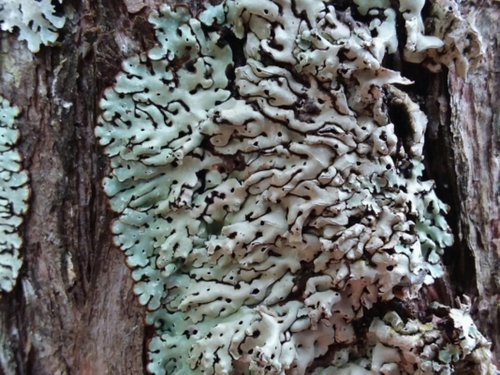
(c) Samuel Brinker, all rights reserved, uploaded by Samuel Brinker
Menegazzia
Sign in to saveMenegazzia is a genus of lichenized fungi containing roughly 70 accepted species. The group is sometimes referred to as the tree flutes, honeycombed lichens, or hole-punch lichens. The most obvious morphological feature of the genus is the distinctive perforations spread across the upper side of the thallus. This makes the group easy to recognise, even for those not particularly familiar with lichen identification.
Species
Tree Flute Lichen
GENUS
- KingdomFungi
- PhylumAscomycota
- ClassLecanoromycetes
- OrderLecanorales
- FamilyParmeliaceae
via GBIF
Museum specimens
- Specimen records
- 1,000
- With media
- 229
- Family
- Parmeliaceae
- Collections
- US, DUKE, NY, WIS
- Recorded in
- Australia, New Zealand, United States, Malaysia, Chile
Wikidata facts
- Instance of
- taxon
- Parent taxon
- Parmeliaceae
- Image
- Menegazzia pertransita - 2008 - BC Myles.jpg
Show 7 more facts
- topic's main category
- Category:Menegazzia
- taxon name
- Menegazzia
- taxon rank
- genus
- Commons category
- Menegazzia
- taxonomic type
- Menegazzia terebrata
- taxon common name
- honeycombed lichen
- taxon author citation
- A. Massal.
Sources (2)
via Wikidata · CC0
~6 min read
Encyclopedic overview
14 sectionsContents
- Etymology
- Taxonomy
- Characteristics
- Thallus
- Apothecia
- Spores
- Chemistry
- Ecology
- Evolution
- Uses
- Species
- Image gallery
- References
- External links
Menegazzia is a genus of lichenized fungi containing roughly 70 accepted species. The group is sometimes referred to as the tree flutes, honeycombed lichens, or hole-punch lichens. The most obvious morphological feature of the genus is the distinctive perforations spread across the upper side of the thallus. This makes the group easy to recognise, even for those not particularly familiar with lichen identification.
The genus has a sub-cosmopolitan distribution (excluding Antarctica), but is concentrated in Australasia, Melanesia, and southern South America. Most species grow exclusively on trees, but some grow on rocks, moss, and/or soil.
Excerpted from Wikipedia’s “Menegazzia” article, available under the CC BY-SA 4.0 licence.
Gallery (2)
Available in 9 languages
via Wikidata sitelinks · CC0