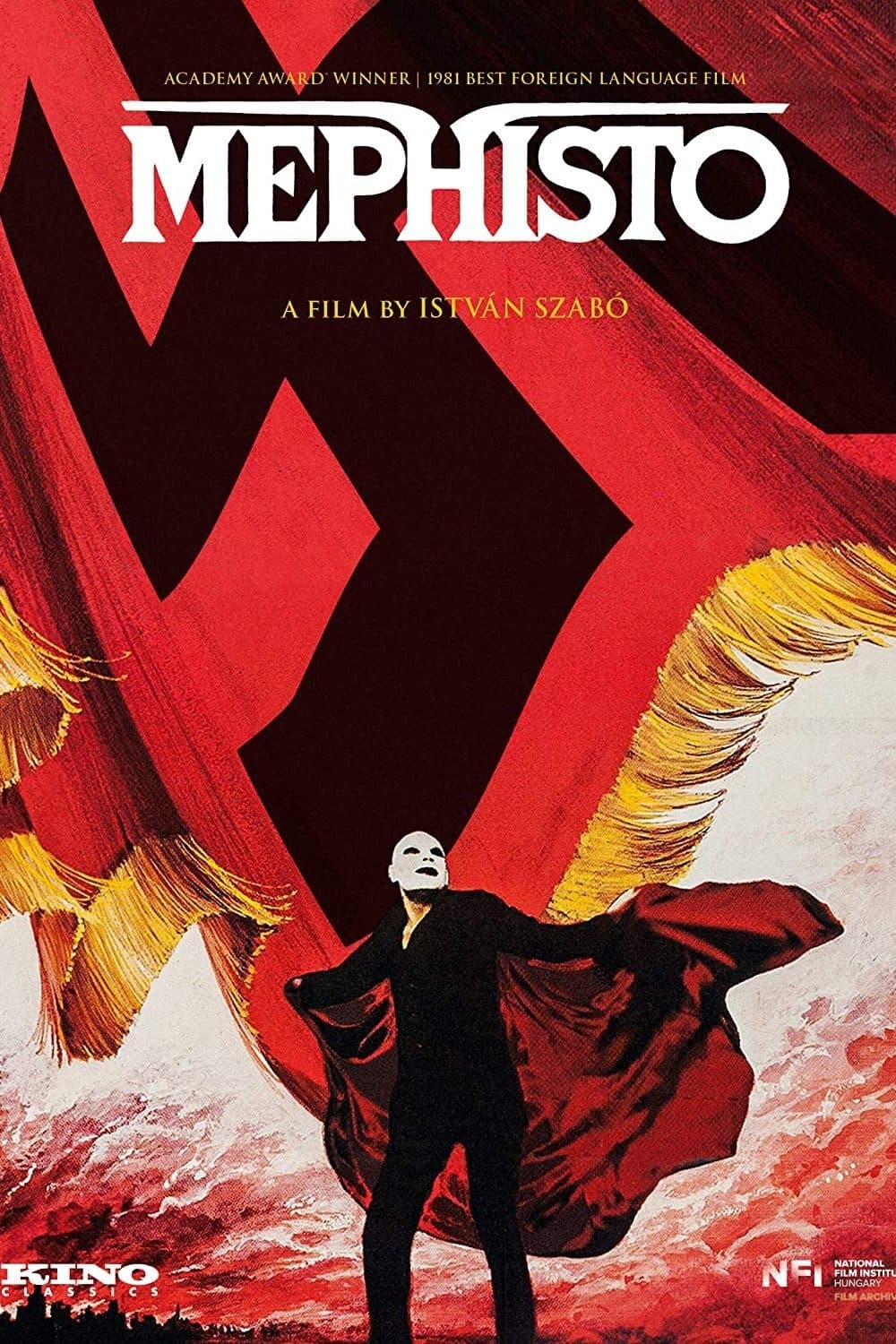
Poster from TMDB
Mephisto
Sign in to save1981 film directed by István Szabó
OverviewAI-generated
Mephisto is a 1981 drama and historical film directed by István Szabó, who also served as screenwriter alongside Péter Dobai. The cast includes Klaus Maria Brandauer, Krystyna Janda, Ildikó Bánsági, and Rolf Hoppe. Produced by Manfred Durniok, the film originates from Austria, Germany, and Hungary, with dialogue in Hungarian and German. Its narrative is set in Nazi Germany and takes place within a theatre building. The work is based on the source material titled Mephisto.
The film has a runtime of approximately 144 to 146 minutes. It received the Academy Award for Best International Feature Film, the National Board of Review Award for Best Foreign Language Film, and a Best Screenplay Award. Review scores include 7.5/10 and 80%. The film is distributed on video on demand by Netflix and was followed by Colonel Redl.
Synthesized by Vinony from 39 facts across 4 sources: Wikidata, TMDb, IMDb, Vinony graph. Generated from structured data (not the Wikipedia text) and checked against those facts — may still contain errors.
Film · TMDB
7.2A German stage actor finds unexpected success and mixed blessings in the popularity of his performance in a Faustian play as the Nazis take power in pre-WWII Germany. As his associates and friends flee or are ground under by the Nazi terror, the popularity of his character supercedes his own existence until he finds that his best performance is keeping up appearances for his Nazi patrons.
Cast
- Klaus Maria Brandauer as Hendrik Höfgen
- Krystyna Janda as Barbara Bruckner
- Ildikó Bánsági as Nicoletta von Niebuhr
- Rolf Hoppe as Tábornagy
- Karin Boyd as Juliette Martens
- György Cserhalmi as Hans Miklas
Themes
- career
- nazi
- pact with the devil
- demon
This product uses the TMDB API but is not endorsed or certified by TMDB.
Key facts
- Directed by
- István Szabó
- Screenplay by
- Péter Dobai, István Szabó
- Story by
- Péter Dobai
- Based on
- Mephisto , by Klaus Mann
- Produced by
- Manfred Durniok
- Starring
- Klaus Maria Brandauer , Krystyna Janda , Ildikó Bánsági , Rolf Hoppe , Martin Hellberg
- Cinematography
- Lajos Koltai
- Edited by
- Zsuzsa Csákány
- Music by
- Zdenko Tamássy
- Production company
- Mafilm Objektív Film Manfred Durniok Filmproduktion Hessischer Rundfunk ORF
- Distributed by
- Analysis Film Releasing Corporation (U.S.)
- Release dates
- 11 February 1981 ( 1981-02-11 ) ( Budapest premiere) 29 April 1981 ( 1981-04-29 ) (West Germany) 8 October 1981 ( 1981-10-08 ) (Hungary)
- Running time
- 144 minutes
- Countries
- Hungary, Austria, West Germany
- Language
- German
via Wikipedia infobox
Wikidata facts
- Instance of
- film
- Genre
- historical film
- Country of origin
- Hungary
- Original language
- German
- Followed by
- Colonel Redl
- Based on
- Mephisto
- Main subject
- Nazi Germany
- Director
- István Szabó
- Screenwriter
- Péter Dobai
- Cast member
- Hédi Temessy
- Producer
- Manfred Durniok
- Cinematographer
- Lajos Koltai
- Narrative location
- Germany
- Duration
- 144
- FilmAffinity ID
- 357580
- Distribution format
- video on demand
Show 5 more facts
- publication date
- 1981-01-01
- title
- Mephisto
- distributed by
- Netflix
- set in environment
- theatre building
- review score
- 80%
Sources (15)
via Wikidata · CC0
~5 min read
Encyclopedic overview
Mephisto is a 1981 German-language political drama film co-written and directed by István Szabó, and based on the novel of the same name by Klaus Mann. It stars Klaus Maria Brandauer as a German stage actor (modelled on Gustaf Gründgens) who finds unexpected success and mixed blessings in the popularity of his performance in a Faustian play as the Nazis take power in pre-Second World War Germany. As his associates and friends flee or are forced underground by the Nazi regime, the popularity of his character ends up superseding his own existence, until he finds that his best performance is keeping up appearances for his Nazi patrons.
The film was a co-production of Hungarian, Austrian, and West German studios; starring German and Hungarian-speaking actors. It premiered in Budapest on 11 February 1981 and received widespread acclaim from critics, winning the Academy Award for Best Foreign-Language Film, the first Hungarian picture to do so. Brandauer's performance earned him many accolades, including BAFTA and German Film Award nominations and launched his film career.
Excerpted from Wikipedia’s “Mephisto” article, available under the CC BY-SA 4.0 licence.