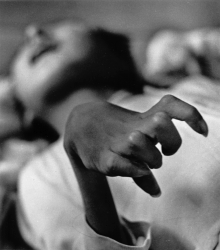
File:Tomokos_hand.gif · Wikimedia Commons · See Wikimedia Commons
Minamata disease
Sign in to savea severe neurological disease caused by mercury poisoning, first discovered in the Japanese city of Minamata.
Key facts
- Specialty
- Toxicology , neurology , psychiatry
- Symptoms
- Ataxia , numbness and muscle weakness
- Complications
- Loss of peripheral vision , and damage to hearing and speech ; in extreme cases: insanity , paralysis , coma ; can also affect fetuses ; see Mercury poisoning for more details
- Usual onset
- Soon after consuming affected seafood
- Duration
- Chronic
- Causes
- Severe mercury poisoning
- Risk factors
- Affected those who consumed fish and shellfish from Minamata Bay
- Diagnostic method
- See mercury poisoning
- Differential diagnosis
- See mercury poisoning
- Prevention
- Proper handling of industrial waste
- Treatment
- See mercury poisoning
- Medication
- See mercury poisoning
- Prognosis
- 35% case fatality rate ; for more details see mercury poisoning
via Wikipedia infobox
Wikidata facts
- Instance of
- environmental conflict
- Named after
- Minamata
- Country
- Japan
Show 6 more facts
- Commons category
- Minamata disease
- native label
- 水俣病
- topic's main category
- Category:Minamata disease
- health specialty
- emergency medicine
- has cause
- methylmercury(1+)
- perpetrator
- Chisso
Sources (1)
via Wikidata · CC0
~40 min read
Encyclopedic overview
Minamata disease (Japanese: 水俣病, Hepburn: Minamata-byō) is a neurological disease caused by severe mercury poisoning. Symptoms include ataxia, numbness in the hands and feet, general muscle weakness, loss of peripheral vision, and damage to hearing and speech. In extreme cases, insanity, paralysis, coma, and death follow within weeks of the onset of symptoms. A form of the disease in babies, with microcephaly, extensive cerebral damage, and symptoms similar to those seen in cerebral palsy also occurred.
Minamata disease was first discovered in the city of Minamata, Kumamoto Prefecture, Japan, in 1956. It was caused by the release of methylmercury in the industrial wastewater from a chemical factory owned by the Chisso Corporation, which continued from 1932 to 1968. It has also been suggested that some of the mercury sulfate in the wastewater was also metabolized to methylmercury by bacteria in the sediment. This highly toxic chemical bioaccumulated and biomagnified in shellfish and fish in Minamata Bay and the Shiranui Sea, which, when eaten by the local population, resulted in mercury poisoning. The poisoning and resulting deaths of both humans and animals continued for 36 years, while Chisso and the Kumamoto prefectural government did little to prevent the epidemic. The animal effects were severe enough in cats that they came to be named as having "dancing cat fever."
Excerpted from Wikipedia’s “Minamata disease” article, available under the CC BY-SA 4.0 licence.