
Minquiers
Sign in to saveAlso known as Les Minquiers, the Minkies
The Minquiers (; Les Minquiers with definite article; ; known as "the Minkies" in local English) are a group of islands and rocks, about south of Jersey. They form part of the Bailiwick of Jersey. They are administratively part of the Parish of Grouville, and of its Vingtaine La Rocque.
Key facts
- Islands.name
- Minquiers
- Islands.image_name
- La Maîtr' Île, Les Mîntchièrs.jpg
- Islands.image_caption
- La Maîtr' Île
- Islands.image_size
- 250px
- Islands.map_image
- Jersey-Les Minquiers.png
- Islands.local_name
- Les Minquiers, Les Mîntchièrs, The Minkies
- Islands.location
- English Channel
- Islands.major_islands
- Maîtresse Île / Maîtr' ÎleLes Maisons
- Islands.country
- Jersey
- Islands.country_admin_divisions_title
- Parish
- Islands.country_admin_divisions
- Grouville
- Islands.population
- none permanent
via Wikipedia infobox
Described at
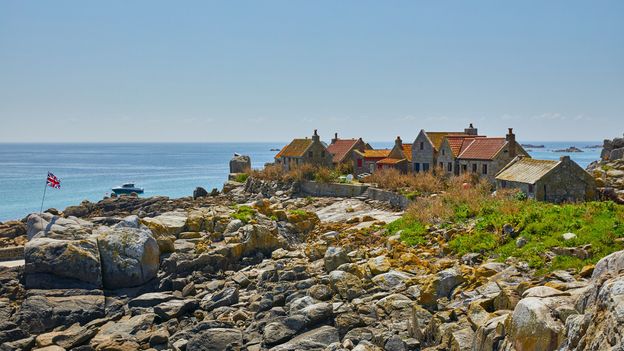
The British islands that disappear every day
Located between Britain and France, the Minquiers have long been subject to the squabbles of dukedoms and governments, torn between Normans, Britons and French for 1,000-plus years.
bbc.com →Located between Britain and France, the Minquiers have long been subject to the squabbles of dukedoms and governments, torn between Normans, Britons and French for 1,000-plus years. "This toilet has the distinction of being the most southern building in the British Isles," reads its neatly printed sign. "Please use with care! The nearest alternative is Jersey 11 miles – Chausey 10 miles." This toilet has the distinction of being the most southern building in the British Isles. Please use with care! At low tide, the islands have a land area around 10 miles long and 7 miles wide – larger than Jersey itself, or the city of Manchester. At high tide, just six hours later, they disappear: barely a few rocks protrude from the water, adding up to around 0.004 square miles. This lends the Minkies, as they are known to locals, a strange atmosphere: part rocky desert-island chain, part watery Atlantis, straddling the boundary between land and sea. This is a liminal place – a place in between – in more ways than one. Floating between Britain and France, the Minquiers have long been subject to not just the whims of the tides, but the squabbles of dukedoms and governments, torn between Normans, Britons and French for more than 1,000 years. Today, they are under the jurisdiction of Jersey, counting as a self-governing part of the British Isles but not part of the United Kingdom. "It's been fought over since 955 CE," said Josh Dearing, skipper of the Jersey Seafaris boat that had just ferried me to Maîtresse over a pancake-flat English Channel, "but the buildings have been here since the 1800s." Dearing – who doubles as a tour guide – led me through Maîtresse's ghostly village, its stone buildings in varying states of disrepair and decay. "They were built by fishermen from the harbour of La Rocque [in southern Jersey], and also miners and quarrymen [who were] after the island's granite," said Dearing. Foragers for vraic – seaweed used as fertiliser – would also make landing here. On the island's northern shore are the ruins of a former hospital, used to treat miners' injuries during the quarrying period in the 19th Century. The buildings sit on the only part of the island that doesn’t vanish with the tides. For the same reason, this is the only scrap of land on the Minquiers that supports greenery, in the form of scented pelargoniums – planted by fishermen who used their soft leaves as toilet paper. Dearing pointed out a neatly carved graffito on the hospital's outside wall, displaying the initials "C BS" above a date: 1865. Most of the buildings date from this time. Nowadays a few of the cottages are still used by fishermen, but most are privately owned by a handful of Jersey families, who will spend a night or two on Maîtresse when the weather is fine. There are no permanent residents, and no hotels – or anywhere else – for tourists to stay. Sales of the cottages are rare, and the owners are protective of their property. As well they might be, for invaders from near and far have long coveted the Minquiers for their strategic and economic importance. "Whoever controls the Minquiers controls the fishing grounds," explained maritime historian Doug Ford, "and for the last 200 years this has also meant the territorial waters. The offshore reefs create a massive barrier, funnelling approaching vessels into easily monitored spaces." The Minquiers were ceded to Edward III of England in 1360, passed into the ownership of French monasteries, and were seized back by Henry V in 1413. They became a favoured hideout for pirates and smugglers who took advantage of the islands' remoteness and inaccessibility – these reefs are treacherous, and have dashed many vessels to shipwreck. The islands were the setting for a diplomatic crisis in 1929, when a Parisian banker decided to build a house here; and again in 1939, when the French artist and yachtsman known as Marin-Marie carried a prefabricated hut to Maîtresse and raised the French flag over the
Excerpt from a page describing this subject · 13,625 chars · not written by Vinony
Wikidata facts
- Instance of
- reef
- Part of
- Minquiers and Ecréhous
- Country
- Jersey
- Located in
- Grouville
- Population
- 0
- Time zone
- UTC±00:00
- Body of water
- English Channel
- Image
- Peter Colback August 2013 Minquiers Dodger 10.JPG
Show 3 more facts
- Commons category
- Minquiers
- nickname
- Minkies
Sources (2)
via Wikidata · CC0
~5 min read
Encyclopedic overview
11 sectionsContents
- Name
- Geography
- Islets
- Protection
- History
- Resolution of status
- In literature
- See also
- Images
- References
- External links
The Minquiers (; Les Minquiers with definite article; ; known as "the Minkies" in local English) are a group of islands and rocks, about south of Jersey. They form part of the Bailiwick of Jersey. They are administratively part of the Parish of Grouville, and of its Vingtaine La Rocque.
The rock shelf around the Minquiers has a larger surface area than Jersey itself, but at high tide, only a few of the main heads remain above water. The largest of these is Maîtresse, measuring approximately 50 metres (55 yards) in length and 20 metres (22 yards) in width, featuring around ten stone cottages in varying conditions of preservation. These are the most southerly buildings in the British Isles, but they have no permanent inhabitants; though fishermen, vraic (seaweed used for fertilizer) collectors, yachtsmen, kayakers, and even radio amateurs make summer landfall.
Excerpted from Wikipedia’s “Minquiers” article, available under the CC BY-SA 4.0 licence.
On the map
2 mapped locations