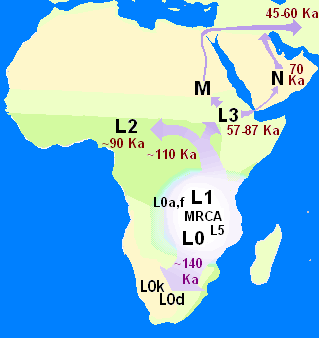
File:Early_diversification.PNG · Wikimedia Commons · See Wikimedia Commons
mitochondrial Eve
Sign in to saveAlso known as mt-MRCA, mitochondrial mother
matrilineal most recent common ancestor of all living humans
Key facts
- Possible time of origin
- c. 100–230 kya
- Possible place of origin
- East Africa
- Ancestor
- n/a
- Descendants
- Haplogroup L0 Haplogroup L1-6
- Defining mutations
- None
via Wikipedia infobox
Wikidata facts
- Instance of
- human
- Subclass of
- most recent common ancestor
- Named after
- Eve
- Gender
- female
- Official website
- www.ebm-guidelines.com/xmedia/duo/duo95417.pdf
- Said to be same as
- Eve
Show 2 more facts
- Commons category
- Mitochondrial Eve
- opposite of
- Y-chromosomal Adam
via Wikidata · CC0
~19 min read
Encyclopedic overview
In human genetics, the Mitochondrial Eve (more technically known as the Mitochondrial-Most Recent Common Ancestor, shortened to mt-Eve or mt-MRCA) is the matrilineal most recent common ancestor (MRCA) of all living humans. In other words, she is defined as the most recent woman from whom all living humans descend in an unbroken line purely through their mothers and through the mothers of those mothers, back until all lines converge on one woman.
In terms of mitochondrial haplogroups, the mt-MRCA is situated at the divergence of macro-haplogroup L into L0 and L1–6. As of 2013, estimates on the age of this split ranged at around 155,000 years ago, consistent with a date later than the speciation of Homo sapiens but earlier than the recent out-of-Africa dispersal.
Excerpted from Wikipedia’s “mitochondrial Eve” article, available under the CC BY-SA 4.0 licence.