
Monaco
Sign in to saveAlso known as Principality of Monaco, mc, Fort-Hercule, Principality and Diocese of Monaco, Principauté de Monaco, Mùnegu, Prinçipatu de Mùnegu, Principato di Monaco
Monaco, officially the Principality of Monaco, is a sovereign city-state and microstate in Western Europe. Situated on the French Riviera, it is a semi-enclave bordered by France to the north, east, and west, with the Mediterranean Sea to the south; the Italian region of Liguria is about east. With a population of 38,423 living in an area of , Monaco is the second smallest sovereign state in the world, after Vatican City, as well as the most densely populated. It also has the world's shortest national coastline of any non-landlocked nation, at . Fewer than 10,000 of its residents are Monégasqu
OverviewAI-generated
Monaco, officially the Principality of Monaco, is a sovereign state and city-state located in Western Europe. It shares a border with France and has Monaco as its capital. The country operates as a constitutional and hereditary monarchy, with the National Council serving as its legislative body. French is the official language, and the euro is a currency used there.
The nation has a population of 38,423 and covers an area of 2.02 square kilometers. It is fully urbanized, with 100 percent of the population living in urban areas. The highest points include Chemin des Révoires, Mont Agel, and Tête de Chien. Its top-level Internet domain is .mc, and it is a member of the United Nations and the Council of Europe.
Monaco is twinned with Kuwait City, Lucciana, and Rivne. The patron saint is Devota, and the anthem is Hymne monégasque. The country is located in the UTC+01:00 time zone. Its postal code is 98000.
Synthesized by Vinony from 65 facts across 9 sources: Wikidata, REST Countries, Open Meteo, Openweathermap, World Bank, OpenStreetMap, PubMed, Vinony graph, Geo. Generated from structured data (not the Wikipedia text) and checked against those facts — may still contain errors.
Weather now
7-day forecast
via Open-Meteo
Country
- Capital
- Monaco
- Population
- 38,423
- Region
- Europe · Western Europe
- Demonym
- Monegasque
- Currencies
- EUR (€)
- Languages
- French
- Calling code
- +377
- Drives on
- Right
- TLD
- .mc
- Timezones
- UTC+01:00
- Borders
- FRA
via REST Countries
Indicators · World Bank
- GDP
- $11.1B(2024)
- Population
- 38,631(2024)
- Life expectancy
- 86.5 yrs(2024)
- Urban population
- 100 %(2024)
- Internet users
- 99 %(2024)
- Forest area
- 0 %(2023)
via World Bank Open Data · CC BY 4.0
Wikipedia views (30d)
201,735 totalvia Wikimedia Pageviews API
Key facts
- Country.conventional_long_name
- Principality of Monaco
- Country.common_name
- Monaco
- Country.image_flag
- Flag of Monaco.svg
- Country.flag_size
- 120
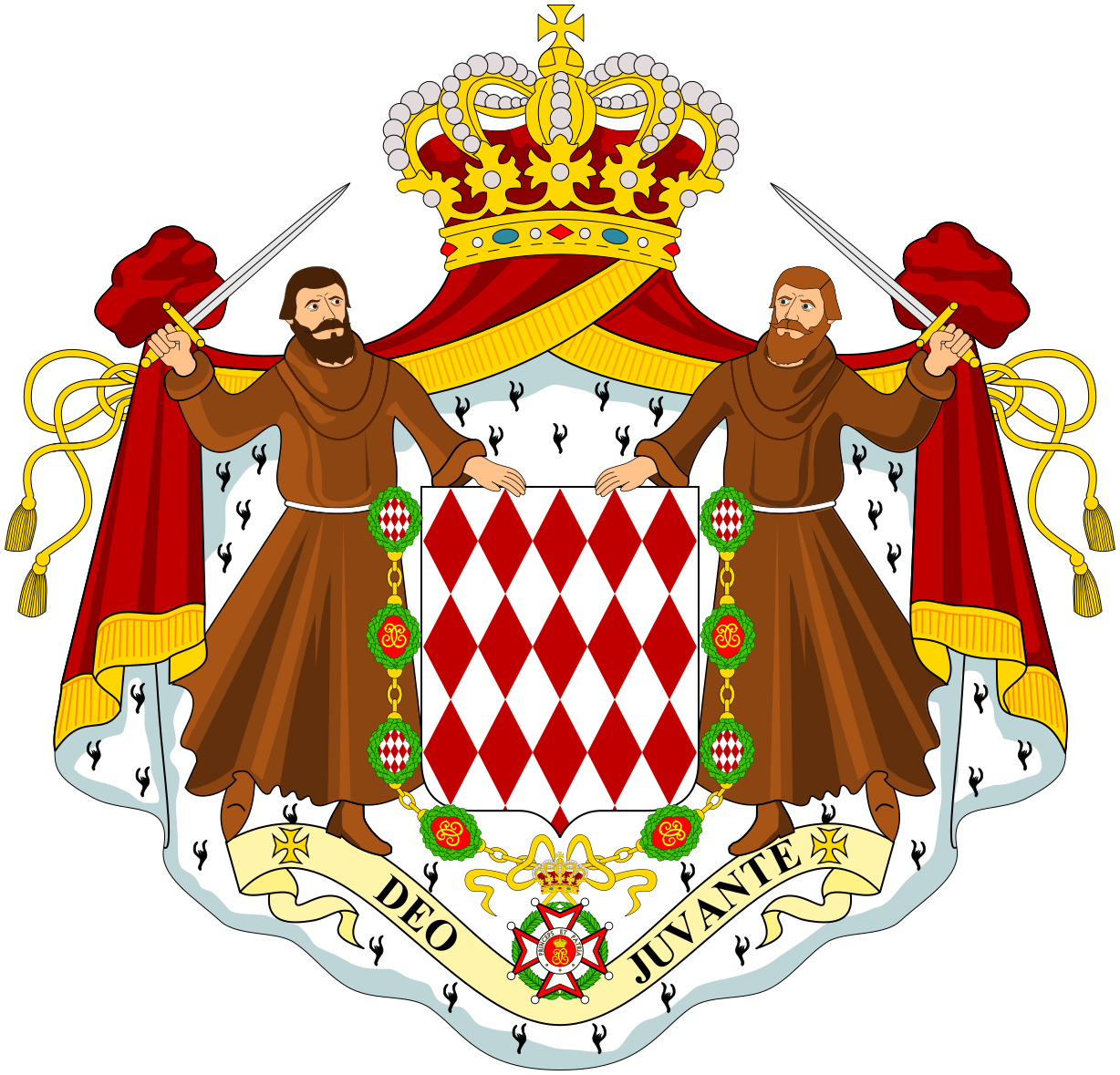
- Country.image_coat
- Great coat of arms of the house of Grimaldi.svg
- Country.coa_size
- 90
- Country.national_motto
- ()
- Country.national_anthem
- ""()File:Monaco National Anthem.ogg
- Country.image_map
- Monaco Europe Location.svg
- Country.capital
- Monaco
- Country.largest_settlement
- Monte Carlo
- Country.largest_settlement_type
- quarter
- Country.official_languages
- French (Meridional)
- Country.languages_type
- Common languages
- Country.government_type
- Unitary parliamentary semi-constitutional monarchy
- Country.leader_title1
- Monarch
- Country.leader_name1
- Albert II
- Country.leader_title2
- Minister of State
via Wikipedia infobox
Research
10,326 papers- The Minderoo-Monaco Commission on Plastics and Human Health.ReviewAnnals of global health · 2023Landrigan PJ, Raps H, Cropper M et al.DOI: 10.5334/aogh.4056
- Monaco treatment planning system tools and optimization processes.ReviewMedical dosimetry : official journal of the American Association of Medical Dosimetrists · 2018Clements M, Schupp N, Tattersall M et al.DOI: 10.1016/j.meddos.2018.02.005
- The Minderoo-Monaco Commission on Plastics and Human Health.Annals of global health · 2023Editorial to accompany the Minderoo-Monaco Commission on Plastics and Human Health in the journal, Annals of Global Health, Neira MDOI: 10.5334/aogh.4083
- Announcing the Minderoo - Monaco Commission on Plastics and Human Health.Annals of global health · 2022Landrigan PJ, Raps H, Symeonides C et al.DOI: 10.5334/aogh.3916
- Monaco.Department of State publication. Background notes series · 1985United States. Department of State. Bureau of Public Affairs
- Anthony Monaco, MD, FACS (1932-2022).Transplantation · 2023DOI: 10.1097/TP.0000000000004506
- American physician in the land of smiles: Dr Robert Monaco in Thailand.British journal of sports medicine · 2024MacDonald JP, Kerr HDOI: 10.1136/bjsports-2023-108015
- November in Monaco.Developmental medicine and child neurology · 2005Evrard PDOI: 10.1017/S0012162205001325
via PubMed
Wikidata facts
- Instance of
- country
- Official name
- Furstendömet Monaco
- Demonym
- Monegassinnen
- Country
- Monaco
- Continent
- Europe
- Capital
- Monaco City
- Official language
- French
- Currency
- Monegasque franc
- Population
- 38857
- Area
- 2.08
- Time zone
- UTC+01:00
- Body of water
- Ligurian Sea
- Head of state
- Albert II, Prince of Monaco
- Form of government
- hereditary monarchy
- Legislature
- National Council
- Anthem
- Hymne monégasque
- Shares border with
- France
- Highest point
- Tête de Chien
- Followed by
- Free Cities of Menton and Roquebrune
- Official website
- www.gouv.mc
- Image
- Panorama von Monaco-La Turbie.jpg
- Nominal GDP
- 8596156574
- Calling code
- +377
- Licence plate code
- MC
Show 59 more facts
- Electrical plug type
- Schuko
- Mains voltage
- 230
- Motto
- Deo Juvante
- Flag
- flag of Monaco
- Coat of arms
- coat of arms of Monaco
- Patron saint
- Devota
- twinned administrative body
- Rivne
- topic's main Wikimedia portal
- Portal:Monaco
- Commons category
- Monaco
- top-level Internet domain
- .mc
- postal code
- 98000
- topic's main category
- Category:Monaco
- inception
- 1297-01-08
- category for people who died here
- Category:Deaths in Monaco
- category for people born here
- Category:Births in Monaco
- category for films shot at this location
- Category:Films shot in Monaco
- category for people buried here
- Category:Burials in Monaco
- category of associated people
- Category:Monegasque people
- diplomatic relation
- China
- history of topic
- history of Monaco
- IPA transcription
- mɐˈnakə
- Commons gallery
- Monaco
- lowest point
- Mediterranean Sea
- mobile country code
- 212
- driving side
- right
- geography of topic
- Geography of Monaco
- age of majority
- 21
- native label
- Prinçipato de Mónego
- office held by head of government
- Minister of State of Monaco
- executive body
- Council of Government
- office held by head of state
- Prince of Monaco
- has characteristic
- free country
- located in/on physical feature
- Western Europe
- maritime identification digits
- 254
- annual number of weddings
- 86
- Unicode character
- 🇲🇨
- language used
- French
- GS1 country code
- 300-379
- VAT rate
- 19.6
- coextensive with
- Commune of Monaco
- highest judicial authority
- Supreme Court of Monaco
- official religion
- Catholicism
- economy of topic
- economy of Monaco
- demographics of topic
- demographics of Monaco
- P8168
- Ilene Woods
- P11012
- Big Bang
- hashtag
- Monaco
- on focus list of Wikimedia project
- Wikipedia:Vital articles/Level/4
- social media followers
- 37160
- present in work
- Civilization V
- different from
- Monaco City
- name in native language
- Principauté de Monaco
- P12749
- Collelongo
- male population
- 17872
- rural population
- 0
- female population
- 18596
- urban population
- 36469
- name
- Hoành Quốc
Sources (15)
via Wikidata · CC0
Travel guide
Understand
This is the second smallest independent state in the world (after the Vatican) and is entirely urban. Monte Carlo is not the capital of Monaco but a government district. The country is divided into nine sectors: Monaco-Ville (the old city), the Condamine (port quarter), Monte-Carlo (business and recreation) and Fontvieille (recreation, second port for smaller boats and light industry) are the most well-known among them.
With no natural resources to exploit other than its location and climate, the principality has become a resort for tourists and a tax haven for wealthy people. Monaco is six times the size of the Vatican and the world's most densely populated country. While its borders have not moved since 1861 (when it lost over 80% of its territory to France), Monaco has still grown its territory by creating artificial land from the sea, which is how the area Fontvielle came to be. Its size is smaller than Central Park.
Get in
Although Monaco is not part of the Schengen Area, it has open borders with France, so it can for all practical purposes be considered part of it. If you want a passport stamp, you can queue for one at the Mairie de Monaco. There is border control for arriving boats from outside the Schengen Area.
If you want to stay for more than 90 days, you will need to obtain a residence permit.
Monaco does not issue its own visas, and instead accepts a Schengen visa for entry. If you plan to visit only Monaco and are entering by boat directly from outside the Schengen Area, you will need to apply for a Schengen visa from a French diplomatic mission (if one is required for your nationality).
Get around
Note that (as of September 2024) it is very difficult to store luggage. The train station info desk even has a sign outright saying it's not possible anywhere in the country.
See
The principality of Monaco offers a great balance of historical and modern attractions. There are various museums and palaces to visit as well as shopping malls and casinos. Monaco also offers relaxation spots along the harbour and even around the attractions. It is relatively easy to navigate Monte Carlo and Monaco if you take the time to learn where the various "short cuts" are. City maps are generally available at most news vendor stands and shops for a small fee. The could be a good starting point before venturing to explore the city.
thumb|right|300px|Monte Carlo Casino thumb|300px|Opéra de Monaco thumb|300px|Monaco-Ville, featuring the Prince's Palace of Monaco thumb|140px|right|Guard at the Prince's Palace thumb|Cathedral Notre-Dame-Immaculée thumb|Musée Océanographique facing the sea thumb|Jardin Exotique with city in the background
Do
thumb|300px|Panoramic view from Tête de Chien
Eat
Food in Monaco is varied, but generally expensive, and even very basic meals often cost over €20-30. Take a look at the menu before entering even shabby restaurants or you may be in for a surprise. There are places where you can find decent value, but they often require knowing about beforehand. Restaurants where locals dine are often located a little bit away from the waterfront and often serve better food for lower prices (however, since you are in Monaco: nothing is a bargain).
There are many restaurants catering to tourists, from the Cafe de Paris across the street from the casino, to the waterfront restaurants along the Port de Fontvieille. During the winter months, you will find the restaurants to have a slightly lower price tag. Bouillabaisse is a good tip.
Drink
Champagne has the status of a national beverage in Monaco. A single glass can cost as much as €40 at a fashionable restaurant!
Sleep
thumb|Fairmont Hotel with the tunnel used in the yearly F1 race
Respect
In many ways, the Respect section of the France page can detail how to be respectful toward the Monegasque population, but Monaco is a separate nation and it may be insulting to casually conflate the two. Monaco's population retain their own history, their own culture, and their own lifestyle. Directions or other help are only a smile and a question away.
Stay safe
Monaco is one of the safest places on the planet, with nationwide video surveillance and one police officer per 100 residents. You can feel safe wearing your diamonds and Rolex, even for a night walk through the streets or coastline, with almost no street-crime, and a strong police presence. It has one of the lowest homicide rates of any country in the world, and among the lowest in terms of overall violent crime. Because of their wealth, public spaces are blanketed with cameras and any kind of disorder may produce an immediate reaction and the attendance of several officers. However, pickpocketing may occur during sporting events, like the Formula One Grand Prix and major football games.
Homosexuality is legal, although there are no specifically gay places in Monaco. You can walk with your same-sex partner hand in hand without being insulted in public places.
Monaco security can follow anyone on public areas, streets & corridors, using the vast camera network without losing you from their screens.
Be wary of dive-bombing seagulls. They like to steal food from people eating outdoors.
Travel guide from Wikivoyage (CC BY-SA 4.0)
~40 min read
Encyclopedic overview
43 sectionsContents
- History
- Arrival of the Grimaldi family
- 1400–1800
- 19th century
- 20th century
- 21st century
- Geography
- Climate
- Government and politics
- Politics
- Administrative divisions
- Traditional quarters and modern geographic areas
- Wards
- Foreign relations
- Twin cities
- Security and military
- Economy
- Tourism
- Gambling industry
- Low taxes
- Numismatics
- Transport
- Demographics
- Language
- Religion
- Education
- Primary and secondary schools
- Colleges and universities
- Culture
- Architecture
- Visual arts
- Museums
- Events, festivals, and shows
- Bread festival
- Parks and gardens
- Music
- Cuisine
- Sports
- Flag
- See also
- Notes
- References
- External links
Monaco, officially the Principality of Monaco, is a sovereign city-state and microstate in Western Europe. Situated on the French Riviera, it is a semi-enclave bordered by France to the north, east, and west, with the Mediterranean Sea to the south; the Italian region of Liguria is about 15 km (9.3 mi) east. With a population of 38,423 living in an area of 2.08 km (0.80 sq mi), Monaco is the second smallest sovereign state in the world, after Vatican City, as well as the most densely populated. It also has the world's shortest national coastline of any non-landlocked nation, at 3.83 km (2.38 mi). Fewer than 10,000 of its residents are Monégasque nationals. Although French is the official language of Monaco, Italian and Monégasque are also widely spoken and understood.
Monaco is governed under a form of semi-constitutional monarchy, with Prince Albert II as head of state, who holds substantial political powers. The prime minister, who is the head of government, can be either a Monégasque or French citizen; the monarch consults with the Government of France before an appointment. Key members of the judiciary are detached French magistrates. The House of Grimaldi has ruled Monaco, with brief interruptions, since 1297. The state's sovereignty was officially recognised by the Franco-Monégasque Treaty of 1861, with Monaco becoming a full United Nations voting member in 1993. Despite Monaco's independence and separate foreign policy, its defence is the responsibility of France, notwithstanding two small military units.
Excerpted from Wikipedia’s “Monaco” article, available under the CC BY-SA 4.0 licence.
Gallery (59)
On the map
3 mapped locations
Available in 267 languages
- Español
- Français
- Deutsch
- 中文
- 日本語
- Русский
- Português
- Italiano
- العربية
- हिन्दी
- Abkhazian
- abstract
- Achinese
- Afrikaans
- Akan
- Albanian
- Albanian
- Amharic
Show 248 more
- ami
- Angika
- Aragonese
- Aramaic
- Armenian
- Arpitan
- Asturian
- Avaric
- Awadhi
- azb
- Azerbaijani
- Bahasa Indonesia
- Balinese
- Bangla
- Bashkir
- Basque
- bat_smg
- Bavarian
- be_x_old
- Belarusian
- Betawi
- Bhojpuri
- Bikol
- Bishnupriya
- Bislama
- Bosnian
- Breton
- Bulgarian
- Buriat
- Burmese
- Catalan
- cbk_zam
- cdo
- Cebuano
- Central Kurdish
- Chamorro
- Chechen
- Cherokee
- Church Slavic
- Chuvash
- Cornish
- Corsican
- Crimean Tatar
- Croatian
- Czech
- dag
- Danish
- Divehi
- dty
- Dzongkha
- Egyptian Arabic
- Erzya
- Esperanto
- Estonian
- Ewe
- Extremaduran
- Faroese
- Fiji Hindi
- Filipino
- Finnish
- fiu_vro
- Friulian
- Fula
- Gagauz
- Galician
- Ganda
- gcr
- Georgian
- Gilaki
- Goan Konkani
- Gothic
- Greek
- Guarani
- Gujarati
- Haitian Creole
- Hakka Chinese
- Hausa
- Hawaiian
- Hebrew
- Hungarian
- hyw
- Iban
- Icelandic
- Ido
- Igbo
- Iloko
- Inari Sami
- Interlingua
- Interlingue
- Inuktitut
- Irish
- Jamaican Creole English
- Javanese
- Kabardian
- Kabyle
- Kannada
- Kanuri
- Kara-Kalpak
- Karachay-Balkar
- Kashmiri
- Kashubian
- Kazakh
- kbp
- Khmer
- Kinyarwanda
- Komi
- Komi-Permyak
- Kongo
- Kotava
- Kurdish
- Kyrgyz
- Ladino
- Lao
- Latgalian
- Latin
- Latvian
- Lezghian
- Ligurian
- Limburgish
- Lingala
- Lingua Franca Nova
- Lithuanian
- lld
- Lombard
- Low German
- Lower Sorbian
- Luxembourgish
- Macedonian
- Madurese
- Malagasy
- Malay
- Malayalam
- Maltese
- Manipuri
- Manx
- Māori
- map_bms
- Marathi
- Mari
- Mazanderani
- Minangkabau
- Mingrelian
- Mirandese
- Moksha
- Mongolian
- Moroccan Arabic
- nds_nl
- Neapolitan
- Nederlands
- Nepali
- Newari
- Northern Frisian
- Northern Sami
- Norwegian
- Norwegian Nynorsk
- Novial
- Obolo
- Occitan
- Old English
- olo
- Oromo
- Ossetic
- Palatine German
- Pampanga
- Pangasinan
- Papiamento
- Pashto
- Picard
- Piedmontese
- Polski
- Pontic
- Punjabi
- Quechua
- roa_rup
- roa_tara
- Romanian
- Romansh
- Rusyn
- Samoan
- Sanskrit
- Santali
- Sardinian
- Saterland Frisian
- Scots
- Scottish Gaelic
- Serbian
- Serbian (Latin)
- Shan
- Shona
- Sicilian
- Silesian
- simple
- Sindhi
- Sinhala
- Slovak
- Slovenian
- Somali
- Sranan Tongo
- Sundanese
- Svenska
- Swahili
- Swati
- szy
- Tachelhit
- Tajik
- Talysh
- Tamil
- Taroko
- Tatar
- Telugu
- Tetum
- Tibetan
- Tiếng Việt
- Toki Pona
- Tongan
- Tsonga
- Tumbuka
- Türkçe
- Turkmen
- Udmurt
- Ukrainian
- Upper Sorbian
- Urdu
- Uyghur
- Uzbek
- Venetian
- Veps
- Volapük
- Walloon
- Waray
- Welsh
- West Flemish
- Western Frisian
- Western Panjabi
- Wolof
- Wu Chinese
- Yakut
- Yiddish
- Yoruba
- Zaza
- Zeelandic
- zh_classical
- zh_min_nan
- zh_yue
- Zhuang
- فارسی
- ไทย
- 한국어
via Wikidata sitelinks · CC0