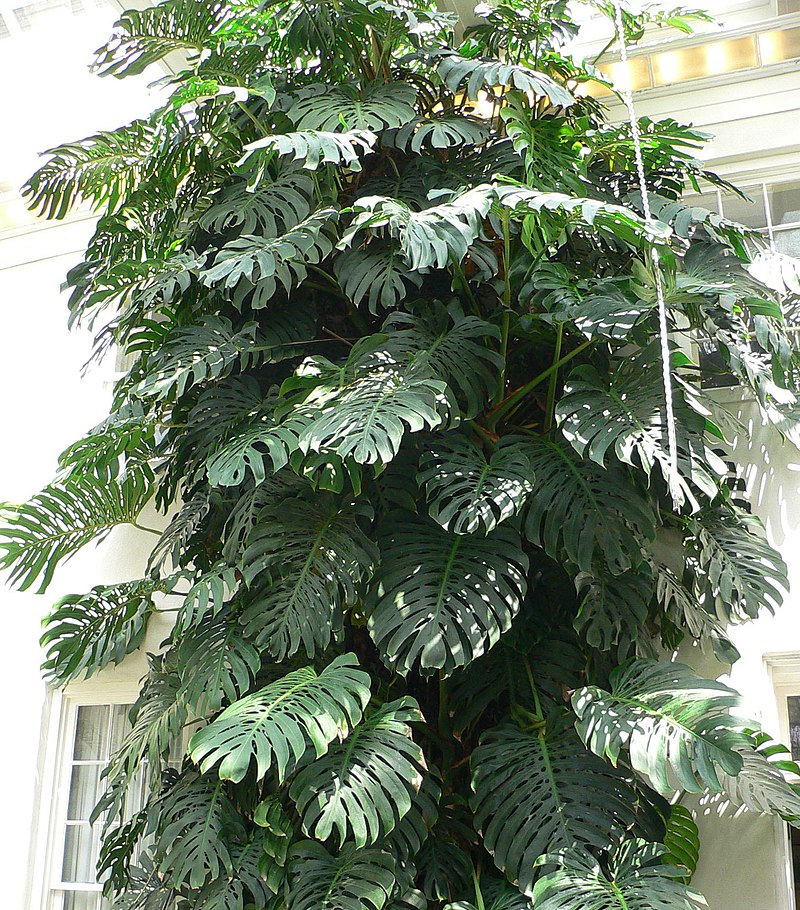
File:Monstera_deliciosa2.jpg · Wikimedia Commons · See Wikimedia Commons
Monstera deliciosa
Sign in to saveAlso known as Fruit Salad Plant, Swiss Cheese Plant, split-leaf philodendron
species of plant
OverviewAI-generated
Monstera deliciosa, commonly known as the Swiss Cheese plant, tarovine, or Cerimán, is a species within the family Araceae. It belongs to the genus Monstera and is classified under the order Alismatales. The taxon is accepted with the authority citation Liebm. Its native range includes Guatemala and various regions of Mexico, specifically the Gulf, Southeast, and Southwest areas.
The plant is also recorded in Beijing, Fujian, and Guangdong in China. Occurrence data from iDigBio lists records from Mexico and Costa Rica, associated with institutions such as ECOSUR, UACH, UNICACH, CICY, and UJAT. The species has 6,165 occurrences recorded in GBIF and 485 records in iDigBio, which includes 307 media items.
Synthesized by Vinony from 39 facts across 8 sources: Wikidata, GBIF, Plants of the World, Gbif Occ, Encyclopedia of Life, WoRMS, iDigBio, Vinony graph. Generated from structured data (not the Wikipedia text) and checked against those facts — may still contain errors.
Species
locust and wild honey
SPECIES
- KingdomPlantae
- PhylumTracheophyta
- ClassLiliopsida
- OrderAlismatales
- FamilyAraceae
龜背芋(学名:Monstera deliciosa),又稱為龜背竹、蓬萊蕉及電信蘭,是天南星科龜背芋属植物。 龜背芋適應性強,性喜温暖,潮湿的环境,但也耐陰、耐陽及有一定的耐旱性,原产于墨西哥的热带雨林中。为著名大型观赏植物。
via GBIF · Kew POWO
Museum specimens
- Specimen records
- 485
- With media
- 307
- Family
- Araceae
- Collections
- ECOSUR, UACH, UNICACH, CICY, UJAT, INECOL
- Recorded in
- Mexico, Costa Rica
Wikidata facts
Show 9 more facts
Sources (1)
via Wikidata · CC0
~9 min read
Encyclopedic overview
Monstera deliciosa, the Swiss cheese plant or split-leaf philodendron, is a species of flowering plant. The common name "Swiss cheese plant" is also used for the related species from the same genus, Monstera adansonii. The common name "split-leaf philodendron" is also used for the species Philodendron bipinnatifidum.
Monstera deliciosa is native to tropical forests of southern Mexico, south to Panama. It has been introduced to many tropical areas, and considered a low-to-moderate invasion risk in Hawaii, Seychelles, Ascension Island and the Society Islands. It is very widely grown in temperate zones as a houseplant. Although the plant contains insoluble calcium oxalate crystals, which cause a needlelike sensation when touched, the ripe fruit is edible.
Excerpted from Wikipedia’s “Monstera deliciosa” article, available under the CC BY-SA 4.0 licence.