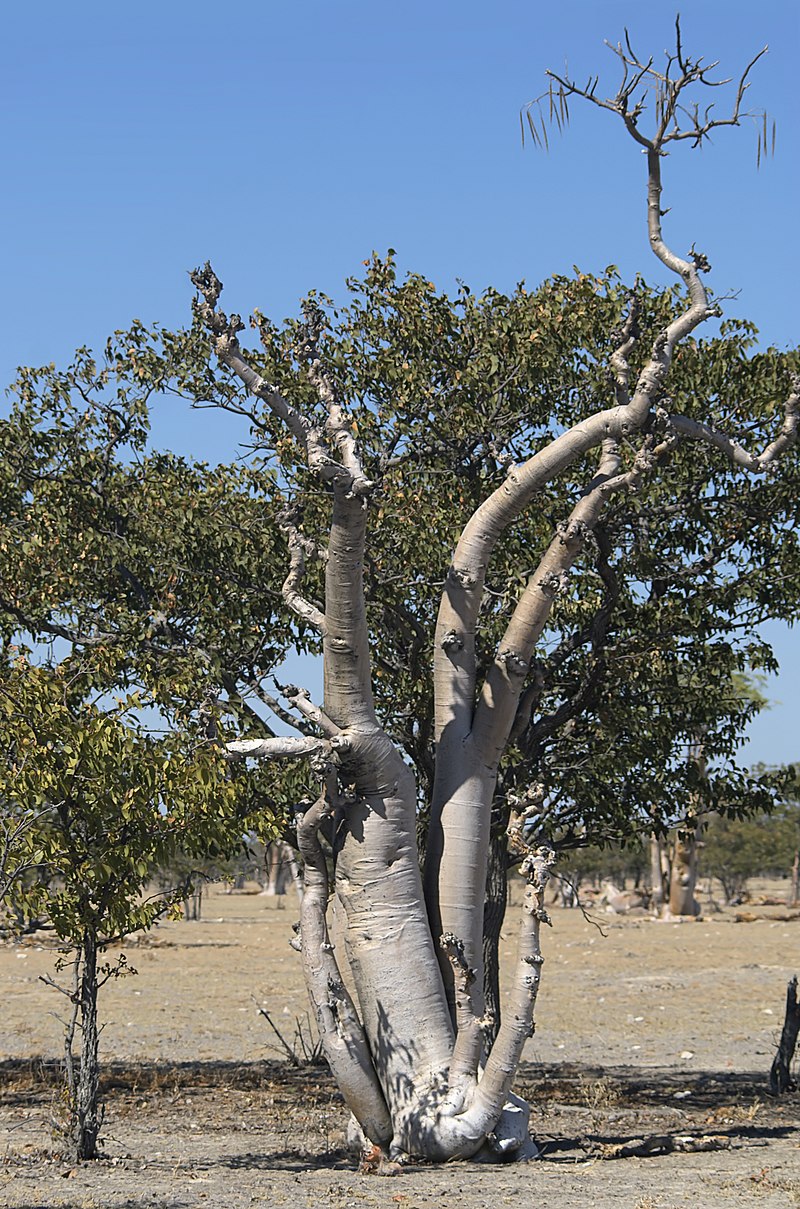
File:Moringa_ovalifolia.jpg · Wikimedia Commons · See Wikimedia Commons
OverviewAI-generated
Moringa is a genus within the family Moringaceae, belonging to the order Brassicales and the class Magnoliopsida. It is part of the phylum Tracheophyta and the kingdom Plantae. The genus is distinct from Morinda and has the common name moringa.
The native range of Moringa includes Angola, Djibouti, Egypt, Eritrea, Ethiopia, the Gulf States, India, Kenya, Lebanon-Syria, Madagascar, Namibia, and Oman. It has also been introduced to locations such as Aldabra, the Andaman Islands, Arizona, Assam, the Bahamas, Bangladesh, Benin, Burkina, California, Cambodia, Cameroon, and Cape Verde.
Records for the genus exist in various databases, including 21,479 occurrences in the Global Biodiversity Information Facility and 103 records in iDigBio. The latter includes media from institutions in Mexico, the United States, Nicaragua, the U.S. Virgin Islands, and Brazil. Additionally, the genus is referenced by 490 other encyclopedia articles.
Synthesized by Vinony from 32 facts across 7 sources: Wikidata, GBIF, PubMed, Gbif Occ, Plants of the World, iDigBio, Vinony graph. Generated from structured data (not the Wikipedia text) and checked against those facts — may still contain errors.
Species
GENUS
- KingdomPlantae
- PhylumTracheophyta
- ClassMagnoliopsida
- OrderBrassicales
- FamilyMoringaceae
Common Name: mai pruk
via GBIF · Kew POWO
Museum specimens
- Specimen records
- 103
- With media
- 59
- Family
- Moringaceae
- Collections
- CICY, SD, IBUNAM, MEL, UFPB, US
- Recorded in
- Mexico, United States, Nicaragua, Virgin Islands (U.S.), Brasil, Colombia, Venezuela, India
Research
3,202 papers- Moringa oleifera: An Updated Comprehensive Review of Its Pharmacological Activities, Ethnomedicinal, Phytopharmaceutical Formulation, Clinical, Phytochemical, and Toxicological Aspects.International journal of molecular sciences · 2023
- Health benefits of Moringa oleifera.Asian Pacific journal of cancer prevention : APJCP · 2014
- Moringa oleifera Lam. in Diabetes Mellitus: A Systematic Review and Meta-Analysis.Molecules (Basel, Switzerland) · 2021
- Moringa induces its beneficial effect via hormesis.Nutrition research reviews · 2024
- Moringa oleifera: a food plant with multiple medicinal uses.Phytotherapy research : PTR · 2007
via PubMed
Wikidata facts
- Instance of
- taxon
- Parent taxon
- Moringaceae
- Image
- Moringa-ovalifolia.jpg
Show 8 more facts
- taxon rank
- genus
- taxon name
- Moringa
- Commons category
- Moringa
- topic's main category
- Category:Moringa (genus)
- taxon common name
- 辣木属
- taxonomic type
- moringa
- different from
- Morinda
via Wikidata · CC0
~5 min read
Encyclopedic overview
Moringa is the sole genus in the plant family Moringaceae. It contains 13 species, which occur in tropical and subtropical regions of Africa and Asia and that range in size from tiny herbs to massive trees. Moringa species grow quickly in many types of environments.
The most widely cultivated species is Moringa oleifera, native to the foothills of the Himalayas in northwestern India, a multipurpose tree cultivated throughout the tropics and marketed as a dietary supplement, health food or source for herbalism practices. The fruit pods of Moringa oleifera ("drumsticks") are consumed as food in many parts of the world, particularly in South Asia. The leaves are commonly used to make tea. Oils are made from the seeds, while powders can be made from the leaves and roots.
Excerpted from Wikipedia’s “Moringa” article, available under the CC BY-SA 4.0 licence.